Keywords: How to Choose Battery Laser Welding Equipment, Power Battery Laser Welding, Laser Welding Parameter, Battery Welding System, Laser Welding Automation
Introduction: The High-Stakes Decision in EV Manufacturing
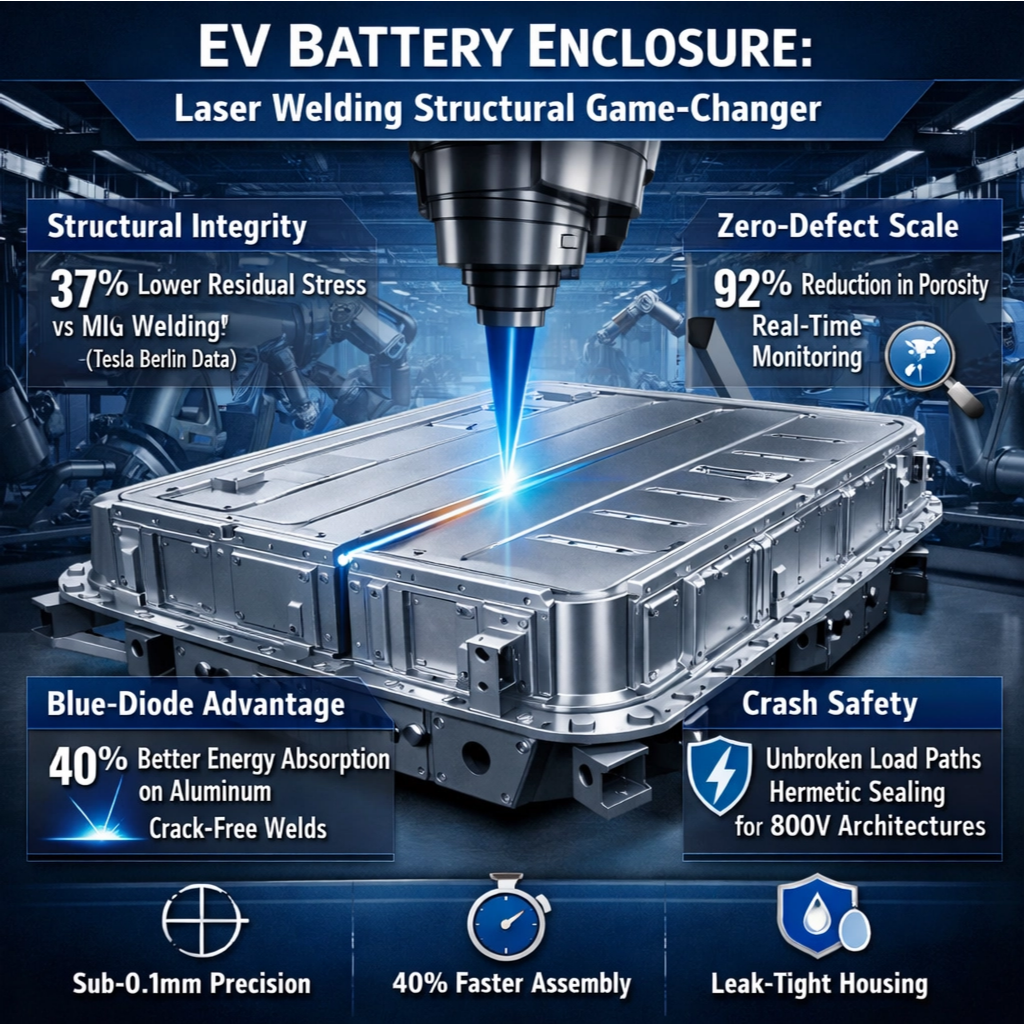
The performance and safety of an Electric Vehicle (EV) are fundamentally dependent on the quality of its power battery. As the core manufacturing process, power battery laser welding is a high-stakes decision. Selecting the wrong equipment can lead to inconsistent welds, high internal resistance, reduced battery life, and even safety hazards. This guide outlines the 5 critical parameters you must evaluate when choosing your next battery welding system to ensure optimal performance and seamless laser welding automation.
1. Laser Source Type and Wavelength: Matching Power to Material
The choice of laser source is paramount, as it dictates the energy delivery mechanism and material interaction.
-
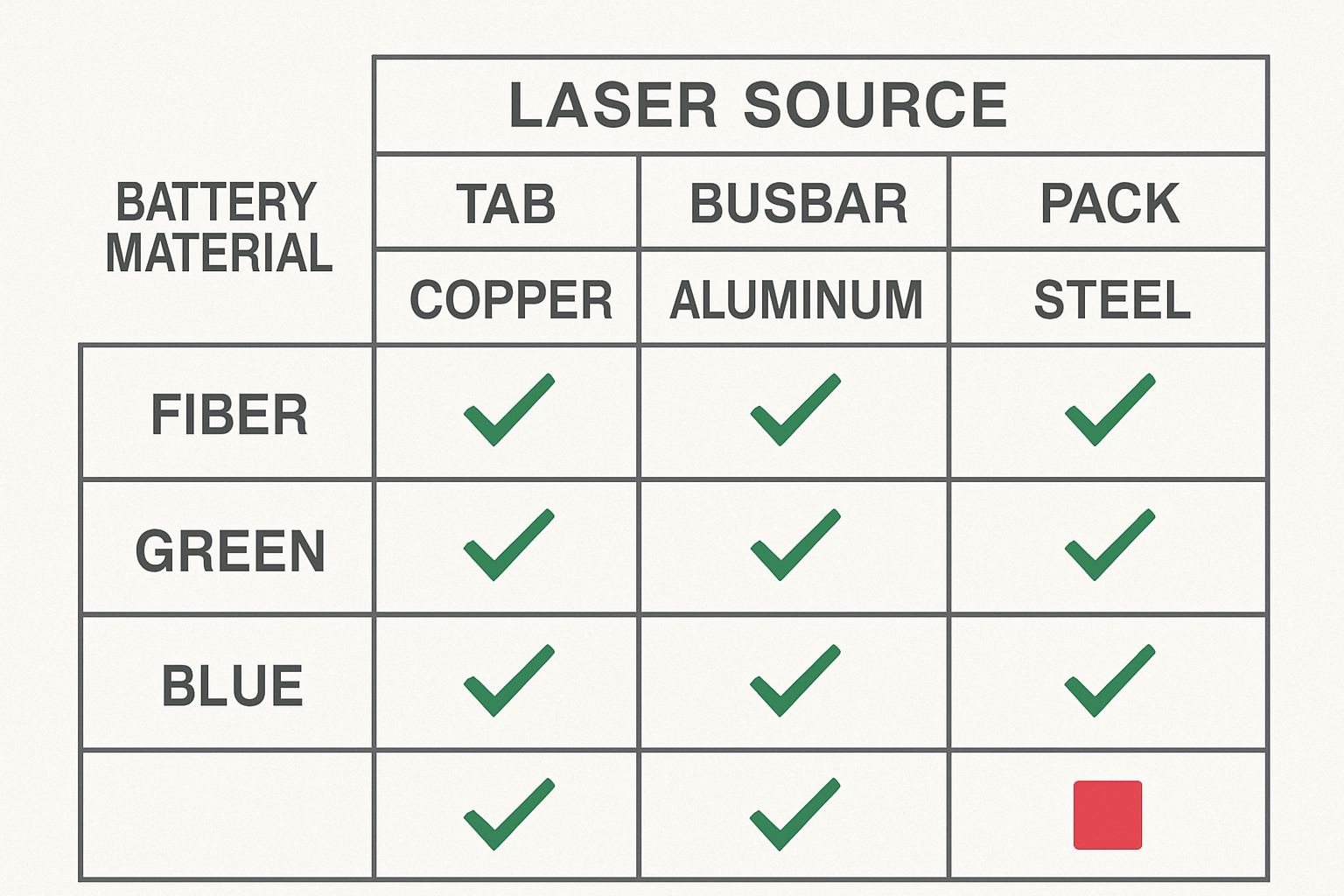
Fiber Lasers (1064nm): The most common choice due to high efficiency and excellent beam quality. They are ideal for welding steel and aluminum components. However, their high reflectivity on copper requires advanced techniques like Wobble Welding or high-power density to overcome.
-
Green Lasers (532nm) or Blue Lasers (450nm): These newer sources are gaining traction, especially for copper welding (e.g., cell tab welding). Copper absorbs these shorter wavelengths much more efficiently, leading to a more stable process, less spatter, and higher quality welds.
-
Critical Parameter: Ensure the chosen laser source and wavelength are optimized for the specific materials (Copper, Aluminum, Steel) and thicknesses you intend to weld. For a versatile system, a high-power fiber laser with advanced beam control is often the best compromise.
2. Beam Quality and Spot Size: Precision for Minimal Resistance
The quality of the laser beam, often measured by the $M^2$ factor, directly impacts the focus spot size and the resulting weld geometry.
-
High Beam Quality (Low $M^2$): A lower $M^2$ value means the beam can be focused to a smaller, more intense spot. This is essential for creating deep, narrow welds (high depth-to-width ratio) which are ideal for battery connections.
-
Small Spot Size: A small spot size concentrates the energy, allowing for rapid melting and solidification, which minimizes the heat-affected zone (HAZ) and is crucial for achieving low internal resistance in the battery.
-
Critical Parameter: Demand a system with excellent beam quality and the ability to maintain a consistent, small spot size across the entire working envelope.
3. Automation and Integration Capability: The Key to Throughput
In EV manufacturing, the system must be designed for high-volume, continuous production. This requires robust laser welding automation.
-
Robotic Integration: The system should be easily integrated with 6-axis or gantry robots for precise and flexible movement, especially for complex 3D welds on modules and packs.
-
Throughput (Cycle Time): Evaluate the system's ability to meet your required production cycle time (e.g., parts per minute). This is a function of laser speed, part handling, and system overhead.
-
Software Interface: The control software must offer seamless communication with your Manufacturing Execution System (MES) for real-time data logging, process control, and traceability.
4. Real-Time Monitoring and Quality Control: Safety and Traceability
Given the safety-critical nature of EV batteries, real-time quality assurance is non-negotiable.
-
Melt Pool Monitoring: Advanced systems use coaxial cameras and sensors to monitor the size, shape, and stability of the weld melt pool in real-time. Deviations can signal defects like porosity or insufficient penetration.
-
Spatter Detection: Excessive spatter can contaminate the cell and lead to short circuits. Monitoring systems should detect and flag excessive spatter events.
-
Post-Weld Inspection: Integrated vision systems should perform immediate, non-destructive inspection of the weld bead for consistency and defects, ensuring every weld is traceable and meets quality standards.
5. Supplier Expertise and Service: A Long-Term Partnership
A battery welding system is a long-term capital investment. The supplier's expertise in the EV sector is as important as the equipment itself.
-
Application Knowledge: Does the supplier have proven experience with your specific cell format (cylindrical, prismatic, pouch) and material combinations (Cu-Al, Al-Al)?
-
Service Network: Given the high cost of downtime, a supplier with a global, responsive service network is essential. Look for guarantees of rapid response and local technical support.
-
Process Development Support: The supplier should be able to assist with initial process development, parameter optimization, and provide training to your in-house engineers.
Conclusion: Investing in Reliability
Choosing the right EV battery laser welding equipment is a complex decision that balances technical specifications with production requirements and long-term support. By focusing on the five critical parameters—laser source, beam quality, automation, real-time monitoring, and supplier expertise—you can ensure your investment delivers the high-quality, high-throughput, and safe battery production required for the future of electric mobility.
Figure 5: Laser Source Selection Matrix for EV Battery Welding

 EN
EN