Inquiry
Inquiry

FDA UDI Compliance: The Essential Validation Process for Laser Marking Equipment

Posted on November 26, 2025

Introduction: Laser Marking as a Critical Process

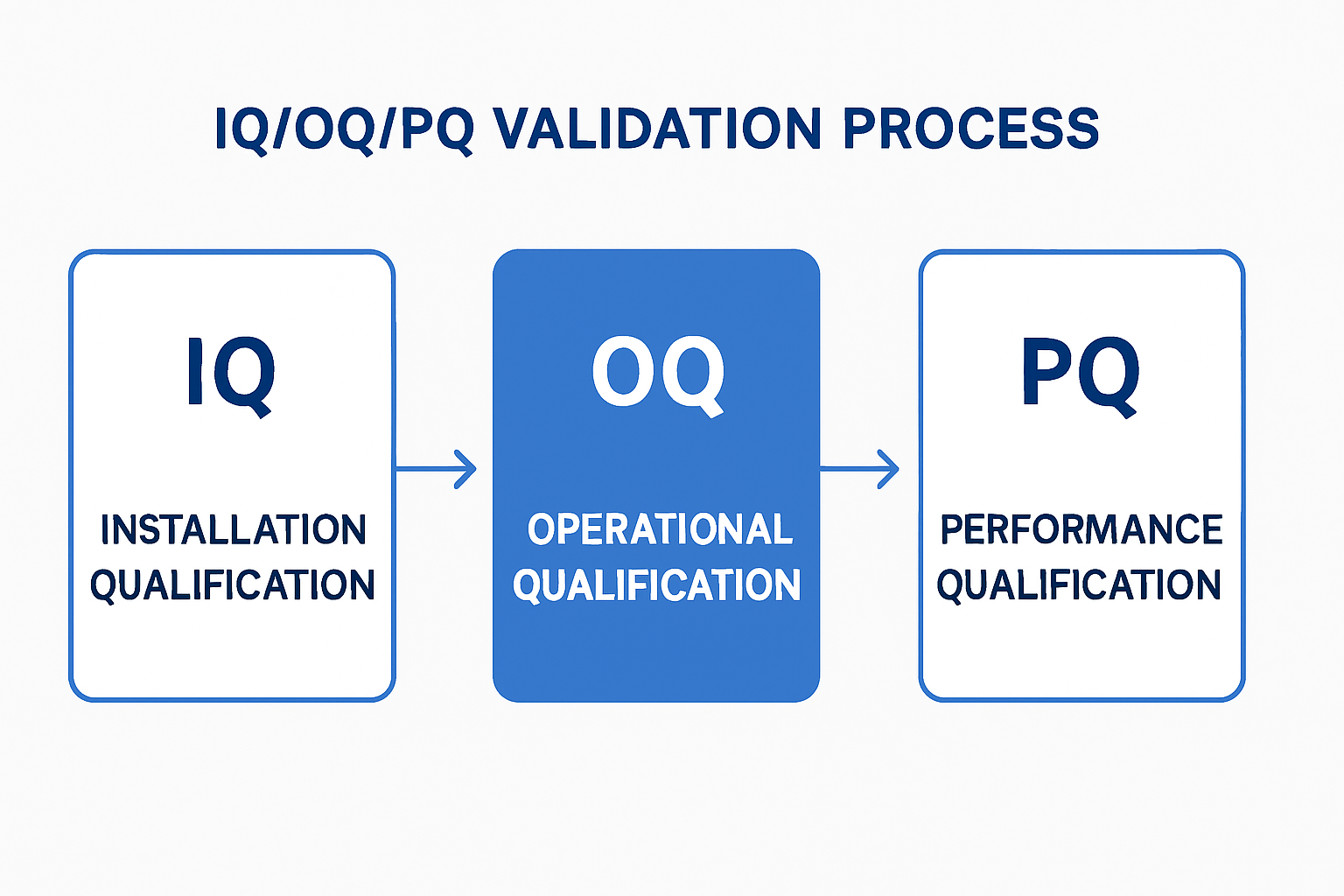
For medical device manufacturers, compliance with the U.S. Food and Drug Administration (FDA) Unique Device Identification (UDI) regulation is mandatory. The UDI system requires a permanent, readable mark on the device or its packaging to enhance medical device traceability and patient safety. Since laser marking is a manufacturing process that directly affects the final product quality and regulatory compliance, the equipment and the process itself must be rigorously validated according to quality system regulations (QSR) and ISO 13485 standards. This article details the essential three-step validation process: Installation Qualification (IQ), Operational Qualification (OQ), and Performance Qualification (PQ).

1. Installation Qualification (IQ): Ensuring Correct Setup

The IQ phase verifies that the laser marking equipment has been installed correctly and that all necessary components, utilities, and documentation are in place.

Key IQ Activities:

  • Equipment Verification: Confirming that the received equipment matches the purchase order specifications (e.g., laser type, power, wavelength).
  • Documentation Review: Verifying that all manufacturer documentation, including manuals, calibration certificates, and maintenance procedures, are present and complete.
  • Utility Checks: Confirming that the installation site provides the required utilities (power, compressed air, exhaust ventilation) and that the environment (temperature, humidity) meets the manufacturer's specifications.
  • Software Installation: Verifying that the marking software and control systems are installed correctly and that all security and access controls are properly configured.

Goal of IQ: To establish that the equipment is correctly installed in the intended environment and is ready for operation.

2. Operational Qualification (OQ): Defining the Operating Window

The OQ phase establishes that the laser marking equipment operates consistently within the specified operating ranges. This step is crucial for defining the "safe operating window" for the marking process.

Key OQ Activities:

  • Parameter Testing: Systematically testing the full range of critical operating parameters, such as laser power, marking speed, frequency, and focus distance.
  • Worst-Case Scenario Testing: Testing the equipment at the extreme limits of the operating range (e.g., minimum and maximum power, fastest and slowest speed) to ensure the system still functions correctly.
  • Alarm and Interlock Testing: Verifying that all safety features, alarms, and interlocks (e.g., door interlocks, emergency stops, fume extraction failure alarms) function as designed.
  • Mark Quality Testing: Generating test marks across the operating range and measuring key quality attributes (e.g., contrast, depth, code readability) to define the acceptable limits.

Goal of OQ: To establish the operating limits and demonstrate that the equipment will produce acceptable results when operated within those limits.

3. Performance Qualification (PQ): Proving Consistent Results

The PQ phase is the final and most critical step, demonstrating that the laser marking process consistently produces acceptable results under actual or simulated production conditions over an extended period. This directly addresses the FDA UDI Requirements for mark permanence and quality.

Key PQ Activities:

  • Production Runs: Performing multiple production runs using actual materials and the defined operating parameters (established in OQ).
  • Mark Permanence Testing: Subjecting the marked devices to simulated end-use conditions, including:
    • Sterilization Cycles: Autoclave, EtO, or Gamma irradiation.
    • Cleaning/Disinfection: Repeated exposure to cleaning agents and scrubbing.
    • Abrasion/Wear: Testing the mark's resistance to physical damage.
  • Traceability Verification: Ensuring that the UDI data marked on the device is accurately linked to the production batch records and the GUDID database.
  • Acceptance Criteria: The marks must consistently meet the pre-defined acceptance criteria (e.g., AQL levels for readability, minimum contrast, no material damage).

Goal of PQ: To demonstrate, with a high degree of assurance, that the laser marking process is effective and reproducible under normal operating conditions, meeting all quality and regulatory standards.

Conclusion: A Partnership for Compliance

The validation of a laser marking system is a complex, multi-stage process that requires deep technical knowledge and strict adherence to ISO 13485 and FDA UDI Requirements. Choosing a laser equipment supplier that can provide comprehensive validation support—including detailed protocols, execution assistance, and final reports—is essential for ensuring medical device traceability and achieving regulatory compliance. This rigorous IQ/OQ/PQ process transforms the laser marker from a piece of equipment into a fully validated, critical manufacturing process.

Figure 4: The Three-Stage IQ/OQ/PQ Validation Process
IQ_OQ_PQ_flowchart.png

Related Articles

Explore more insights to inform your business decisions