
 EN
EN



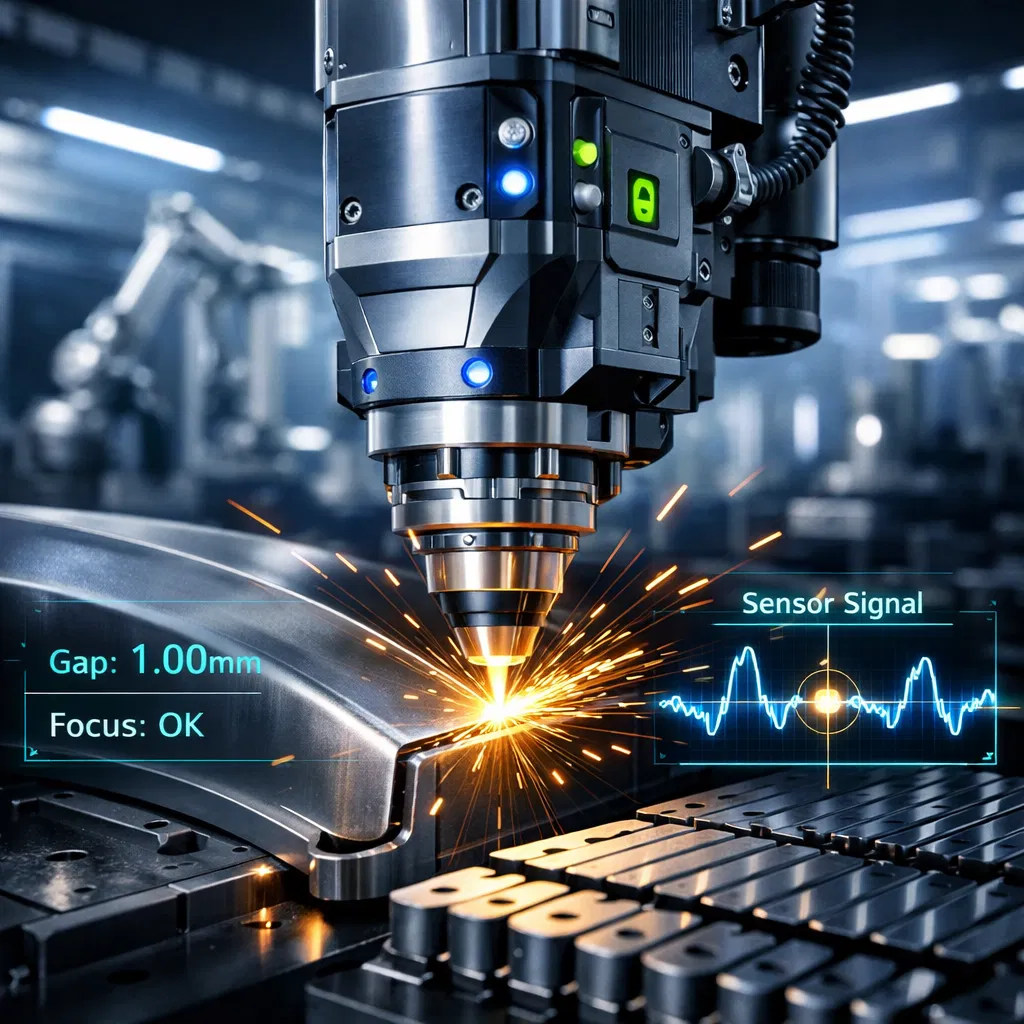
How autofocus laser cutting heads improve precision, speed, and reliability in EV battery and solar cell production. Learn about sensor technologies, response time optimization, and maintenance best practices for maximum uptime.
The Precision Challenge in New Energy Manufacturing
Modern new energy manufacturing operates at scales that would have seemed impossible a decade ago. EV battery lines process millions of cells daily. Solar fabs handle ultra-thin silicon wafers by the thousands per hour. Lightweight aluminum components for battery housings and vehicle structures move through cutting stations at speeds that push mechanical systems to their limits.
Yet one factor remains constant across all these applications: the distance between the laser nozzle and the workpiece matters more than almost any other parameter.
A cutting head positioned too high spreads the beam, reducing power density and creating wide kerfs with slag attachment. Too low risks crashing into the part, destroying expensive optics and stopping production. In ideal conditions, maintaining the perfect standoff distance is straightforward. But new energy manufacturing rarely operates in ideal conditions.
EV battery tabs vary in thickness as coatings deposit unevenly. Aluminum battery housings distort from welding heat, creating localized high spots. Solar wafers, now routinely below 130μm thick, flutter on the cutting stage. Without real-time adjustment, focus errors accumulate—and with them, quality defects, scrap, and unplanned downtime.
This is why autofocus laser cutting heads have moved from optional luxury to essential technology for competitive new energy manufacturers. By continuously sensing the workpiece position and adjusting the cutting head or internal optics, these systems maintain perfect focus regardless of material variations, thermal distortion, or fixturing tolerances.
How Autofocus Systems Work
Sensor Technologies
Autofocus laser heads rely on one of two primary sensing methods, each suited to different applications:
Capacitive sensors are the most common in cutting applications. The nozzle itself becomes one plate of a capacitor, with the conductive workpiece forming the other. As the distance changes, capacitance changes proportionally. The control system measures this and adjusts position to maintain a preset gap—typically 0.5–2.0mm for most cutting applications.
Capacitive sensing offers several advantages:
- No separate sensor hardware to align or protect
- Direct measurement at the cut zone
- Response times below 1ms
- Insensitivity to smoke or spatter (within limits)
The limitation? The workpiece must be conductive. This works perfectly for aluminum battery housings, copper busbars, and steel components—but not for solar wafers or polymer separators.
Laser triangulation sensors solve the non-conductive problem. A low-power red or IR laser projects a spot onto the workpiece; a camera detects the spot's position and calculates distance via triangulation. These systems achieve micron-level resolution on any surface, from mirror-polished aluminum to matte black polymers.
Modern triangulation sensors integrate directly into the cutting head, measuring immediately ahead of the cut zone. Response times of 2–5ms allow real-time adjustment even at high traverse speeds.
Adjustment Mechanisms
Once the sensor detects a height variation, the system must respond. Two architectures dominate:
Z-axis stage adjustment moves the entire cutting head up or down. This maintains consistent nozzle standoff distance, which is critical for gas flow dynamics in laser cutting. Heavy heads require robust linear motors to achieve fast response—acceleration of 2–3G is typical for high-performance systems.
Internal focusing lens adjustment moves only the final focusing optic within the head. This is faster (lower moving mass) and allows the nozzle to remain fixed, simplifying gas delivery. However, it changes the beam path length slightly, which can affect beam quality if not carefully compensated.
The best systems combine both: fast lens adjustment for small, high-frequency corrections, with stage movement for larger adjustments or when crash avoidance requires rapid retraction.
Speed and Precision: The Performance Envelope
Response Time Requirements
In high-speed cutting, the relationship between response time and part geometry is straightforward: the faster the traverse speed, the faster the autofocus must respond.
Consider a battery tab cutting application at 20 m/min (333 mm/s). A 0.5mm height variation occurring over 10mm of travel gives the autofocus system just 30ms to detect and correct. If response time exceeds this, the beam will be out of focus for part of the cut, potentially creating a defect.
Modern autofocus heads achieve closed-loop response times of 10–20ms from height change detection to full correction. This maintains focus within ±0.1mm even on highly variable surfaces at speeds up to 30 m/min.
Repeatability and Accuracy
Sensor resolution tells only part of the story. The system's ability to return to the same position repeatedly—hysteresis, thermal drift, and mechanical backlash—ultimately determines cut quality.
Production-proven autofocus heads achieve:
- Static accuracy: ±15μm
- Dynamic tracking error: <50μm at 20 m/min
- Thermal drift: <10μm over 8-hour shift (after warm-up)
For EV battery busbar cutting, where penetration depth must be controlled within 0.1mm to avoid damaging cells beneath, this level of precision is non-negotiable.
Application-Specific Tuning
Different new energy applications demand different autofocus strategies:
EV battery foil cutting (copper/aluminum, 6–20μm) : The challenge here is not large height variations but detecting the foil's presence at all. Ultrathin materials reflect little sensor energy. Specialized systems use low-force contact probes or air-reflux sensors that measure back-pressure changes as the nozzle approaches.
Aluminum battery housing cutting (1–4mm) : Thermal distortion during cutting creates dynamic height changes. The autofocus system must predict as well as react—using feed-forward algorithms that anticipate distortion based on cut path and parameters.
Solar wafer scribing (130–180μm) : Brittle materials demand non-contact sensing and gentle acceleration profiles. Piezo-based lens adjustment (rather than voice coil) provides the smooth motion needed to avoid cracking while maintaining focus on warped wafers.
Maintenance and Reliability: Keeping Autofocus Systems Operational
Common Failure Modes
Autofocus systems add complexity, and complexity can reduce reliability if not properly designed. Common issues include:
Sensor contamination: Capacitive sensors require clean nozzles. Spatter buildup changes the effective sensor area, causing drift. Laser sensors need clean windows; even a thin smoke film reduces signal strength.
Mechanical wear: Z-axis stages experience millions of cycles annually. Recirculating ball bearings and linear motors must be specified for 24/7 operation.
Thermal drift: Heat from the cutting process conducts into the head. Without active cooling or thermal compensation, day/night temperature variations can shift focus by 0.1mm or more.
Design for Reliability
The most reliable autofocus systems incorporate:
Active nozzle cleaning: Automated spatter removal systems keep the nozzle face clean without operator intervention. Some designs use mechanical scrapers; others use brief reverse gas pulses to blow off accumulation.
Sealed sensor paths: Laser triangulation sensors with purge air maintain clean optical paths even in smoky cutting environments. Positive pressure prevents particulate ingress.
Thermal management: Water-cooled heads maintain stable temperature regardless of cutting load. Integrated temperature sensors feed compensation algorithms that adjust for residual drift.
Predictive maintenance: Modern systems track usage metrics—cycles, travel distance, acceleration—and alert operators before components reach end of life. One EV battery manufacturer using AutoFocus-C series heads reduced unplanned downtime by 76% after implementing predictive maintenance alerts.
Maintenance Best Practices
For manufacturers operating autofocus cutting heads, a disciplined maintenance schedule extends life and maintains performance:
Daily:
- Visual inspection of nozzle for spatter or damage
- Check sensor windows for contamination
- Verify zero position with reference surface
Weekly:
- Clean nozzle bore with appropriate tools
- Test response time using diagnostic software
- Check cooling system flow and temperature
Monthly:
- Inspect bellows or protective covers for wear
- Verify calibration against master gauge
- Backup autofocus parameters and settings
Quarterly:
- Replace protective windows regardless of appearance
- Lubricate moving components per manufacturer specifications
- Full system calibration by trained technician
Following these practices, manufacturers achieve 20,000+ operating hours between major autofocus system overhauls—matching the lifespan of the laser source itself.
Real-World Performance Data
Case Study: EV Battery Tab Cutting
A Korean battery manufacturer producing 4680 cylindrical cells needed to cut copper and nickel-plated tabs (0.2–0.5mm thick) with ±0.1mm accuracy. Their fixed-focus cutting head required manual adjustment whenever material thickness changed—typically 3–4 times per shift—leading to setup scrap and operator errors.
They implemented AutoFocus-C heads with capacitive sensing and 15ms response time. Results after six months:
- Setup time eliminated (automated adjustment per batch)
- Focus-related scrap reduced from 1.2% to 0.15%
- Cut edge variation decreased from ±0.15mm to ±0.04mm
- Annual savings: $210,000 from scrap reduction alone
Case Study: Solar Cell Edge Isolation
A Chinese solar manufacturer processing 150μm wafers at 8,500 units per hour faced intermittent cracking during edge isolation—0.3% of wafers lost, costing millions annually. The root cause: wafer warpage up to ±80μm causing focus variation that increased thermal stress.
Installing AutoFocus-S heads with laser triangulation sensing (non-contact, 5ms response) eliminated the issue:
- Wafer breakage rate: 0.02% (industry-leading)
- Focus maintained within ±20μm across all wafers
- No throughput reduction (autofocus adjustment occurs during scanning)
The process engineer noted: "We initially worried autofocus would slow us down. In fact, it eliminated the need for frequent calibration stops, so net throughput increased."
PrecisionLase: Integrated Autofocus Solutions for New Energy
Autofocus capability is not an add-on—it's a core design consideration that affects every aspect of laser processing performance. PrecisionLase, powered by GuangYao Laser's decade of industrial laser experience, integrates autofocus technology directly into cutting heads optimized for new energy applications.
Since 2015, GuangYao Laser has invested 15% of annual revenue into core laser source and application research—including dedicated beam delivery and motion control development. Our 15,000 m² Shenzhen R&D and manufacturing campus houses over 200 employees, with 30 engineers focused on cutting head design and automation integration. This investment has resulted in autofocus systems now operating on thousands of production lines across Asia, Europe, and North America.
Our autofocus cutting head portfolio includes:
AutoFocus-C series: Capacitive sensing for conductive materials (EV battery housings, busbars, structural components). Response time <15ms, tracking accuracy ±25μm at 30 m/min. Integrated spatter management for 24/7 operation.
AutoFocus-S series: Laser triangulation sensing for all materials, including solar wafers and polymer separators. Non-contact measurement with 5ms response, ±10μm accuracy. Cleanroom-compatible design with sealed optical paths.
AutoFocus-H series: Hybrid systems combining fast lens adjustment (2ms response) with Z-stage range (50mm travel). Designed for applications requiring both high speed and large adjustment range, such as 3D cutting of formed battery housings.
Every system ships with comprehensive documentation, including calibration certificates, maintenance guides, and IQ/OQ validation protocols. Our global service network—with hubs in Shenzhen, the USA, and Germany—provides 24/7 technical support, remote diagnostics, and on-site service within 48 hours for most locations.
Conclusion: Autofocus as a Competitive Advantage
In new energy manufacturing, where margins are tight and quality requirements absolute, every process parameter matters. Focus control—once treated as a set-and-forget variable—has emerged as a critical differentiator between world-class lines and those struggling with scrap and downtime.
The choice of autofocus technology depends on your specific applications:
- For EV battery metal cutting, capacitive sensing with robust spatter management delivers the reliability required for 24/7 operation
- For solar wafer processing, non-contact laser triangulation maintains focus on thin, fragile substrates without risk of damage
- For mixed-material lines, hybrid systems provide the flexibility to handle diverse parts without hardware changes
Beyond the hardware, the right partner brings application expertise, integration support, and a commitment to continuous improvement. PrecisionLase offers exactly that partnership—proven across hundreds of new energy production lines worldwide.
Ready to optimize your laser cutting with advanced autofocus? Contact PrecisionLase for free line analysis, demonstration on your parts, and consultation with engineers who have solved these challenges for leading EV and solar manufacturers globally.
Table of Contents
- The Precision Challenge in New Energy Manufacturing
- How Autofocus Systems Work
- Speed and Precision: The Performance Envelope
- Maintenance and Reliability: Keeping Autofocus Systems Operational
- Real-World Performance Data
- PrecisionLase: Integrated Autofocus Solutions for New Energy
- Conclusion: Autofocus as a Competitive Advantage
