
 EN
EN



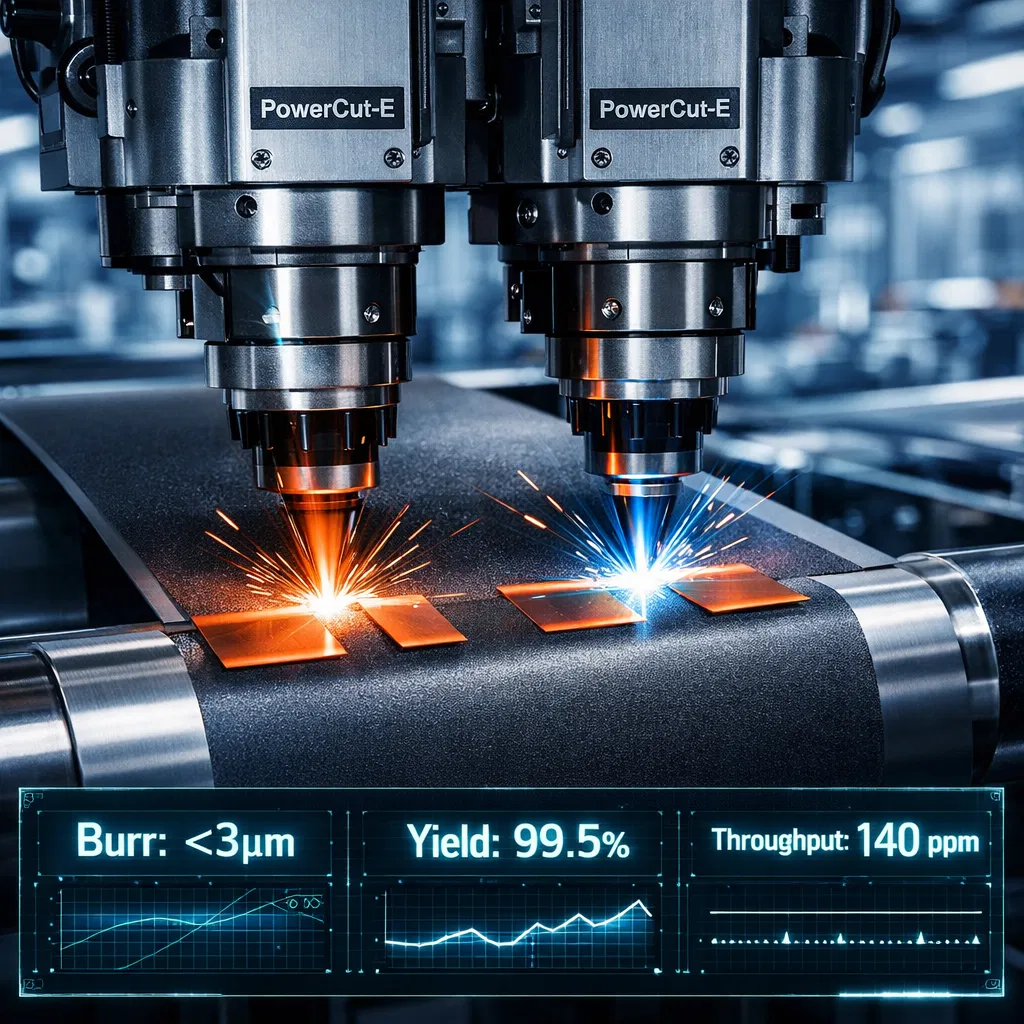
Learn how a Tesla supplier achieved <3μm burr, 99.5% yield, and 30% higher throughput with PrecisionLase laser cutting systems for battery electrodes. Real production data and ROI analysis.
The Electrode Quality Challenge in High-Performance Batteries
Electric vehicle performance hinges on battery consistency. A single cell with an internal defect can degrade an entire pack's capacity, accelerate aging, or—in worst cases—create safety risks. Among all manufacturing steps, electrode cutting ranks among the most critical quality control points.
Lithium battery electrodes consist of thin metal foils (copper for anode, aluminum for cathode) coated with active material layers typically 50–100μm thick. During cutting, the goal is to separate individual electrode sheets from a continuous web while maintaining:
- Burr height below 5μm: Burrs can puncture separators, causing internal shorts
- Minimal heat affected zone: Excessive heat delaminates coating or melts foil
- No active material fallout: Edge integrity preserves capacity and cycle life
- High throughput: Cost targets demand over 100 parts per minute
For manufacturers supplying Tesla and other top-tier OEMs, these requirements are non-negotiable. Yet traditional die-cutting reaches fundamental limits as electrode formats evolve toward thicker coatings, thinner foils, and complex geometries.
This case study examines how one leading Chinese battery manufacturer—a direct supplier to Tesla's Shanghai Gigafactory—transitioned from rotary die-cutting to laser processing, achieving quality and productivity gains that secured their position in the world's most demanding EV supply chain.
The Challenge: Scaling Production Without Compromising Quality
The Manufacturer's Profile
Our client, based in Jiangsu Province, produces prismatic cells for multiple EV manufacturers, with Tesla representing approximately 40% of their output. Their production line, originally designed for 21700 cylindrical cells, had been retooled for large-format prismatics used in Tesla's structural battery pack.
The electrode cutting station processed both anode and cathode materials. For anodes, they cut 10μm copper foil with graphite coating, resulting in a total thickness of 120μm. For cathodes, they processed 15μm aluminum foil with NMC811 coating, totaling 140μm thickness. Daily production volume reached 2 million electrode sheets, with stringent tolerance requirements including burr height below 5μm and no coating delamination at the cut edge.
The Die-Cutting Bottleneck
Their existing rotary die system had served well during pilot production but struggled as volumes ramped. Burr formation became the first warning sign—after 50,000 cuts, die wear produced burrs exceeding 8μm, requiring frequent replacement and requalification. Each die change cost 4 hours of downtime, directly impacting production targets.
Coating delamination presented an equally serious issue. Compressive forces from the die crushed the active material at the cut edge, creating a dense region that impeded lithium diffusion. This reduced effective electrode area by 2–3%, translating directly to lost battery capacity.
Tooling inflexibility added strategic risk. Design changes for new cell formats required new dies with 8-week lead times—unacceptable for their rapid iteration cycle as EV models evolved. Meanwhile, annual die replacement costs exceeded $200,000, plus labor for changeovers and quality revalidation.
The quality director summarized their situation: "We were meeting Tesla's spec—barely. But we knew as volumes increased, die cutting would become our biggest quality and cost risk."
The Laser Solution: PowerCut-E Series Implementation
After evaluating multiple laser technologies, the manufacturer selected PrecisionLase's PowerCut-E30 system—a dual-head MOPA fiber laser cutter specifically optimized for electrode processing.
Why MOPA Fiber Laser?
For thin metal foils, wavelength matters less than pulse control. MOPA (Master Oscillator Power Amplifier) technology allows independent adjustment of pulse duration from 2 to 500 nanoseconds, enabling three critical capabilities. First, it enables cold cutting of copper with heat affected zone below 10μm using 10 nanosecond pulses. Second, it delivers clean ablation of aluminum without melt recast using 50 nanosecond pulses. Third, it produces burr-free edges by vaporizing material rather than mechanical tearing.
The PowerCut-E30 delivers 30W average power per head with peak pulse power reaching 10kW—sufficient for cutting speeds up to 500 mm/s on 10–20μm foils while maintaining edge quality.
System Configuration
The installation included dual cutting heads operating simultaneously, each processing separate electrode lanes to maximize throughput. An inline vision inspection system with high-speed cameras measured burr height and edge quality in real time, flagging any deviation before electrodes reached downstream assembly.
Autofocus control using capacitive sensing maintained ±10μm focus despite foil flutter that could reach ±150μm on the high-speed web. MES integration connected directly to the manufacturing execution system for recipe management and complete data logging. The entire system achieved Class 1000 cleanroom compatibility through HEPA-filtered exhaust capturing over 99.5% of ablation byproducts.
Validation and Ramp-Up
The transition required rigorous process validation to satisfy Tesla's quality requirements. PrecisionLase provided pre-written IQ/OQ documentation adapted to the manufacturer's specific electrode designs, accelerating the validation timeline.
Sample testing involved cutting 10,000 electrodes with detailed inspection for burr height, delamination extent, and tensile strength compared to base material. A 72-hour continuous run monitored power stability and cut quality under production conditions, confirming system reliability.
The critical milestone came during Tesla's onsite audit, where the laser process passed with no findings—a testament to both the equipment performance and the comprehensive validation documentation.
Within 8 weeks of installation, the PowerCut-E30 was operating at full production capacity.
Results: Quantifying the Improvement
After six months of production, the manufacturer documented comprehensive results across quality metrics, production efficiency, and financial impact.
Quality Improvements
Burr height, the most critical parameter for separator safety, decreased from an average of 4.2μm with die-cutting to just 2.1μm with laser processing—a 50% reduction. More importantly, the occurrence of burrs exceeding the 5μm threshold dropped from 3.8% of parts to only 0.12%, representing a 97% reduction in safety risk.
Coating delamination width, which affects active material utilization, decreased from 85μm to just 12μm—an 86% improvement. This translated directly to higher effective electrode area and better cell capacity. Edge tensile strength, measured as percentage of base material strength, increased from 92% to 98%, indicating less structural damage during cutting.
First-pass yield improved from 97.2% to 99.5%, a 2.3 percentage point gain that significantly reduced rework and scrap costs.
Production Efficiency Gains
Throughput increased substantially. The dual-head laser system processed 140 electrodes per minute compared to 110 with the die cutter—a 27% improvement that expanded production capacity without additional floor space.
Changeover time plummeted from 45 minutes for die changes to just 5 minutes for recipe recall, an 89% reduction that enabled more frequent production scheduling optimization. Overall equipment uptime improved from 91% to 96.5%, primarily due to elimination of die wear-related stops and reduced maintenance requirements.
Scrap rate decreased from 2.4% to 0.8%, a 67% reduction that saved significant material costs while increasing effective output.
Financial Impact
The financial benefits extended across multiple categories. Die replacement and maintenance costs, previously exceeding $187,000 annually, were eliminated entirely. Scrap reduction alone saved $420,000 per year based on material and processing costs for the 2 million electrodes produced daily.
Labor savings from fewer changeovers and reduced inspection requirements added another $95,000 annually. Total documented direct savings reached $702,000 per year against an equipment investment of $380,000 for the dual-head system. Payback period calculated to 6.5 months.
The production manager noted: "We expected quality improvement—lasers always win on precision. What surprised us was the throughput gain. The dual-head system actually runs faster than our old die cutter, and changeovers are now measured in minutes instead of hours."
Beyond the Numbers: Strategic Advantages
Design Flexibility
Within three months of installation, the manufacturer introduced two new electrode designs for next-generation cells. With die cutting, each would have required 8-week tooling lead times and $15,000 in die costs. With laser cutting, new designs ran the same day—just a CAD file upload and recipe validation.
This flexibility enables faster iteration as battery chemistry evolves and allows rapid response to customer design changes without capital expenditure for new tooling.
Quality Traceability
The PowerCut-E30's MES integration automatically logs every cut's parameters and inspection results. During a subsequent Tesla audit, the manufacturer provided complete traceability for 5 million electrodes—cut-by-cut data showing consistent quality across six months. This level of documentation strengthens their position as a preferred supplier and reduces audit burden.
Scalability
As the manufacturer expands capacity for Tesla's Cybertruck battery line, they have ordered three additional PowerCut-E30 systems. The common platform ensures identical process performance across all lines—critical for maintaining quality as production scales. Operators trained on the first system can run any subsequent line without retraining.
Key Technology Features Driving Results
Pulse Control for Mixed Materials
The MOPA laser's adjustable pulse duration proved essential for processing both copper and aluminum with the same head. For copper, 10 nanosecond pulses achieved cold ablation with minimal heat diffusion, preserving foil integrity. For aluminum, 50 nanosecond pulses provided controlled melting and ejection without recast. For coated regions, multi-pass strategies removed coating before cutting foil, eliminating delamination.
Real-Time Burr Monitoring
The inline vision system measures each cut edge immediately after processing, flagging any electrode with burr exceeding 4μm. This closed-loop control has virtually eliminated burr-related defects reaching downstream assembly. The system also trends burr measurements over time, alerting maintenance before gradual degradation affects quality.
Active Focus Control
Capacitive sensors maintain nozzle standoff within ±10μm despite foil flutter up to ±150μm. This ensures consistent cut quality even on high-speed webs and compensates for variations in material thickness or web tension.
Particulate Management
The integrated exhaust captures over 99.5% of ablation byproducts, maintaining cleanroom conditions and preventing redeposition on electrodes. HEPA filtration ensures that only clean air returns to the production environment, meeting ISO Class 7 (Class 10,000) requirements with margin.
PrecisionLase: Partnering with EV Battery Leaders
The Tesla supplier case represents just one of over 50 battery electrode installations completed by PrecisionLase in the past 24 months. Backed by GuangYao Laser's 15,000 m² R&D and manufacturing campus, we bring deep industry expertise and proven technology.
Our dedicated battery process development team includes over 40 engineers focused exclusively on laser-material interactions for energy storage applications. This investment has resulted in MOPA fiber lasers engineered specifically for 24/7 production environments, with MTBF exceeding 50,000 hours for laser sources.
Every PowerCut system ships with comprehensive IQ/OQ documentation and process recipes for common electrode materials, reducing customer ramp-up time from months to weeks. Our global service network—with hubs in Shenzhen, the USA, and Germany—provides 24/7 technical support, remote diagnostics, and on-site service within 48 hours for most locations.
The PowerCut electrode cutting series includes three configurations. The PowerCut-E20 offers 20W single-head operation for R&D and pilot lines. The PowerCut-E30 delivers 30W dual-head processing for high-volume production. The PowerCut-E50 provides 50W high-speed configuration for ultra-thick coatings and maximum throughput.
Conclusion: Laser Cutting as a Competitive Necessity
For EV battery manufacturers supplying demanding customers like Tesla, electrode cutting quality is not just a spec—it's a competitive differentiator. The manufacturer in this case study didn't just solve a quality problem; they transformed their production economics, gaining higher throughput, lower scrap, and the flexibility to iterate designs at the speed of innovation.
The choice of laser technology matters. MOPA fiber lasers with pulse control, integrated vision, and robust autofocus deliver the combination of precision and productivity that modern electrode lines require. But equally important is the partner behind the equipment—one with deep process expertise, validation support, and a commitment to continuous improvement.
PrecisionLase offers exactly that partnership, proven across millions of electrodes produced daily for the world's leading EV manufacturers.
Ready to optimize your battery electrode cutting? Contact PrecisionLase for free line analysis, sample processing on your materials, and consultation with engineers who have solved these challenges for Tesla suppliers and beyond.
Table of Contents
- The Electrode Quality Challenge in High-Performance Batteries
- The Challenge: Scaling Production Without Compromising Quality
- The Laser Solution: PowerCut-E Series Implementation
- Results: Quantifying the Improvement
- Beyond the Numbers: Strategic Advantages
- Key Technology Features Driving Results
- PrecisionLase: Partnering with EV Battery Leaders
- Conclusion: Laser Cutting as a Competitive Necessity
