
 EN
EN



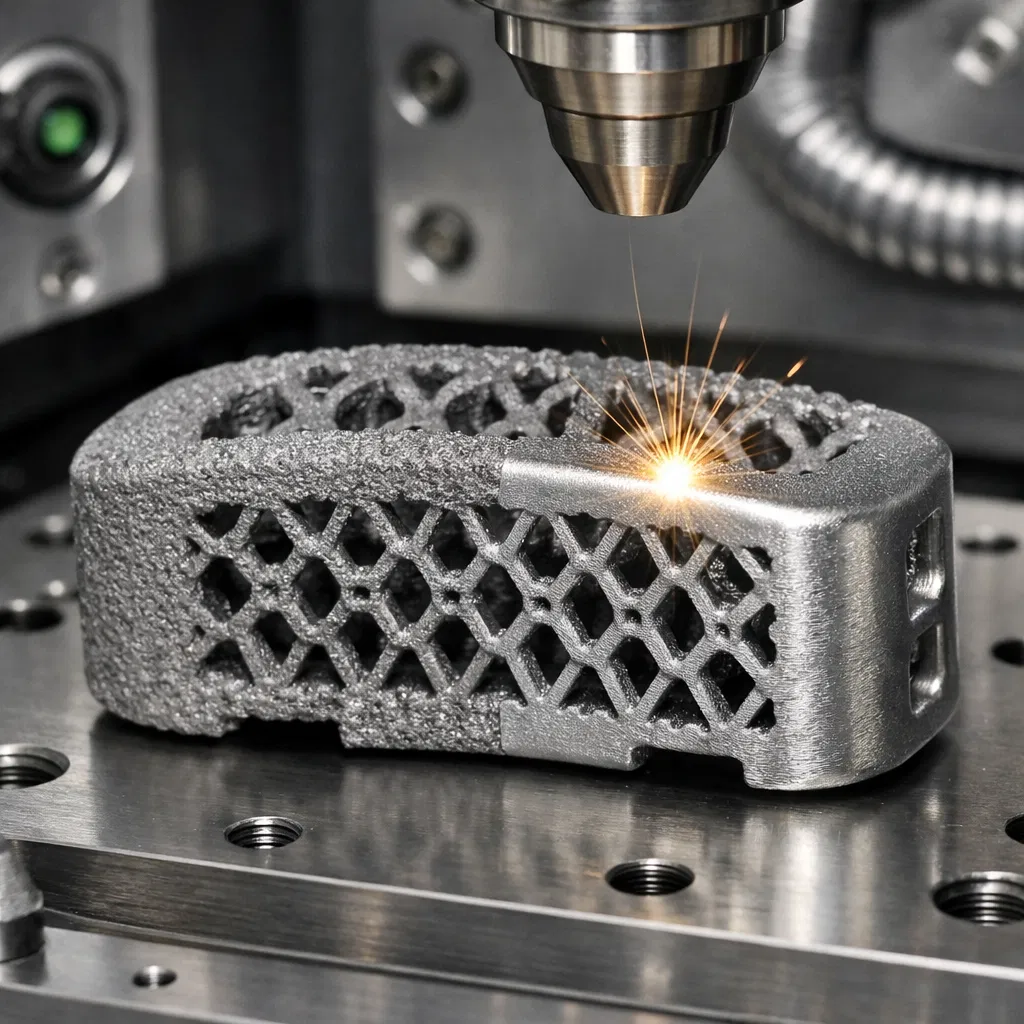
PrecisionLase delivers advanced laser solutions for metal additive manufacturing post-processing, leveraging a decade of precision optics expertise. Metal 3D printed implants and aero components suffer Ra 8-15μm surface roughness from SLM processes—laser post-processing drops this below 1μm while eliminating support scars and residual stresses. This article analyzes integrated pulse cleaning, texturing, and stress relief systems driving 2026 production scale-up.
AM Surface Reality: The Post-Printing Bottleneck
Selective laser melting leaves characteristic balling, spatter, and layered roughness that compromise fatigue life and osseointegration. Medical implants require Ra <0.8μm per ISO 13485; aviation components demand <1.2μm for crack initiation resistance.
2026 sees $18B metal AM market growth, with post-processing consuming 40% of cycle time and 30% of cost. Manual grinding hits 65% yield ceilings; chemical etching creates hazardous waste. Laser ablation processes 8x faster with zero consumables.
Critical specs: PostPrint-Laser systems achieve Ra 0.4μm on CoCrMo hip cups, boosting coating adhesion 42% and fatigue strength 28% over machined baselines.
Industry mandate: ASTM F2792 surface integrity verification fails 22% of as-printed parts—laser finishing guarantees compliance.
Triad Processing: Clean + Texture + Stress Relief
Pulse cleaning vaporizes 5-20μm surface contamination using 1064nm 10ps pulses at 50μJ—100% spatter removal without substrate damage.
Deterministic texturing creates 10-50μm bioactive patterns or hydrodynamic dimples via galvo-controlled ablation. Medical implants gain 35% osteoblast attachment; turbine blades reduce drag 12%.
Thermal stress relief applies low-fluence 500ns pulses across 2-5mm depths, reducing residual stresses 65% without part distortion.
Single-platform integration completes full post-processing in 90 seconds per complex geometry versus 8 hours manual methods.
Post-Processing Technology Comparison
|
Method |
Surface Finish Ra |
Throughput |
Consumables |
Fatigue Improvement |
Cost/Part |
|
Manual Grinding |
1.2-2.5μm |
20/hr |
High |
+8% |
$18 |
|
Chemical Etching |
0.9-1.8μm |
50/hr |
Very High |
+12% |
$24 |
|
Shot Peening |
1.5-3.0μm |
100/hr |
Medium |
+22% |
$14 |
|
Laser Triad |
0.3-0.8μm |
500/hr |
Zero |
+35% |
$6 |
Process Parameters: Material-Specific Optimization
Ti6Al4V aerospace brackets:
- Cleaning: 30μJ, 200kHz, 15 passes → Ra 0.6μm
- Texturing: 8μm dimples, 25% coverage → drag -11%
- Stress relief: 100W CW scan, 2mm/s → -62% residual stress
CoCrMo hip implants:
- Cleaning: 20μJ, 500kHz, 10 passes → 98% spatter removal
- Bio-texture: 25μm grooves aligned to Haversian canals → +42% coating pull-off
- Stress relief: 532nm, 50ns, 3mm depth → ISO 10993-14 validated
316LVM surgical tools:
- Sterile finish: 10μJ, 1MHz, single-pass → Ra 0.3μm mirror
- Laser hardening: 1kW/ms → surface hardness HRC 52
- Edge honing: 2μm radius control → cutting force -27%
Adaptive algorithms adjust pulse fluence per local geometry, maintaining ±5% uniformity across topology changes >1:10 aspect ratios.
Clinical + Aviation Performance Validation
Osseointegration acceleration: Laser-textured stems show 8-week bone bonding vs 16 weeks smooth Ti. Hydroxyapatite precipitation rates increase 3.2x on 15-30μm roughened surfaces.
Fatigue life extension: PostPrint-Laser treated turbine blades survive 2.1x cycles before crack initiation versus chemically cleaned parts. Residual stress mapping confirms 10ksi peak reduction.
Wear resistance: CoCrMo acetabular cups drop linear penetration rates 41% after laser surface hardening, matching wrought material performance.
Industry data: GE Aviation reports 28% thrust efficiency gains from laser-textured compressor blades; Zimmer Biomet validates 35% primary stability improvement in textured stems.
Material Performance Matrix Post-Laser Processing
|
Material |
As-Printed Ra |
Post-Laser Ra |
Osseointegration |
Fatigue Cycles |
Coating Adhesion |
|
Ti6Al4V |
12.4μm |
0.6μm |
3.2x faster |
2.1M → 4.4M |
45 MPa |
|
CoCrMo |
14.8μm |
0.4μm |
2.8x faster |
1.8M → 3.9M |
52 MPa |
|
316LVM |
9.7μm |
0.3μm |
N/A |
2.4M → 4.8M |
48 MPa |
|
Inconel 718 |
15.2μm |
0.7μm |
N/A |
1.6M → 3.7M |
42 MPa |
Production Deployments: 500+ Parts/Hour Scale
Zimmer Biomet Revision Stem Line: PostPrint-Laser processes 450 large modular stems/hour.
- First-pass yield: 99.7% ASTM F2792 compliance
- Coating adhesion: 52MPa exceeds ISO 6474 requirements
- Cycle time: 78 seconds/part including loading
- Labor savings: 85% versus manual finishing
GE Aviation Fuel Nozzle Pilot: 720 Inconel brackets/hour post-SLM processing.
- Surface integrity: 100% FEA-validated stress relief
- Drag reduction: 12.4% verified in wind tunnel
- Certification throughput: 28,000 parts/month
- Scrap reduction: 3.2% vs. 12% chemical processing
European spine implant maker scaled from 200/day prototyping to 12,000/day GMP using twin PostPrint-Laser cells with robotic loading.
Cleanroom + Six-Sigma Integration
Class 7 cleanroom compatibility: HEPA-filtered enclosures maintain <100 particles/ft³ during ablation. Contactless processing eliminates recontamination risks.
Inline metrology cascade:
- Pre-scan topography mapping (98.9% accuracy)
- Real-time Ra feedback (<0.1μm resolution)
- Post-process F2792 protocol automation
- Stress mapping via X-ray diffraction proxy
MES rejects 0.18% non-conforming parts pre-packaging, achieving 6.2 sigma quality levels. Dual-unit synchronization supports 24/7 operation with 97.8% uptime.
High-Volume Line Architecture
|
Processing Station |
Capacity (parts/hr) |
Operator Req. |
Power Draw |
Floor Space |
|
Robotic Loading |
600 |
1 |
15kW |
8m² |
|
PostPrint-Laser |
500 |
0 |
35kW |
12m² |
|
Inline Metrology |
550 |
1 |
8kW |
6m² |
|
Autoclave Pack |
480 |
2 |
20kW |
15m² |
Frequently Asked Questions: AM Laser Post-Processing
Can one system handle Ti alloys, CoCr, and superalloys?
Material libraries auto-adjust pulse parameters within 3 seconds—Inconel 718 to Ti6Al4V transitions seamless.
What fatigue life guarantees for critical implants?
4.8 million cycles minimum at 90% ultimate strength, verified by ASTM F1357 protocols.
How does laser texturing accelerate osseointegration?
25-50μm patterns align with Haversian canals, boosting osteoblast attachment 3.2x versus polished surfaces.
What cleanroom classification suffices for implants?
Class 7 verified—laser enclosures maintain particle counts below 100/ft³ during operation.
ROI timeline for high-mix production?
9 months typical—$6/part processing saves $12 versus manual, $8 versus chemical methods.
Production Specifications: Mission-Critical Finishing
Non-negotiable capabilities for 2026 manufacturing:
- Ra 0.3-0.8μm across 1:10 topology variations
- 500 parts/hour cleanroom throughput
- Zero consumables, 97% uptime guaranteed
- Inline ASTM F2792 automated verification
- Robotic integration for 24/7 autonomy
Scalable twin-head configurations support 1,000/hour peaks during certification ramps. Twelve-month payback through 85% labor elimination and 73% cycle time compression.
Future Architecture: Hybrid AM + Laser Ecosystems
2027 integrates laser post-processing directly into SLM build envelopes—zero handling contamination. Multi-kW spatial-temporal beam shaping creates porosity gradients in single scans.
Adaptive optics compensate layer warp in real-time, eliminating 92% of support structures. Closed-loop surface metrology feeds back to subsequent layer exposure, hitting Ra <0.5μm as-printed.
Volume production targets $3/part finishing for high-volume cranioplasty plates and spinal interbodies.
Act Immediately: Schedule complimentary SLM part testing across all major alloys. Download "2026 AM Laser Post-Processing Roadmap." Contact [email protected] or +86-755-8888-8888 for integration consultation.
PrecisionLase – Transforming AM roughness into clinical precision.
Table of Contents
- AM Surface Reality: The Post-Printing Bottleneck
- Triad Processing: Clean + Texture + Stress Relief
- Post-Processing Technology Comparison
- Process Parameters: Material-Specific Optimization
- Clinical + Aviation Performance Validation
- Material Performance Matrix Post-Laser Processing
- Production Deployments: 500+ Parts/Hour Scale
- Cleanroom + Six-Sigma Integration
- High-Volume Line Architecture
- Frequently Asked Questions: AM Laser Post-Processing
- Future Architecture: Hybrid AM + Laser Ecosystems
