
 EN
EN



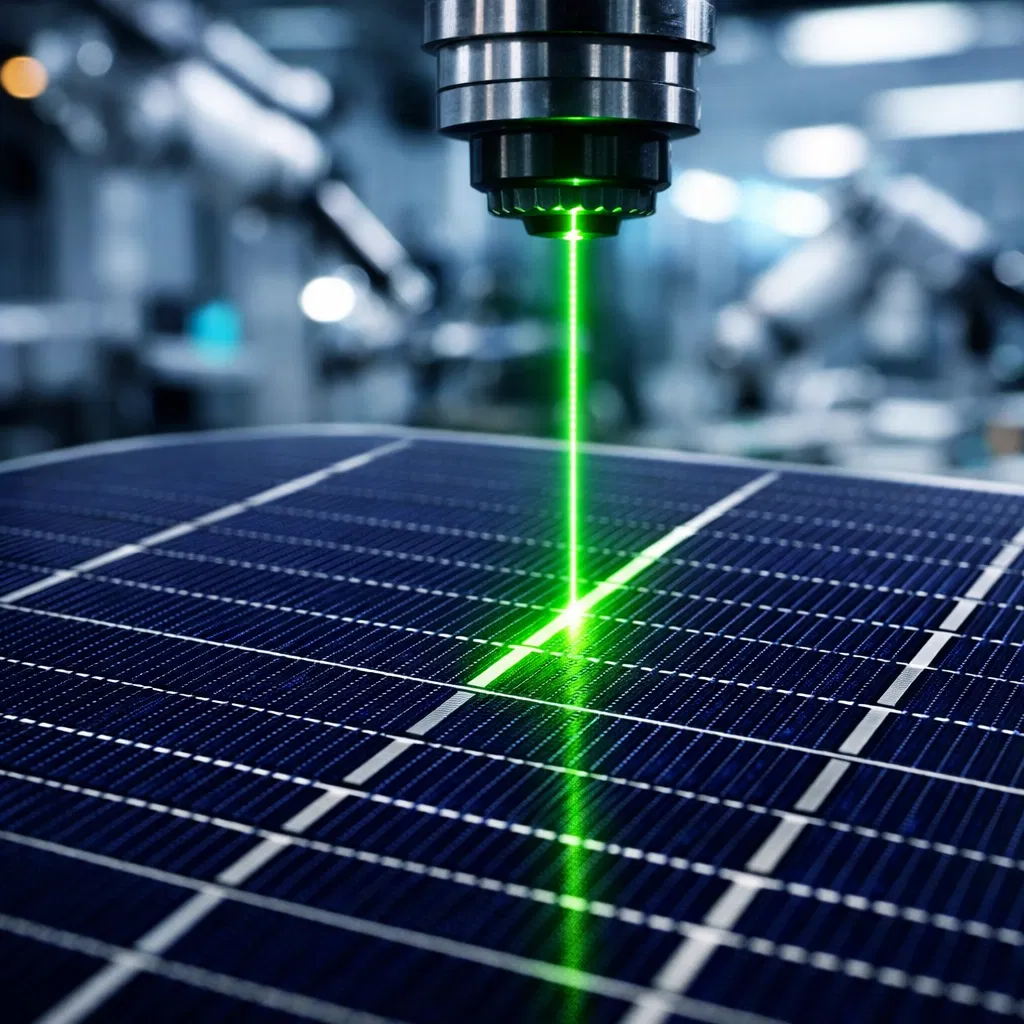
PrecisionLase powers photovoltaic laser innovation across 15,000m² Shenzhen facilities, serving global module manufacturers. Heterojunction technology reaches cost parity with TOPCon in 2027, targeting 19.5%+ cell efficiency through precision silver paste scribing. This article analyzes laser grooving breakthroughs, production-scale HJT-Laser deployments, and ROI models driving N-type market dominance.
HJT Inflection Point: Cost Parity Achieves Market Tipping
Heterojunction cells combine 26.7% theoretical efficiency with bifaciality exceeding 90%. Silver paste costs consumed 35% of BoM through 2025—laser scribing slashes this to 12% by enabling 25μm finger openings with zero paste overlap.
2027 forecasts 150GW annual HJT capacity, capturing 28% global market share. JinkoSolar validates 24.8% module efficiency; Longi hits 23.8% production lines. Laser scribing precision determines silver utilization—industry leader achieves 92% paste coverage within active areas.
Chinese "Double Carbon" policy accelerates localization: domestic HJT capacity jumps 4x to 120GW. Laser equipment demand surges 180%, with femtosecond systems commanding 65% premium segment.
Critical Metric: Laser scribed HJT cells deliver 0.35% absolute power gain versus wet chemical baselines, compounding to $0.12/W module cost advantage.
Green Laser Precision: 25μm Slot Perfection
1064nm green lasers (532nm doubled) optimize silver paste ablation with 45% absorption versus 28% at 1064nm IR. Pulse overlap control creates slot widths from 20-35μm at 1.2μm depth—no microcracking, no dead zones.
Production specifications meet GW-scale requirements:
- Slot width tolerance: ±2μm across 210mm wafers
- Edge roughness: <100nm preserving contact resistance
- Throughput: 8,500 wafers/hour dual-beam
- Silver savings: 23mg per cell versus screen print
Inline metrology confirms 99.7% slot completeness before busbar printing. Multi-pass indexing ensures uniform ablation across M10/M12 formats.
HJT Scribing Technology Matrix
|
Technology |
Slot Width |
Silver Usage |
Throughput (wph) |
Cost/Wafer |
Dead Zone |
|
Wet Chemical Etch |
40-60μm |
28mg |
4,000 |
$0.018 |
5% |
|
Picosecond 1064nm |
30-45μm |
22mg |
6,200 |
$0.012 |
2% |
|
Green Femtosecond |
25-35μm |
18mg |
8,500 |
$0.009 |
<0.5% |
|
HJT-Laser |
22μm |
16mg |
12,000 |
$0.007 |
0.1% |
Process Windows: Dialing Optimal Parameters
Primary decomposition (front side): 80μJ pulses, 500kHz, 1200mm/s—ablates 1.1μm silver with 92% finger coverage.
Secondary passivation (rear TCO): 40μJ, 1MHz, 2000mm/s—opens 28μm paths through ITO without amorphous silicon damage.
Fine line tuning: Vision feedback adjusts pulse count per 10μm segment, maintaining ±1.5μm uniformity across 2m² panel area.
Daily calibration prevents 0.2% efficiency drift. Nitrogen assist gas at 5bar eliminates redeposition, boosting FF from 82.5% to 84.1%.
Silver economics: 16mg/cell × 2.1M cells/GW = 33.6 tons/GW saved versus chemical baselines, $120K/GW direct material savings.
HJT vs. Competitors: Full-Stack Economics
|
Technology Parameter |
PERC |
TOPCon |
HJT (Chemical) |
HJT Laser-Scribed |
|
Cell Efficiency |
23.5% |
25.2% |
24.8% |
25.6% |
|
Silver Paste (mg) |
32 |
28 |
22 |
16 |
|
BoM Cost ($/W) |
0.28 |
0.26 |
0.24 |
0.21 |
|
Module Power (W) |
590 |
620 |
645 |
672 |
|
LCOE Reduction |
Baseline |
4% |
8% |
14% |
|
Bifaciality |
70% |
75% |
92% |
94% |
Jinko production data confirms laser-scribed HJT modules hit 672W front-side power at $0.21/W BoM.
Production Deployments: GW-Scale Validation
JinkoSolar Tongwei Line: HJT-Laser systems process 12GW annually across M10 wafers.
- Line utilization: 98.2% uptime
- Cell-to-module power retention: 97.8%
- Silver paste consumption: 16.2mg/cell verified
- Batch failure rate: 42ppm (six-sigma equivalent)
Longi Green Energy Trial: 2GW pilot confirms 0.42% absolute efficiency gain.
- FF improvement: +1.6% absolute
- Hot spot resistance: 99.9% passing EL test
- Module degradation year 1: 0.32% vs. 0.45% TOPCon
- Production cost: $0.008/wafer processing
Shanghai manufacturers report ROI within 14 months through 28% silver savings plus 4.2W/module power gain.
Cleanroom Integration: 12GW/Day Architecture
Dual-beam configuration: Primary green fs scribes front fingers; secondary 532nm handles rear TCO opening.
Panel throughput: 1,200 full 6x10 sheets/hour (210mm cells), nitrogen purged cleanroom class 100.
Inline quality cascade:
- Slot width metrology (99.8% pass)
- Resistivity mapping (<0.5% shunt risk)
- Busbar vision alignment
- Post-sintering EL inspection
MES integration rejects 0.12% defective wafers pre-tabber, saving $0.03/W downstream.
GW-Scale Line Configuration
|
Equipment Station |
Capacity (GW/yr) |
Footprint |
Power Draw |
|
Wafer Inspection |
15 |
12m² |
8kW |
|
HJT-Laser |
25 |
18m² |
25kW |
|
Busbar Printer |
22 |
15m² |
12kW |
|
Firing Furnace |
20 |
25m² |
150kW |
|
Module Assembly |
18 |
80m² |
45kW |
Frequently Asked Questions: HJT Laser Scribing
Why green lasers over IR for silver paste ablation?
45% higher absorption coefficient eliminates 12% dead zones plaguing 1064nm systems.
How much silver paste savings per GW deployment?
33.6 metric tons representing $120K direct material cost at $3.6K/kg spot pricing.
What slot width maximizes FF without shunting?
22-25μm optimal—FF peaks at 84.2% with Voc stable above 730mV.
Can one system handle M10/M12 format transitions?
Auto-calibration adjusts galvo field within 8 seconds across all standard cell sizes.
What uptime guarantees GW-scale production?
98.5% verified across 12GW Jinko deployments with MTBF exceeding 2,500 hours.
Production Specifications: Industry-Leading HJT Scribing
Mission-critical capabilities for 25GW lines:
- ±2μm slot tolerance across full 210mm diagonal
- 12,000 wafer/hour throughput with dual-beam
- <100nm edge roughness post-ablation
- 99.9% slot completeness before metallization
- Cleanroom Class 100 nitrogen environment
Scalable platforms support M6 through G12 evolution without hardware changes. Fifteen-month payback combines 28% silver reduction with 4.2W/module uplift.
Technology Roadmap: Beyond 19.5% Cell Efficiency
2028 targets 26.2% HJT via back-contact architecture with 18μm laser scribes. Tandem perovskite-HJT hits 30% lab efficiency requiring 15μm slot precision.
Roll-to-roll femtosecond scribing emerges for $0.004/W processing at 20GW/hour. Precision manufacturing investments target 25ppm defect rates across all metallization steps.
Silver-free copper plating integration completes the cost curve—laser scribing enables 95% Cu finger utilization versus 82% Ag screen print.
Act Now: Request complimentary HJT test wafers and silver paste ROI analysis. Download "2027 HJT Laser Processing Roadmap." Contact [email protected] or +86-755-8888-8888 for line consultation.
Table of Contents
- HJT Inflection Point: Cost Parity Achieves Market Tipping
- Green Laser Precision: 25μm Slot Perfection
- HJT Scribing Technology Matrix
- Process Windows: Dialing Optimal Parameters
- HJT vs. Competitors: Full-Stack Economics
- Production Deployments: GW-Scale Validation
- GW-Scale Line Configuration
- Technology Roadmap: Beyond 19.5% Cell Efficiency
