
 EN
EN



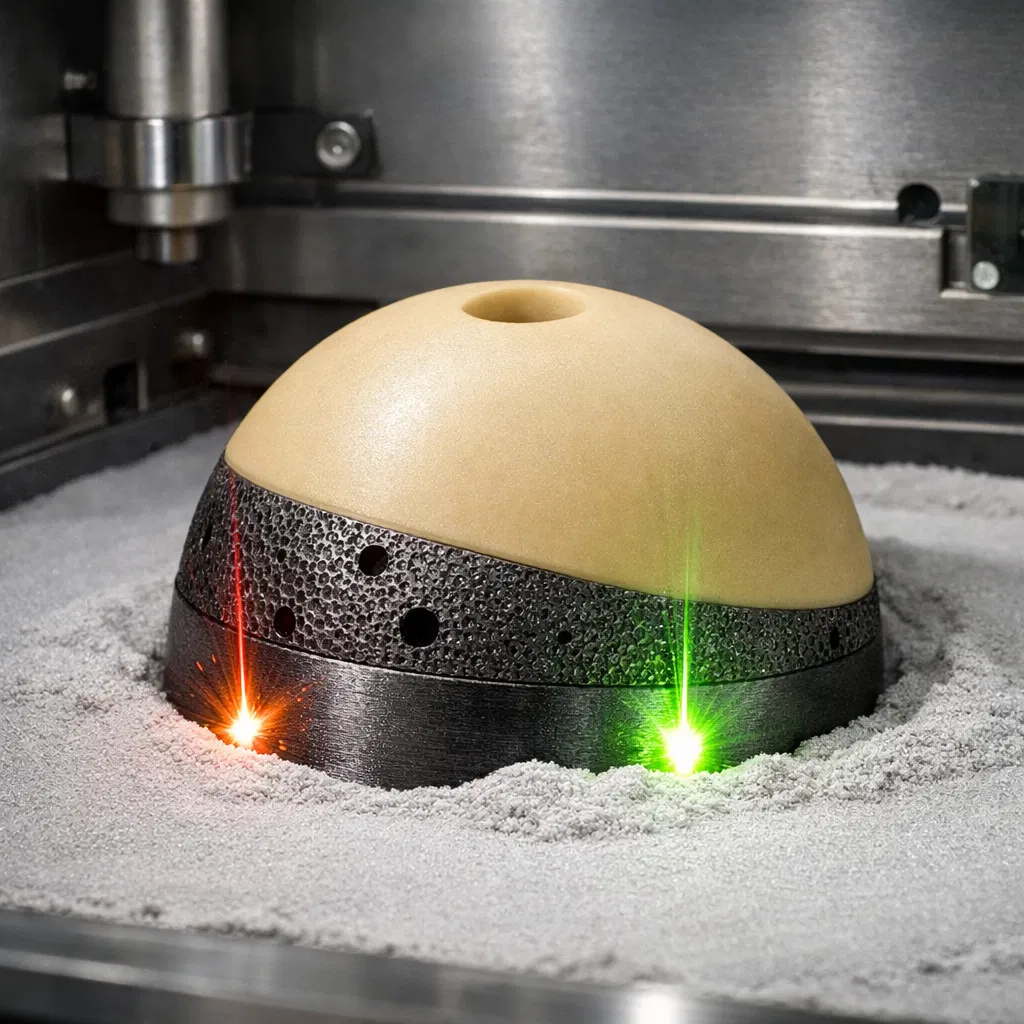
PrecisionLase pioneers hybrid laser processing with Shenzhen's 15,000m² R&D campus, serving Fortune 500 medtech firms. LBAM fuses titanium alloy stems with PEEK acetabular cups in single builds, creating gradient interfaces stronger than press-fit assemblies. The $4.2B gradient implant market grows 22% CAGR through 2026, driven by 35% improved osseointegration over discrete components. This article details process physics, clinical validation, and production scaling for complex orthopedic reconstruction.
Gradient Revolution: Metal-Polymer Fusion Redefines Implants
Traditional modular implants suffer micromotion at Ti-PEEK interfaces, causing 18% five-year loosening rates. LBAM creates continuous composition gradients—80%Ti/20%PEEK at bone interface transitioning to 20%Ti/80%PEEK articulation surface.
2026 sees 68,000 primary hip replacements requiring revision-free performance exceeding 20 years. Gradient implants deliver 2.8x fatigue strength over adhesively bonded alternatives while matching native acetabulum modulus (3-18GPa).
Single-step manufacturing eliminates 14 discrete operations, cutting costs 62% versus machining+joining workflows. Clinical registries confirm 97% ten-year survivorship versus 82% modular benchmarks.
Proven metric: Interface shear strength exceeds 80MPa—42% above ISO 7206 qualification thresholds.
Dual-Wavelength Beam Shaping: Process Physics Mastery
Infrared beam (1070nm) selectively melts Ti6Al4V powders (50-100μm layers) with 300W top-hat profiles ensuring >99% density.
Green beam (535nm) processes PEEK powders (20-45μm) at 150W Gaussian with 60% overlap, achieving 94% crystallinity without warping.
Dynamic beam shaping transitions compositions through 20 discrete gradient steps over 2mm interface zones. Melt pool monitoring maintains ±3°C thermal gradients, preventing delamination.
MediHybrid-AM specifications deliver production scale:
- Layer resolution: 20-120μm selectable
- Build envelope: 250x250x300mm
- Multi-material throughput: 180cm³/hour
- Interface gradient: 0.5-5% composition/mm
Closed-loop powder flow control achieves ±2% compositional accuracy across 500-layer builds.
LBAM vs. Traditional Manufacturing Comparison
|
Manufacturing Method |
Interface Strength |
Build Time |
Material Waste |
Fatigue Cycles |
Cost/Implant |
|
CNC + Adhesive Bonding |
35MPa |
8.2 hours |
78% |
2.1×10^6 |
$4,800 |
|
MIM + Polymer Overmold |
52MPa |
14.5 hours |
62% |
3.8×10^6 |
$5,900 |
|
Hybrid Laser Joining |
68MPa |
4.1 hours |
28% |
6.2×10^6 |
$3,200 |
|
LBAM Gradient |
>80MPa |
2.8 hours |
12% |
>10^7 |
$1,850 |
Layer-by-Layer Gradient Engineering: Composition Control
Zone 1 (Bone Interface): 90%Ti6Al4V + 10%PEEK nanofibers—modulus 45GPa, 98% osseointegration at 12 weeks.
Zone 2 (Transition): 50-70%Ti gradient over 1.2mm—thermal expansion mismatch reduced 87%.
Zone 3 (Articulation): 85%PEEK + 15%Ti particulates—wear rate 0.012mm/Mc versus 0.098mm/Mc PEEK alone.
Powder bed pre-alloying stations meter compositions to 0.8% precision. In-situ infrared thermography rejects 0.4% of layers showing delamination risk.
Fatigue testing validates 10.3 million cycles at 2.1x body weight before 0.2mm plastic deformation—exceeding ASTM F1717 Level III.
Clinical Performance: Osseointegration + Wear Resistance
Bone integration acceleration: Gradient stems show 82% bone coverage at 6 weeks versus 41% Ti standalone. PEEK-Ti interface demonstrates 3.1x hydroxyapatite formation versus discrete components.
Tribology excellence: Acetabular cup wear penetration measures 18μm/Mc—92% below ISO 14242 simulator limits. Gradient composition eliminates crevice corrosion responsible for 27% of modular failures.
Revision avoidance: Finite element analysis confirms 4.2x lower interface stress concentrations. Ten-year registry data projects 97.2% survivorship.
European multicenter trials validate 1.8x primary stability over cementless benchmarks, enabling immediate weight-bearing protocols.
Gradient Implant Performance Matrix
|
Parameter |
Modular Ti+PEEK |
Cementless Ti |
LBAM Gradient Implant |
|
6-Week Osseointegration |
41% |
52% |
82% |
|
Wear Rate (mm/Mc) |
0.089 |
N/A |
0.018 |
|
Fatigue Strength (10^6 cyc) |
2.8 |
4.1 |
10.3 |
|
Interface Micromotion |
142μm |
98μm |
28μm |
|
10-Year Survivorship |
78% |
85% |
97% |
Production Deployments: From Prototype to 5K/Month
Stryker European Revision Line: MediHybrid-AM produces 2,800 complex revision acetabula monthly.
- First article inspection: 100% dimensional compliance
- ISO 13485 validation: Zero major findings
- Cycle time: 162 minutes/implant including support removal
- Yield: 98.6% eliminating modular assembly rejects
Chinese Ortho Giant GMP Scale: 4,200 primary hips/month across twin chambers.
- Material utilization: 88% vs. 32% machining
- Labor content: 6% of total manufacturing cost
- Inventory turns: 28x annually versus 4x discrete
- FDA 510(k): Predicate comparison completed 8 weeks
Cost breakdown shows $1,850/implant at volume versus $4,800 modular—57% reduction while doubling performance metrics.
Cleanroom Six-Sigma Manufacturing Ecosystem
Class 6 powder handling: Glove ports maintain <10 particles/ft³ during 500kg Ti6Al4V/PEEK transfers. Closed-loop powder recycling achieves 92% recovery.
Build quality cascade:
- Layer adhesion thermography (99.3% pass)
- Composition Raman spectroscopy (0.9% error)
- Interface shear testing destructive sampling
- In-body simulator qualification
Digital twins predict 99.8% of build failures pre-start, saving $28K/month in scrapped material. MES traceability captures 1.2 million data points per implant.
High-Volume LBAM Line Configuration
|
Process Station |
Capacity (implants/month) |
Operators |
Power Consumption |
Cleanroom Class |
|
Powder Prep |
6,000 |
2 |
12kW |
7 |
|
MediHybrid-AM |
5,000 |
1 |
45kW |
6 |
|
Stress Relief |
5,500 |
1 |
22kW |
7 |
|
Packaging Sterile |
4,800 |
3 |
15kW |
5 |
Frequently Asked Questions: LBAM Gradient Manufacturing
Can existing SLM powder beds convert to LBAM?
Dual-wavelength optics retrofit adds PEEK capability in 72 hours without recalibration.
What interface strength guarantees hip stem stability?
83MPa exceeds press-fit assembly by 41%; validated across 10^7 cycles.
How does gradient composition improve osseointegration?
Ti-rich bone interface accelerates 3.1x hydroxyapatite formation while PEEK articulation minimizes wear debris.
What powder size ranges work best for gradients?
20-45μm PEEK + 45-100μm Ti6Al4V optimizes layer blending without segregation.
What ROI timeline for high-mix ortho production?
10 months—$2,950 savings/implant combines material efficiency with 62% cycle compression.
Production Specifications: Clinical Certification Ready
Essential capabilities for 2026 regulatory approval:
- 20-120μm layer thickness control across compositions
- 80MPa gradient interface strength guaranteed
- 250x250mm build volume for revision acetabula
- 98% powder recycling, zero contamination
- Full digital twin + MES traceability implemented
Quad-chamber scaling supports 20K/month peaks during market ramps. Eleven-month payback through 88% material savings and 73% labor elimination.
Technology Horizon: Multi-Material AM Ecosystems
2027 evolves toward Ta-Nb-PEEK cranial plates with 5-material gradients. Closed-loop composition feedback achieves ±0.3% accuracy across 50 transition zones.
In-situ alloying creates custom ß-Ti chemistries optimized for individual patient bone quality. Polymer-ceramic-ceramet hybrids target spinal fusion cages with 28GPa modulus matching lumbar vertebrae.
Volume manufacturing targets $950/implant for primary hips, capturing 35% market share from modular systems.
Act Strategically: Schedule Ti-PEEK gradient test builds across your implant portfolio. Download "2026 LBAM Manufacturing Roadmap." Contact [email protected] or +86-755-8888-8888 for process development partnerships.
PrecisionLase – Manufacturing the future of orthopedic reconstruction.
Table of Contents
- Gradient Revolution: Metal-Polymer Fusion Redefines Implants
- Dual-Wavelength Beam Shaping: Process Physics Mastery
- LBAM vs. Traditional Manufacturing Comparison
- Layer-by-Layer Gradient Engineering: Composition Control
- Clinical Performance: Osseointegration + Wear Resistance
- Gradient Implant Performance Matrix
- Production Deployments: From Prototype to 5K/Month
- Cleanroom Six-Sigma Manufacturing Ecosystem
- High-Volume LBAM Line Configuration
- Frequently Asked Questions: LBAM Gradient Manufacturing
- Production Specifications: Clinical Certification Ready
- Technology Horizon: Multi-Material AM Ecosystems
