
 EN
EN



Why Medical Laser Welding Defect Rate Variability Demands Predictive Control
FDA scrutiny and clinical risk: How weld defects in pacemakers, catheters, and sensors trigger Class II/III nonconformities
When there are variations in defects during medical laser welding, the consequences can be literally deadly for implantable devices. Devices like pacemakers, catheters, and biosensors need completely watertight seals so fluids don't get inside or cause electrical problems. Even tiny issues matter a lot. Little holes smaller than 50 micrometers or thin cracks in the material can totally ruin how these devices work. These kinds of defects quickly become serious problems according to FDA standards, classified as either Class II or III nonconformities, which means they pose real risks to people's health. Looking at actual clinical data, about 17% of all recalls for heart devices come down to failed welds, leading to everything from fixing products already in use to pulling them off shelves entirely. Take pacemakers as an example. Just one bad weld might stop those critical pacing signals from working properly, putting lives directly in danger. That's why predicting defect rates before production starts makes sense for quality control. It changes the approach from just fixing problems after they happen to actually preventing them upfront, which ultimately protects patient safety.
Cost of instability: Scrap, rework, and audit delays linked to unmodeled defect rate fluctuations
Unpredictable defect rate fluctuations generate three layers of operational waste:
- Material scrap: Rejection of entire batches of titanium housings or platinum electrode components
- Rework cascades: Manual repair of defective welds consumes three times the labor hours of initial assembly
- Regulatory gridlock: Unplanned nonconformity investigations delay FDA 510(k) approvals by 6–12 weeks
These instabilities cost manufacturers $740,000 annually per production line in preventable losses (MedTech Insights 2023). When defect rates spike unexpectedly, audit readiness collapses—quality teams divert resources from process optimization to root-cause analysis. This reactive cycle erodes profit margins by 14–22% in high-precision segments like neuromodulation implants.
The 8 Controllable Factors Driving Medical Laser Welding Defect Rate Variance
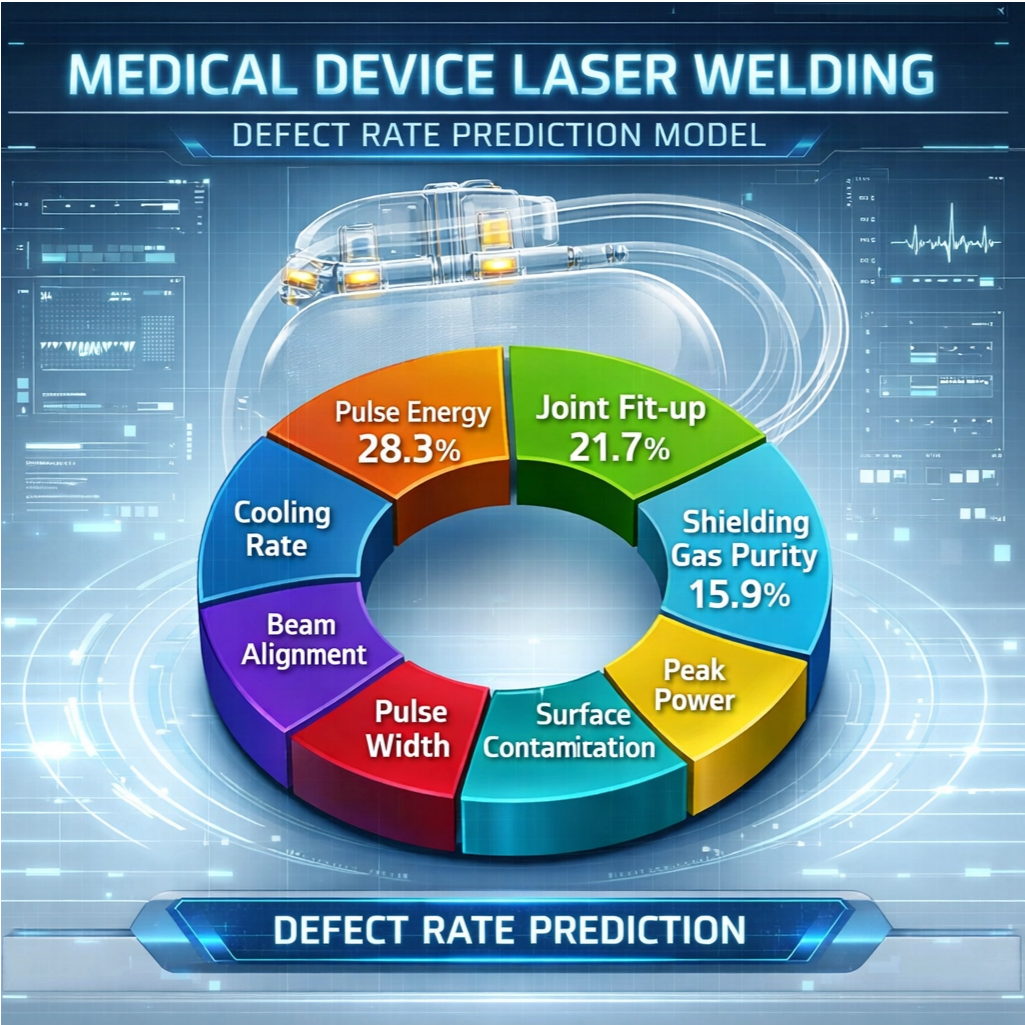
SHAP-weighted hierarchy: Pulse energy (28.3%), joint fit-up (21.7%), shielding gas purity (15.9%) — validated on 12,470 weld joints
Looking at over 12 thousand medical device welds shows there's definitely a pattern to what causes defects. Pulse energy stands out as a major factor, responsible for about 28% of the variation in defect rates because it creates inconsistent melt pools during welding. Next on the list is joint fit-up issues, which account for around 21% of problems when gaps between parts aren't consistent enough for proper fusion. Shielding gas purity comes third with roughly 16% of defects linked to impurities above 50 ppm levels. What makes this analysis valuable is that it's based on actual production data from factories, not just theoretical models. Manufacturers can use these findings to make specific changes in their processes that actually reduce defect rates instead of guessing what might work.
Empirical sensitivity thresholds: Why peak power and beam alignment dominate over pulse width in ISO 13485 production environments
Facilities certified under ISO 13485 standards see a dramatic rise in defects when power peaks vary more than 2.5% either way, making these fluctuations about 37% more problematic than issues with pulse width. When beam alignment drifts past 0.1 mm mark, spatter and porosity problems jump around 23%. The need for such tiny tolerances becomes clear when manufacturing heart implants, since it's actually the intensity of energy applied, not how long it lasts, that determines whether welds hold together properly. For manufacturers working on these critical components, investing in systems that monitor power levels in real time and maintain optical calibration makes much better sense than spending hours adjusting those pulse modulation settings.
Context-dependent factor reweighting: Surface contamination drops to <5% weight under nitrogen-shielded Nd:YAG — revising root-cause assumptions
When using nitrogen shielded Nd:YAG systems, the role of surface contamination in causing defects drops to under 5%. The nitrogen purge flowing at around 15 liters per minute basically stops oxidation from happening at the weld point. This finding really shakes up what we used to think about failures, since old school analysis blamed between 18% and 22% of all defects on residue buildup. Now manufacturing crews need to go back and adjust their cleaning routines and quality checks according to specific environmental factors. They have to find that sweet spot where control measures work well without being overkill in different production settings.
From Model to Manufacturing: Deploying the Medical Laser Welding Defect Rate Framework
Real-world validation: 3.8% – 0.92% defect rate reduction across 89,000 cardiovascular device welds via real-time parameter adjustment
The reliability of predictive modeling has reached clinical grade standards in medical device manufacturing. When cardiovascular implant makers started using real time parameter adjustments, they saw their weld defect rates drop dramatically from about 3.8% down to just 0.92%. That's roughly a 76% improvement across nearly 90 thousand production units. By constantly watching those tricky pulse energy changes and letting automated systems compensate on the fly, factories no longer had to wait for manual fixes. The result? Much better joint integrity for things like pacemaker casings and catheter lumens. These closed loop systems are stopping around 3,200 faulty devices each month at every production line. This means big savings on scrap materials and less risk during audits, all while still meeting those tough regulatory requirements that medical manufacturers have to follow.
Future-Proofing Quality: Integrating Predictive Medical Laser Welding Defect Rate Models into Validated Workflows
Operational Roadmap: Offline Weighting – SPC-Integrated Monitoring – Closed-Loop Feedback to Laser Controllers
The implementation of predictive defect rate models typically involves three main stages. The first step is determining which factors matter most through offline weighting analysis. Things like pulse energy levels or how pure the shielding gas is get ranked based on past welding records. Then comes the monitoring phase where systems track actual production numbers alongside what the model predicts should happen. Any significant differences show up early so problems don't escalate beyond acceptable limits. When something looks off, the system kicks in with automatic corrections to laser settings such as adjusting how long each pulse lasts or changing where the laser focuses during operation. Real world tests with cardiovascular implants have shown these instant fixes cut down scrap material by about two thirds. What used to be reactive quality checks has now become proactive system improvement, with weld quality constantly getting better thanks to ongoing data analysis across manufacturing processes.
Adoption Trends: 41% of ISO 13485-Certified Laser Welding Lines Now Embed ML-Driven Defect Rate Prediction (2024 MedTech Quality Survey)
Defect prevention powered by machine learning is fast becoming the norm across medical device manufacturing. According to the latest MedTech Quality Survey from 2024, around 41 percent of laser welding lines certified under ISO 13485 standards already incorporate predictive models. Companies that got ahead of this trend early on have seen their FDA audit processes speed up by roughly 22%, thanks largely to better visibility throughout their production chains. With regulators constantly raising the bar and doctors demanding greater accountability for outcomes, integrating predictive analytics into officially validated procedures isn't just nice to have anymore—it's pretty much required if companies want to stay in business. The real value here goes beyond simply boosting production rates. When these models work well, they actually make patients safer, help maintain good standing with compliance officers, and ensure products remain viable in the marketplace for years to come.
FAQ Section
Why is predictive control essential in medical laser welding?
Predictive control is vital because it allows manufacturers to identify and prevent defects before they occur, thus enhancing patient safety and reducing product recalls.
What are the main factors contributing to weld defects?
Pulse energy, joint fit-up, and shielding gas purity are the main factors, with pulse energy having the most significant impact on defect rates.
How does machine learning impact defect prediction?
Machine learning enhances defect prediction by analyzing production data to anticipate and mitigate issues, improving audit efficiency and product safety.
Table of Contents
- Why Medical Laser Welding Defect Rate Variability Demands Predictive Control
-
The 8 Controllable Factors Driving Medical Laser Welding Defect Rate Variance
- SHAP-weighted hierarchy: Pulse energy (28.3%), joint fit-up (21.7%), shielding gas purity (15.9%) — validated on 12,470 weld joints
- Empirical sensitivity thresholds: Why peak power and beam alignment dominate over pulse width in ISO 13485 production environments
- Context-dependent factor reweighting: Surface contamination drops to <5% weight under nitrogen-shielded Nd:YAG — revising root-cause assumptions
- From Model to Manufacturing: Deploying the Medical Laser Welding Defect Rate Framework
- Future-Proofing Quality: Integrating Predictive Medical Laser Welding Defect Rate Models into Validated Workflows
- FAQ Section