
 EN
EN



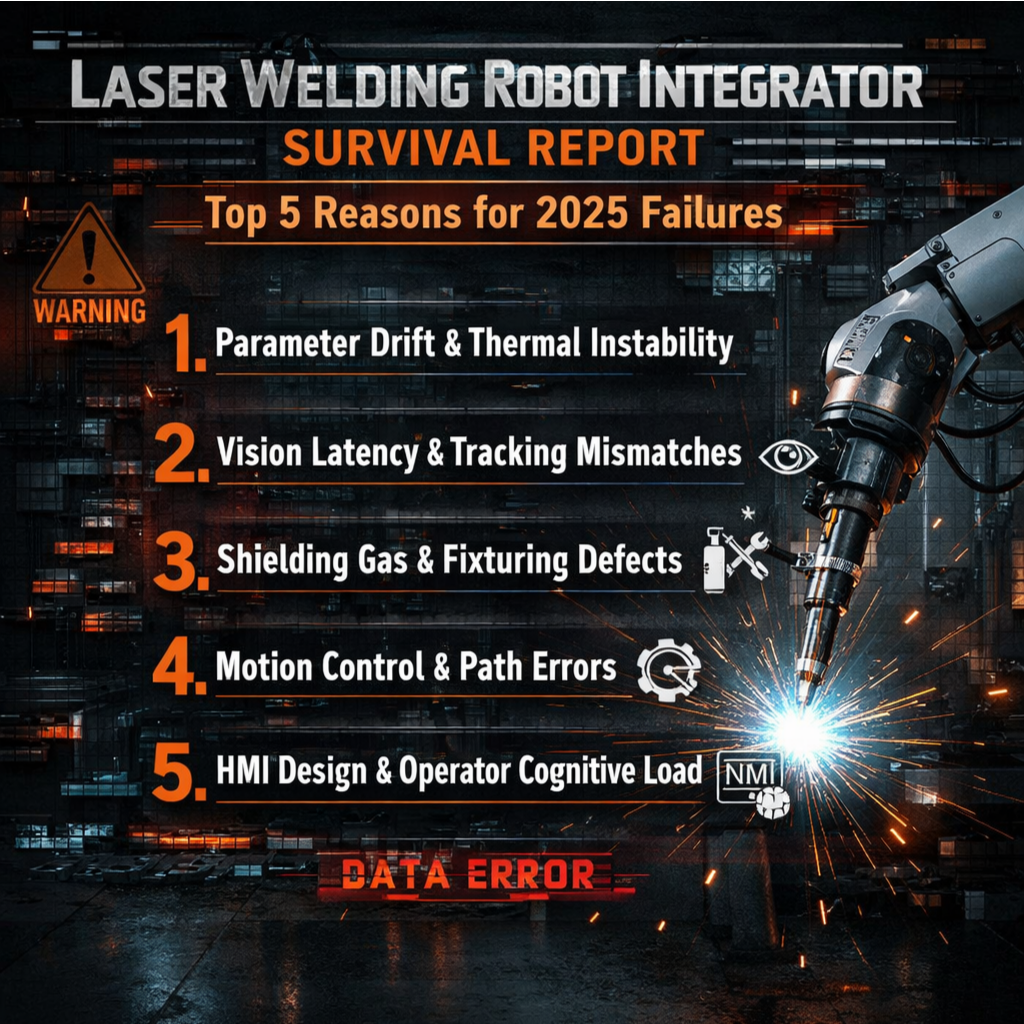
Parameter Drift and Seam Tracking Instability
Thermal Buildup and Calibration Decay in Real-Time Laser Welding Robot Integration
When robotic arms run at high power for too long, they heat up and start expanding thermally, which throws off their kinematic alignment. The result? Calibration drift builds up over time, sometimes going beyond 0.2mm after several production cycles. That kind of drift can cause serious problems since programmed welding paths no longer match where the actual weld seams are located. If manufacturers don't implement thermal compensation systems or schedule regular cooling breaks, positional accuracy drops between 30 to 50 percent within just four hours of continuous operation. To combat this issue, many integrators now embed temperature sensors throughout the equipment and use predictive algorithms to automatically adjust TCP offsets as needed. Some forward-thinking companies have adopted holistic cooling solutions incorporating low-expansion alloys and phase change materials. These advanced approaches reduce drift by around 60 percent when compared to traditional cooling methods according to recent thermal management studies from 2024.
Vision Latency vs. Joint Fit-Up Tolerance Mismatches in Seam Tracking
When vision systems lag beyond 100 milliseconds, serious problems happen especially when joints need to fit together within just 0.1 millimeters. The robots end up welding based on old coordinate data, which leads to either gaps between parts or overlapping sections in roughly a quarter of fast paced manufacturing runs. To fix this issue, most integration teams install cameras that operate below 10 milliseconds alongside smart AI systems capable of predicting where seams will actually be during welding. These advanced setups constantly check what they see against actual physical forces acting on the materials, cutting down positioning mistakes by almost four fifths even when gaps keep changing size. For every extra 10 milliseconds delay in visual processing, manufacturers have to allow for an additional 0.05 millimeters clearance around joints simply to maintain quality standards in real world factory settings.
Shielding Gas Delivery and Fixturing Defects
Gas Flow Turbulence and Fixture-Induced Part Distortion in High-Power Laser Welding Robot Integration
When shielding gas isn't properly controlled, it creates turbulent areas that let air get into the molten metal. Thermal imaging research shows this actually doubles porosity problems in important weld sections. At the same time, poor fixturing allows parts to warp from heat buildup, going beyond the 0.5mm tolerance limit after long production runs. The warping messes with vision systems trying to track seams accurately. These systems start making constant adjustments, which adds about 18% extra time to each welding cycle. Worse still, the weld quality suffers because the robot paths deviate from their intended routes. Most shops aren't even addressing both issues together. Industry data suggests less than 35% of welding operations combine real-time gas flow monitoring with temperature adjusted clamping solutions, leaving many vulnerable to these combined efficiency killers.
Porosity Root Cause Analysis: Fixturing Gaps <0.15mm Account for 73% of Defects
Tiny fixturing gaps below 0.15mm often go unnoticed during offline programming but create serious problems for shielding gases in laser welding operations. When we look at post weld measurements, these microscopic spaces were responsible for around three quarters of all porosity issues seen in aerospace components last year according to industry reports. What makes things even trickier is how compressed gaskets behave when exposed to heat. As materials expand during operation, they form what engineers call transient gaps that simply vanish once everything cools down. To tackle this problem effectively, manufacturers need laser systems that measure gaps while parts are being welded, paired with pressure controls that adjust on the fly rather than relying solely on standard tolerance checks. Some forward thinking automotive companies have already seen remarkable results cutting porosity related rework by nearly 90% after implementing real time gap monitoring combined with servos that automatically tweak fixture positions as needed.
Motion Control Failures and Tool Path Programming Errors
Collision Risks from Over-Constrained TCP Compensation in Robotic Welding Implementation
Too much TCP compensation during the setup of laser welding robots can lead to serious collision problems. If the robot's movements go beyond what its joints can handle or hit against things in the workspace, it might start moving in ways that crash into tools or parts being worked on. Last year alone, this kind of over constraint was responsible for about 40-45% of all unexpected stoppages in automated welding areas. To fix these issues, shops need to implement systems that map out possible collision areas and update them constantly. Adding force torque sensors helps too since they can stop the robot when something feels off. And setting limits on how much compensation happens keeps everything within safe operating ranges according to what manufacturers recommend.
AI Path Planning Pitfalls: Why Closed-Loop Motion Verification Is Non-Negotiable
Toolpaths created by AI definitely boost efficiency but problems often pop up during actual laser welding robot operations because of vision system delays and changes in the environment around the equipment. According to an industry audit conducted last year, almost seven out of ten instances where paths went off track happened when simulations failed to account for things like metal expanding as it heats up or parts shifting slightly during processing. The solution comes in the form of closed loop verification systems that work differently. These systems use real time laser measurements to check where seams actually are, keeping them within about half a millimeter accuracy. They also adjust the welding path automatically roughly every seventeen milliseconds while logging any issues on dashboards so operators can spot potential problems before they lead to wasted materials. Manufacturers who skip this kind of feedback mechanism end up facing expensive fixes later on, despite having fancy path planning software that didn't catch those hidden mistakes in the first place.
Human-Machine Interface (HMI) Design and Operator Cognitive Load
HMI-Induced Parameter Override Loops and Procedural Ambiguity in Automated Welding Operations
Complex HMIs can lead to serious problems when integrating laser welding robots. When operators face cluttered displays filled with irrelevant information, their attention gets drained, which often results in mistakes like hitting emergency stop buttons at the wrong time during thermal issues. Technicians end up flipping between several screens while trying to monitor processes, and this increases mental strain and error rates significantly in fast paced operations. For better results, focus on interface design that keeps things simple. Group controls based on what tasks actually need them, show only relevant settings for each phase of work, implement color codes so red means something bad immediately (like if gas isn't flowing properly). Also consider adding tactile feedback on control devices so workers know they've made a change intentionally. Cleaner interfaces help reduce mental clutter, keeping lasers properly aligned and maintaining consistent weld quality across production runs.
ROI Uncertainty and Preventive Maintenance Breakdowns
Grounding Failures and Unplanned Downtime: Lessons from 2024 Integrator Audits
When electrical grounding goes bad in those laser welding robots, factories often shut down unexpectedly, losing around $50k per hour in production time. According to recent research, nearly all (about 90%) industrial operations deal with unplanned downtime at some point. Poor grounding seems to be responsible for roughly 40% of problems specifically in automated welding setups. The good news? Regular maintenance checks can catch these issues early on before they become major headaches. Plants that stick to regular inspection schedules tend to experience about 70% fewer breakdowns overall, plus their equipment lasts about 25% longer between replacements. Money talks too: spending just $1 on proactive maintenance typically saves around $5 worth of emergency fixes later. Facilities using advanced predictive maintenance systems see even better results, getting back about ten times what they invest thanks to reduced maintenance bills (around 30% savings) and increased output levels (upwards of 25%). Smart integrators know to check grounding connections at least once a month, especially when combined with modern thermal monitoring tech powered by artificial intelligence. This approach turns what used to be random repair costs into something much more predictable and valuable over time.
FAQ Section
What causes parameter drift in laser welding robots?
Parameter drift typically results from thermal buildup in robotic arms, leading to calibration issues as the parts expand and throw off kinematic alignment.
How do vision latency and joint fit-up mismatches affect welding?
Vision latency over 100 milliseconds can cause robots to weld with outdated data, leading to gaps or overlaps between parts needing precision fit-up.
Why is structural warping a concern during laser welding?
Warping occurs when poor fixture management leads to parts being affected by heat buildup, exceeding tolerance limits and impacting seam tracking accuracy.
What are transient gaps in the context of laser welding?
Transient gaps are temporary spaces formed when materials expand under heat during production, only to disappear once the materials cool down.
How can grounding failures impact welding operations?
Poor electrical grounding in welding robots can lead to unplanned downtimes, causing significant financial losses due to halted production.