
 EN
EN



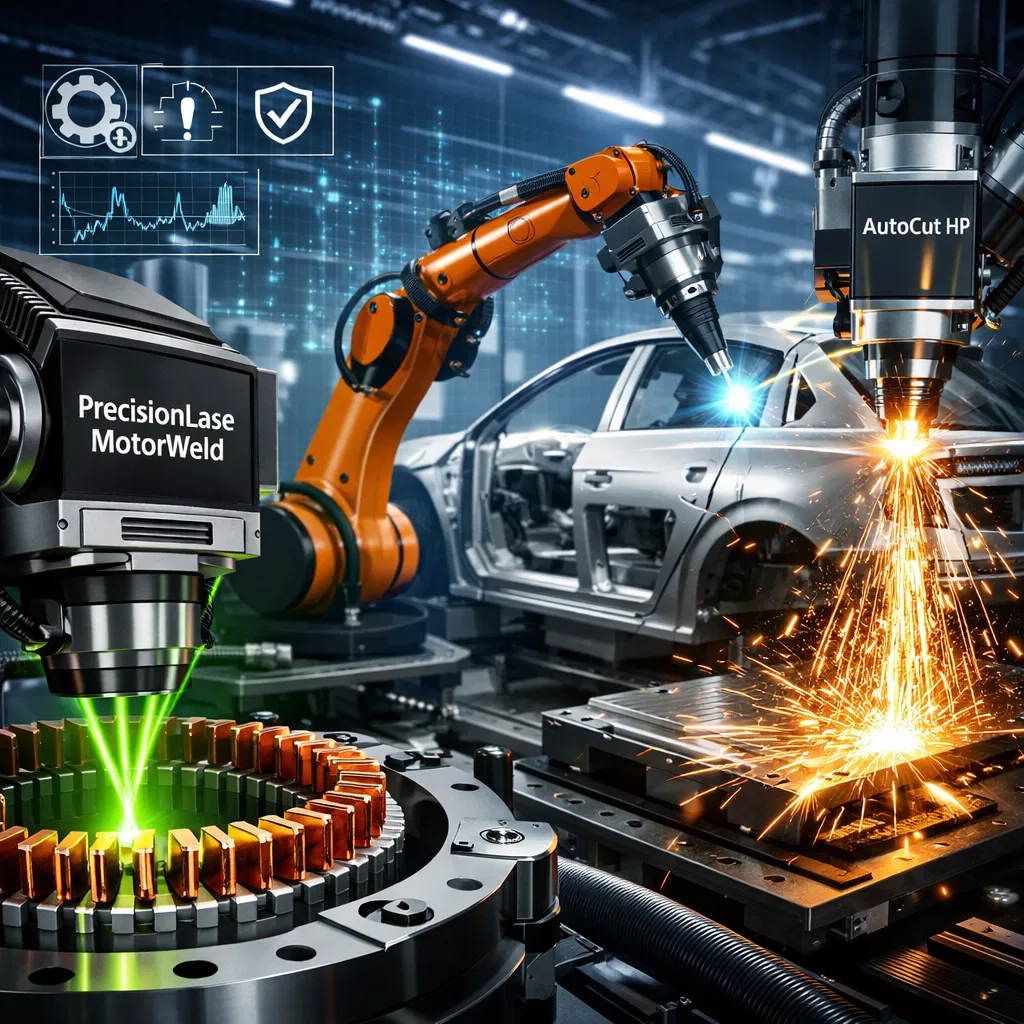
The automotive industry is undergoing its most profound transformation since the assembly line. With global electric vehicle production doubling between 2023 and 2026, manufacturers are racing to scale output while reducing weight, improving safety, and extending range . At the center of this industrial revolution lies laser technology—the only manufacturing process capable of delivering the precision, speed, and flexibility required for modern EV production.
Industry data indicates that laser-based processes now account for over 40% of all joining and cutting operations in EV manufacturing, up from just 15% a decade ago . From the battery cell to the body-in-white structure, lasers are enabling designs and production methods impossible with traditional techniques.
This article explores the key trends shaping laser applications in new energy vehicle manufacturing for 2026, and how PrecisionLase PowerWeld, AutoWeld, and AutoCut series are helping manufacturers achieve new levels of productivity and quality.
The Expanding Role of Lasers in EV Production
Electric vehicles present unique manufacturing challenges that traditional methods struggle to address. The combination of lightweight materials, complex geometries, and stringent safety requirements demands joining and cutting processes that are:
- Non-Contact: Eliminating mechanical stress on delicate components
- High-Speed: Matching the throughput requirements of mass production
- Flexible: Adapting to multiple material combinations and thicknesses
- Precision: Achieving micron-level accuracy for critical safety components
- Monitorable: Providing real-time quality data for process control
Laser technology meets all these requirements, which explains its rapid adoption across the EV production chain. In 2026, we see three distinct application areas driving innovation: battery pack assembly, electric motor manufacturing, and body-in-white construction.
Trend 1: High-Power Laser Cutting for Structural Components
As EV platforms mature, designers are pushing for larger battery packs integrated directly into the vehicle structure. This "cell-to-body" approach requires cutting thick materials—high-strength steel and aluminum alloys up to 20mm thick—with unprecedented precision .
The AutoCut HP Advantage
PrecisionLase developed the AutoCut HP series specifically for these demanding applications. Utilizing ultra-high-power fiber lasers (6kW to 15kW) combined with advanced beam shaping technology, the AutoCut HP system delivers:
- Clean, Dross-Free Edges: Nitrogen-assisted cutting produces oxidation-free surfaces ready for welding without secondary processing
- High-Speed Penetration: Cutting speeds up to 3x faster than plasma or waterjet alternatives
- Material Flexibility: Seamless switching between steel, aluminum, and copper without tooling changes
- Automated Nesting: AI-optimized part layout maximizing material utilization and minimizing waste
For EV manufacturers producing battery enclosure trays, chassis components, and structural cross-members, the AutoCut HP represents a step-change in productivity. One major EV manufacturer reported a 40% reduction in cutting cycle time after replacing plasma cutting with AutoCut HP systems, while eliminating downstream grinding operations entirely.
Trend 2: Copper Hairpin Welding for Electric Motors
The shift to hairpin stator technology has revolutionized electric motor manufacturing. By replacing traditional round wire windings with rectangular copper bars, hairpin designs achieve higher copper fill factors—typically 70% compared to 45% for random windings—resulting in more powerful and efficient motors .
However, welding hairpin ends presents a formidable challenge. The welds must:
- Join multiple copper bars with minimal cross-sectional area
- Exhibit near-zero electrical resistance
- Withstand thermal cycling without fatigue
- Be completed in milliseconds to maintain production throughput
MotorWeld: Green Laser Solution for Copper Joining
Conventional infrared lasers struggle with copper's high reflectivity, leading to inconsistent welds and high scrap rates. PrecisionLase addressed this challenge with the MotorWeld 100 system, featuring:
- Green Laser Technology (532nm): Copper absorption increases from ~5% to ~40%, enabling stable keyhole welding without spatter
- Multi-Kilowatt Power: Sufficient energy for simultaneous welding of multiple hairpin ends in a single cycle
- Real-Time Penetration Monitoring: Integrated OCT sensors verify weld depth for every joint, ensuring electrical integrity
- High-Speed Galvanometric Scanning: Positioning speeds up to 10 m/s minimize cycle times
The MotorWeld system has become the preferred choice for EV motor manufacturers seeking to maximize throughput without compromising quality. One Tier 1 automotive supplier reported throughput increases of 35% while achieving defect rates below 50 parts per million.
Trend 3: Remote Laser Welding for Body-in-White Assembly
Body-in-white (BIW) construction for EVs differs fundamentally from traditional vehicles. Without the need to accommodate an internal combustion engine, designers have greater freedom to optimize structures for battery protection and occupant safety. This has led to increased use of aluminum alloys, tailored blanks, and multi-material hybrid structures .
AutoWeld 3000: High-Speed Remote Welding
Traditional resistance spot welding struggles with aluminum's high conductivity and oxide layer, requiring frequent electrode dressing and resulting in inconsistent weld quality. Remote laser welding offers a compelling alternative.
The PrecisionLase AutoWeld 3000 system delivers:
- Scanning Optics: Welding positions up to 1 meter from the optics, eliminating robot repositioning between welds
- Programmable Beam Shaping: Adjustable spot geometry optimized for different joint configurations
- Real-Time Seam Tracking: Vision-guided positioning compensating for part tolerances
- Multi-Material Capability: Joining steel to aluminum with intermetallic layer control
- Integrated Quality Monitoring: In-process weld penetration verification
Case Study: EV Body Assembly Line Transformation
The Challenge:
A major EV manufacturer needed to increase BIW production capacity by 50% without expanding floor space. Their existing resistance spot welding line required 120 robots and produced 3,500 welds per vehicle body. Cycle time was constrained by electrode dressing requirements and robot repositioning.
The PrecisionLase Solution:
We deployed eight AutoWeld 3000 remote laser welding cells, each equipped with dual scan heads and integrated vision systems. The new configuration:
Reduced Robot Count: Each AutoWeld cell replaced 10-12 spot welding robots
Eliminated Consumables: No electrodes to dress or replace
Increased Weld Speed: Individual weld times reduced from 500ms to 150ms
Improved Quality: Real-time monitoring detected defects immediately, enabling 100% inspection
The Result:
The client achieved a 60% increase in production capacity within the same floor space while improving weld consistency and eliminating electrode-related downtime. The integrated data logging provided complete traceability for every weld on every vehicle.
Comparing Traditional Joining vs. Laser Solutions
| Application | Traditional Method | PrecisionLase Solution | Key Advantage |
|---|---|---|---|
| Thick Plate Cutting | Plasma / Waterjet | AutoCut HP | 3x faster, no secondary finishing |
| Copper Hairpin Welding | Infrared Laser / TIG | MotorWeld 100 | Stable process, 40% copper absorption |
| BIW Assembly | Resistance Spot Welding | AutoWeld 3000 | 60% higher throughput, no consumables |
| Battery Busbar Welding | Ultrasonic / Infrared | PowerWeld-Busbar | Consistent penetration, real-time monitoring |
The Turnkey Advantage: Integration with MES and ERP
In 2026, laser equipment cannot operate as an island. Modern EV manufacturing requires seamless integration between production equipment and higher-level manufacturing systems. PrecisionLase systems are designed from the ground up for Industry 4.0 connectivity.
Real-Time Data Exchange
All PrecisionLase systems feature native interfaces for common MES and ERP platforms. Weld parameters, quality results, and production counts are transmitted in real-time, enabling:
- Statistical Process Control: Automated monitoring of process capability
- Predictive Maintenance: Alerts when components require service before failure
- Full Traceability: Complete genealogy linking every component to its production parameters
- Remote Diagnostics: Factory experts can access systems worldwide for troubleshooting
Turnkey Implementation
Beyond equipment supply, PrecisionLase offers comprehensive integration services. Our team works with your automation partners to ensure seamless communication between robots, conveyors, vision systems, and laser controllers. This turnkey approach—validated in our 15,000 m² Shenzhen facility—reduces implementation risk and accelerates time to production [citation:precisionlase about].
The ROI Advantage: Quantifying the Laser Difference
Manufacturers evaluating laser technology often focus on initial capital investment. However, the total cost of ownership analysis tells a different story. Consider a typical BIW assembly line producing 200,000 vehicles annually:
| Cost Factor | Resistance Spot Welding | AutoWeld 3000 Laser Welding |
|---|---|---|
| Equipment Investment | $8M | $12M |
| Floor Space Required | 8,000 m² | 4,500 m² |
| Robot Count | 120 | 32 |
| Consumables (Annual) | $240,000 | $15,000 |
| Maintenance (Annual) | $180,000 | $95,000 |
| Energy Consumption (Annual) | $320,000 | $210,000 |
| 5-Year Total Cost | $15.2M | $14.1M |
Beyond direct cost savings, laser welding delivers quality improvements that translate to reduced warranty claims and enhanced brand reputation—benefits difficult to quantify but essential for long-term competitiveness.
Innovation Driven by R&D Excellence
PrecisionLase's ability to deliver cutting-edge solutions stems from our commitment to research and development. With 15% of annual revenue reinvested into core laser source and application R&D, we continuously push the boundaries of what's possible [citation:precisionlase about].
Our Shenzhen R&D center houses:
- Metallurgical Laboratories: Analyzing weld microstructure and material properties
- Process Development Cells: Testing new applications before customer deployment
- AI Training Facilities: Developing neural networks for quality prediction
- Reliability Testing Stations: Validating system performance under extreme conditions
This investment ensures that when new materials or battery formats emerge, PrecisionLase has already developed and validated the processes required to manufacture them at scale.
Strategic Partnerships for Future Mobility
The complexity of EV manufacturing demands collaboration across the supply chain. PrecisionLase maintains close working relationships with:
- Material Suppliers: Understanding new alloys and composites before they reach production
- Battery Manufacturers: Developing welding processes for next-generation cell formats (4680, solid-state)
- Automotive OEMs: Integrating laser processes into vehicle design from the earliest stages
- Research Institutions: Exploring fundamental laser-material interactions
These partnerships ensure that our systems evolve in parallel with industry requirements, not in reaction to them.
Conclusion: Lasers as the Enabler of EV Scale
The transition to electric vehicles is not just about changing powertrains—it requires reimagining how vehicles are manufactured. Laser technology has emerged as the critical enabler of this transformation, delivering the speed, precision, and flexibility that EV production demands.
From cutting thick structural components with the AutoCut HP to welding copper hairpins with the MotorWeld 100 and assembling body-in-white structures with the AutoWeld 3000, PrecisionLase provides the comprehensive laser solutions required for every stage of EV manufacturing.
With over 500 customers across 40 countries, ISO 13485 certification, and a 15,000 m² R&D facility driving continuous innovation, PrecisionLase stands ready to partner with manufacturers building the future of mobility [citation:precisionlase about].
Ready to Transform Your EV Production?
Stop compromising between speed, quality, and flexibility. Let PrecisionLase demonstrate how our laser solutions can elevate your manufacturing capabilities.
[Contact our automotive laser experts today] to schedule a process demonstration with your actual components. Experience firsthand why leading EV manufacturers across North America, Europe, and Asia trust PrecisionLase for their most demanding applications.
