
 EN
EN



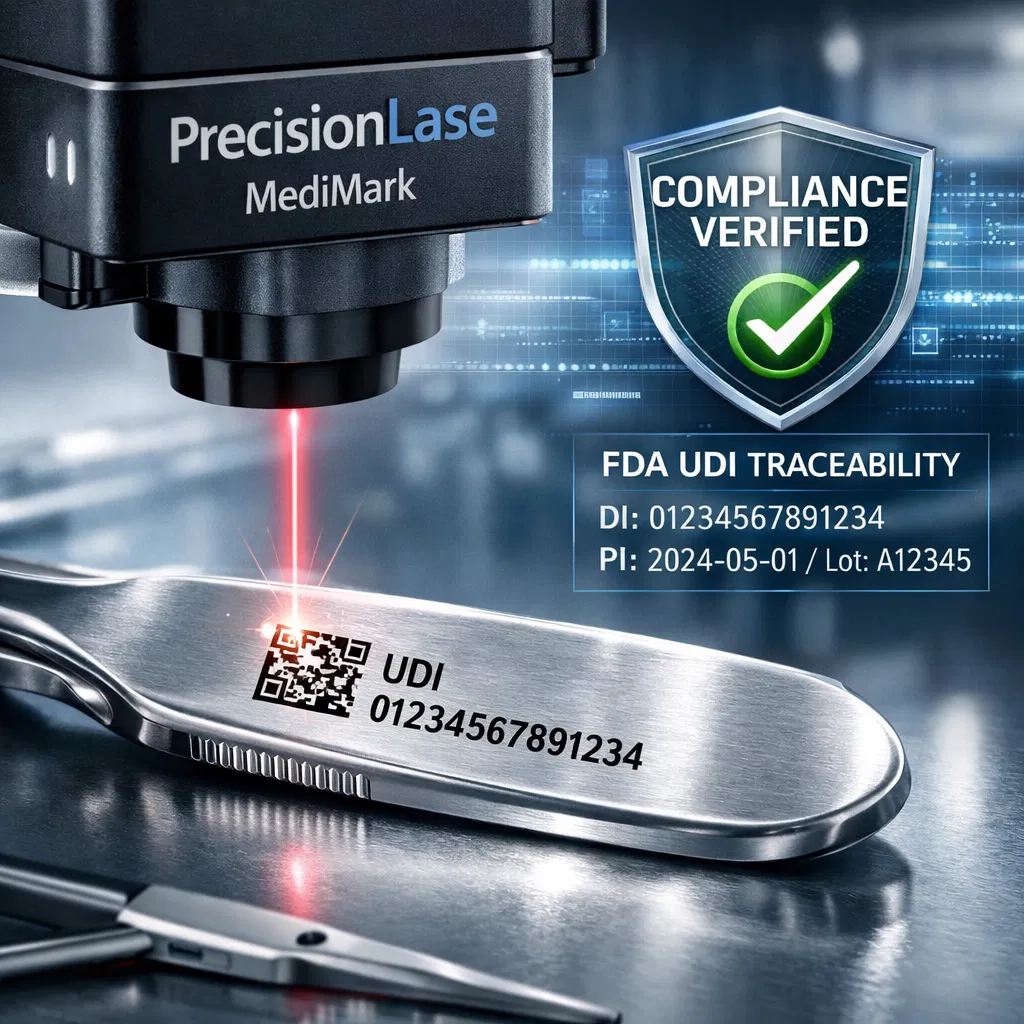
The Unique Device Identification (UDI) system has transformed medical device traceability, but as we move through 2026, the stakes have never been higher. With the FDA's Quality Management System Regulation (QMSR) now fully in effect as of February 2, 2026, manufacturers face renewed scrutiny on labeling controls and validation protocols . Non-compliance carries significant consequences—ranging from shipment detentions to costly product recalls and FDA warning letters that can damage brand reputation for years.
For medical device manufacturers, the marking itself is the foundation of compliance. If the 2D Data Matrix code is not永久, readable, and verified, the entire traceability chain collapses. This article provides a comprehensive guide to FDA UDI compliance for laser marking equipment, detailing the validation processes required to ensure your devices meet 2026 regulatory standards.
The UDI Imperative: Why Laser Marking Has Become the Gold Standard
The FDA's UDI rule requires that each medical device and its packaging bear a unique identifier comprising a Device Identifier (DI) and Production Identifier (PI). This identifier must remain legible throughout the device's intended use and withstand sterilization, cleaning, and handling without degradation .
Traditional marking methods—inkjet printing, adhesive labels, chemical etching—have proven inadequate for this challenge. Ink can smudge or wash off during sterilization. Labels can peel or become illegible. Chemical etching may compromise material integrity or create sites for bacterial colonization.
Laser marking has emerged as the definitive solution for UDI compliance because it offers:
- Permanence: Marks are integral to the material surface, not applied on top of it
- Sterility Compatibility: No inks or chemicals that could contaminate sterile fields
- High Contrast: Readable marks on stainless steel, titanium, and medical-grade polymers
- Micron Precision: Capability to mark tiny implants and curved surfaces
- Process Control: Digital precision enabling full validation and traceability
However, owning a laser marker is not enough. The process of marking must be validated to satisfy FDA requirements and ISO 13485 standards. This is where Installation Qualification (IQ), Operational Qualification (OQ), and Performance Qualification (PQ) become essential.
Understanding Equipment Validation: IQ, OQ, and PQ
In regulated medical device manufacturing, validation is the documented act of proving that any process consistently produces results meeting predetermined specifications. For laser marking equipment, this validation is structured into three distinct phases .
Installation Qualification (IQ): Verifying Proper Setup
IQ establishes that the laser marking system is installed correctly according to manufacturer specifications and regulatory requirements . This phase documents:
- Equipment Identification: Model numbers, serial numbers, and firmware versions
- Installation Environment: Verification that power supplies, cooling systems, and exhaust meet specifications
- Utility Connections: Confirmation of proper electrical, compressed air, and network connections
- Software Installation: Verification that control software is correctly installed and configured
- Safety Systems: Testing of interlocks, emergency stops, and laser safety enclosures
- Documentation Control: Collection of manuals, certificates, and supplier documentation
For PrecisionLase systems, we provide comprehensive IQ documentation packages that streamline this process, ensuring your installation meets both our specifications and FDA expectations.
Operational Qualification (OQ): Demonstrating Functional Performance
OQ demonstrates that the laser marking system operates as intended across its defined operating ranges . This phase involves:
- Parameter Verification: Testing that laser power, frequency, scan speed, and focal position can be set and maintained accurately
- Software Functionality: Validating that control software properly executes marking programs, manages user access, and maintains audit trails
- Safety Feature Testing: Confirming that interlocks, emissions controls, and alarms function correctly
- Communication Protocols: Verifying data exchange with MES or ERP systems for UDI data transfer
- Repeatability Testing: Running multiple marking cycles to demonstrate consistent performance
The OQ phase establishes the equipment's "operating window"—the range of parameters within which it can produce acceptable marks. This window becomes the foundation for process control during production.
Performance Qualification (PQ): Confirming Process Capability
PQ validates that the integrated system—equipment, software, materials, and procedures—consistently produces UDI marks meeting all specifications under actual production conditions . This phase includes:
- Material-Specific Testing: Marking actual device materials (stainless steel, titanium, PEEK, etc.) through their full thickness and geometry ranges
- Sterilization Validation: Subjecting marked samples to representative sterilization cycles (autoclave, EtO, gamma) and verifying mark integrity post-sterilization
- Readability Verification: Testing Data Matrix codes with industry-standard verifiers to ensure Grade B or better per ISO/IEC 15415
- Biocompatibility Confirmation: For implantable devices, verifying that marking does not compromise material biocompatibility per ISO 10993 standards
- Long-Term Durability: Simulating device lifetime handling and cleaning to confirm mark permanence
PQ provides the documented evidence that your marking process is "in control" and capable of producing compliant UDI marks day after day, batch after batch.
The AI Advantage: Self-Calibration and Real-Time Verification
Traditional laser marking validation relies on periodic offline inspection—operators remove samples, check them under microscopes or verifiers, and adjust parameters if problems are found. This approach creates two fundamental problems: defects may be produced between inspection intervals, and manual inspection introduces human error.
PrecisionLase has integrated AI-powered self-calibration into our MediMark series to address these challenges. Our systems feature:
In-Process Vision Verification
Immediately after marking each device, an integrated high-resolution camera captures the UDI code and analyzes it against ISO grading standards. Codes that fall below Grade B trigger an immediate alert, and the system can automatically reject non-compliant parts before they enter the packaging stream .
Real-Time Parameter Adjustment
If the vision system detects degradation in mark quality—perhaps due to minor lens contamination or material variation—the AI controller automatically adjusts laser parameters to restore optimal performance. This closed-loop control maintains process capability without operator intervention.
Predictive Maintenance Alerts
By analyzing trends in mark quality and system performance, the AI predicts when components require cleaning or replacement. Maintenance can be scheduled during planned downtime rather than causing unexpected production interruptions.
This AI integration transforms validation from a periodic documentation exercise into a continuous real-time assurance system. The result is what one Quality Manager described in their review of the MediMark-F20 system:
Meeting Global UDI Requirements: Beyond the FDA
While FDA compliance is often the primary focus for manufacturers selling into the United States, global market access requires understanding multiple UDI frameworks. The European Union's MDR and China's NMPA have implemented their own UDI systems with important differences .
EU MDR UDI Requirements
The European system introduces the concept of Basic UDI-DI—a key identifier used for device registration in EUDAMED that does not appear on the label itself. This differs from the FDA approach and creates potential confusion for manufacturers who assume all UDI systems are identical .
China NMPA UDI Requirements
China's UDI system places particular emphasis on production date visibility, requiring that the manufacturing date appear in YYYY-MM-DD format on the label. For manufacturers accustomed to FDA's more flexible approach, this single requirement can force label redesigns and process changes .
Why Supplier Selection Matters
Navigating these varying requirements demands a marking partner with deep regulatory expertise. PrecisionLase maintains FDA registration, ISO 13485:2016 certification, and CE marking—demonstrating our commitment to understanding and meeting global standards [citation:precisionlase about]. Our systems are designed with the flexibility to accommodate multiple UDI formats and regulatory requirements, ensuring your devices can access markets worldwide without equipment replacement.
The Validation Process: A Step-by-Step Approach
Implementing a validated laser marking process requires systematic planning and execution. Based on our experience working with over 500 customers across 40 countries, PrecisionLase recommends the following approach:
Phase 1: Requirements Definition
- Document your UDI data structure (DI + PI elements)
- Define mark specifications (size, location, contrast, grade requirements)
- Identify all device materials and geometries requiring marking
- Establish sterilization methods and validation requirements
Phase 2: Equipment Selection and IQ
- Select laser technology appropriate for your materials (fiber for metals, UV for polymers)
- Verify proper installation per manufacturer specifications
- Document all installation parameters and configurations
- Establish calibration schedules and procedures
Phase 3: Process Development and OQ
- Define the operating window for each material and mark type
- Test parameter combinations to identify optimal settings
- Verify software functionality and data integration
- Document all operational procedures
Phase 4: Performance Qualification
- Run production-representative batches across multiple shifts
- Verify mark quality pre- and post-sterilization
- Test code readability with industry-standard verifiers
- Document all results in a comprehensive PQ report
Phase 5: Ongoing Monitoring and Maintenance
- Implement routine verification checks (daily/weekly)
- Establish change control procedures for process modifications
- Schedule regular calibration and preventive maintenance
- Maintain complete documentation for regulatory inspections
Common Validation Pitfalls and How to Avoid Them
Even experienced manufacturers encounter challenges during laser marking validation. Here are the most common issues and strategies to prevent them:
Underestimating Material Variability
Device materials can vary between suppliers or even between batches from the same supplier. Your validation should account for this variability by testing materials at the extremes of their specification ranges.
Inadequate Sterilization Testing
Some marks that appear perfect after marking degrade during sterilization. Always validate marks after complete sterilization cycles, not before.
Insufficient Sample Sizes
Statistical confidence requires adequate sample sizes. Work with your quality team to determine appropriate sampling plans based on risk and production volume.
Neglecting Data Integration
The mark is only half the equation. Your UDI data must be correctly transmitted from your ERP or MES to the laser marker. Validate this data flow thoroughly to prevent "correct mark, wrong data" errors .
Conclusion: Compliance Through Partnership
FDA UDI compliance is not a one-time project but an ongoing commitment to quality and traceability. As regulations evolve and global markets demand harmonization, medical device manufacturers need partners who understand both the technology and the regulatory landscape.
PrecisionLase brings together ISO 13485-certified processes, FDA-registered facilities, and AI-powered laser technology to deliver marking solutions that are compliant by design [citation:precisionlase about]. Our MediMark series is engineered specifically for medical device applications, with validation support packages that streamline your regulatory journey.
Whether you are marking surgical instruments, implantable devices, or diagnostic equipment, the right laser marking system—properly validated—provides the foundation for UDI compliance and patient safety.
Ready to Achieve 100% UDI Compliance?
Stop worrying about FDA inspections and recall risks. Let PrecisionLase show you how validated laser marking can transform your traceability process.
[Contact our medical device compliance experts today] to schedule a consultation and demonstration of the MediMark-F20 system. Experience firsthand why leading medical device manufacturers across 40 countries trust PrecisionLase for their most critical marking applications.
