
 EN
EN



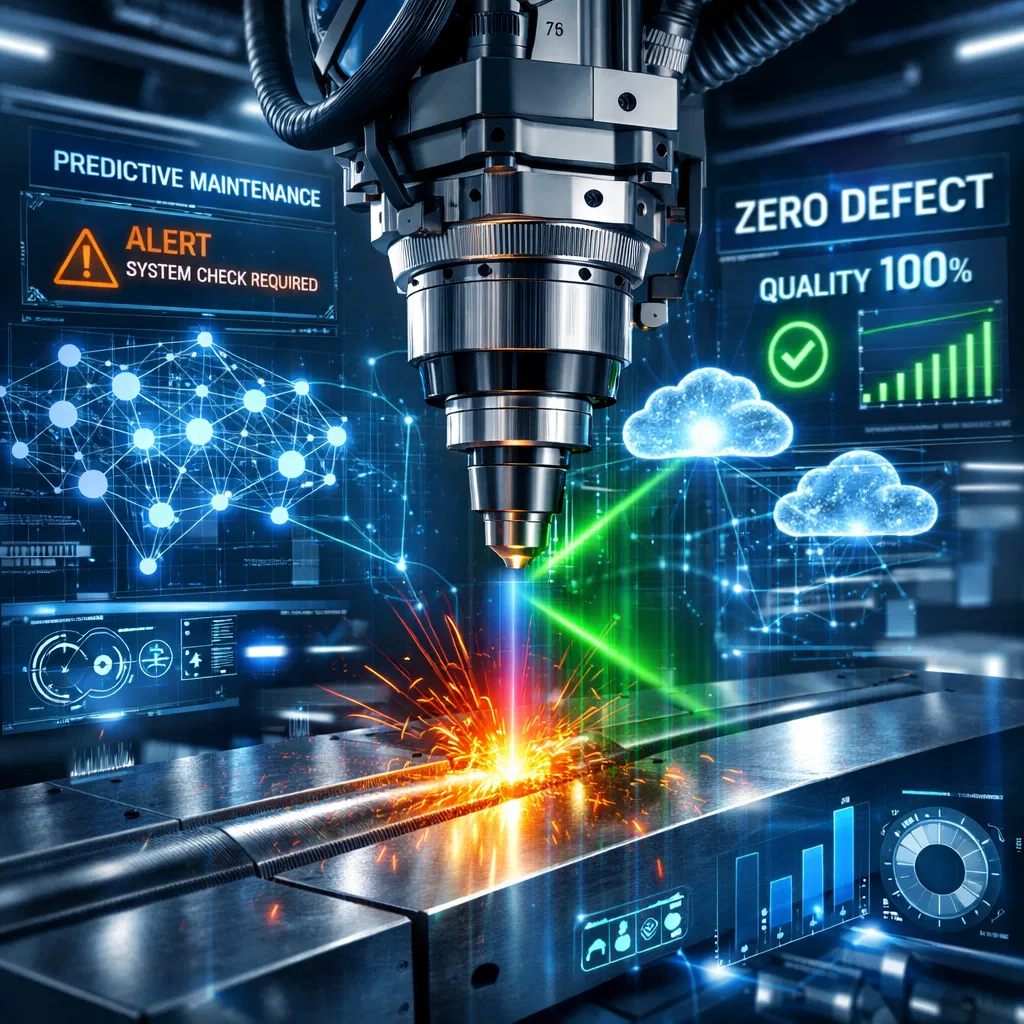
The fourth industrial revolution is no longer a future concept—it is the operating reality for world-class manufacturers. By 2027, the integration of artificial intelligence, real-time monitoring, and cloud-based optimization will separate industry leaders from those struggling to maintain competitiveness. For medical device and electric vehicle battery manufacturers, the stakes are particularly high. Production stoppages measured in minutes can cost millions, while quality deviations can risk patient safety or trigger massive vehicle recalls.
Industry data reveals that manufacturers implementing AI-driven predictive maintenance are achieving up to 40% reduction in unplanned downtime, while those leveraging real-time process monitoring are catching defects before they become finished goods . These advantages compound over time, creating competitive moats that traditional manufacturers cannot cross.
This final article in our series explores the transformative trends shaping laser equipment for 2027 and beyond, and how PrecisionLase's AI-powered systems are helping over 500 customers worldwide future-proof their production operations.
The Intelligence Imperative: Why 2027 Demands Smarter Equipment
The transition to Industry 4.0 is driven by three irreducible market forces:
Force 1: Zero-Defect Expectations
Medical device regulators and automotive OEMs no longer accept statistical defect rates. The expectation is zero defects—not as an aspirational goal but as a contractual requirement. Achieving this demands process control far beyond human capability.
Force 2: Unplanned Downtime Intolerance
In high-volume production, every hour of unplanned downtime represents tens of thousands of dollars in lost output. The 2027 manufacturer cannot afford reactive maintenance; they must predict failures before they occur.
Force 3: Complete Traceability Requirements
Regulators and customers demand full genealogy for every component. This requires equipment that not only performs operations but documents every parameter, every measurement, and every decision in secure, auditable formats.
Traditional laser equipment—dumb machines executing fixed programs—cannot meet these demands. The future belongs to intelligent laser systems that sense, analyze, adapt, and communicate.
Trend 1: Real-Time Melt Pool Monitoring and Closed-Loop Control
Laser welding has long been described as a "black box" process. Operators set parameters based on initial testing, but once production begins, they have limited visibility into what actually happens inside the keyhole. By 2027, this uncertainty will be unacceptable.
Optical Coherence Tomography Integration
PrecisionLase systems now incorporate optical coherence tomography (OCT) —the same technology used in ophthalmology—adapted for industrial welding. OCT measures penetration depth in real-time by analyzing reflected light from the bottom of the keyhole .
This capability transforms welding from an open-loop process to a closed-loop control system. If penetration deviates from the target range, the laser power or scan speed adjusts automatically within milliseconds to correct the weld before it becomes a defect.
Spectroscopic Analysis for Material Identification
Advanced systems also integrate spectroscopic sensors that analyze the plasma plume during welding. Different materials emit characteristic spectral signatures, enabling the system to:
- Verify that the correct materials are being joined
- Detect contamination before it compromises weld integrity
- Identify transition points in multi-material joints
- Provide documentary evidence of material verification for regulatory compliance
Trend 2: Cloud-Based Parameter Optimization
The most sophisticated laser system is limited by the knowledge of its programmers. No single engineer can anticipate every material variation, every joint configuration, or every environmental condition that might affect weld quality. This is where cloud-based optimization becomes transformative.
Collective Learning Across Installations
PrecisionLase's CloudConnect platform aggregates anonymized process data from hundreds of installations worldwide—with customer permission, of course. Machine learning algorithms analyze this data to identify correlations invisible to human analysis:
- Which parameter combinations produce the most consistent welds for specific material batches
- How environmental factors (humidity, temperature) affect process stability
- What early indicators predict eventual equipment failure
- Which process variations correlate with field performance
Continuous Improvement Without Disruption
The insights derived from cloud analytics are translated into optimized parameter sets delivered back to individual systems. A welding cell in Germany might receive updated parameters based on learnings from a similar application in Japan—without requiring local engineers to reinvent the process.
This collective intelligence means that every PrecisionLase customer benefits from the accumulated experience of our entire installed base. As we often tell customers: "When you buy a PrecisionLase system, you get 500+ customers' worth of process knowledge."
Trend 3: Predictive Maintenance and Remote Diagnostics
Equipment downtime is the enemy of throughput. Traditional maintenance approaches—run-to-failure or fixed-interval servicing—are either too risky or too wasteful. By 2027, predictive maintenance will be standard.
Vibration and Thermal Monitoring
PrecisionLase systems embed sensors throughout critical subsystems:
- Galvanometer scanners monitored for bearing wear and mirror degradation
- Laser sources analyzed for power stability and diode degradation
- Cooling systems tracked for flow rate and temperature consistency
- Optics monitored for contamination and transmission efficiency
AI-Powered Failure Prediction
Machine learning models analyze sensor data continuously, comparing current readings against historical patterns. When the system detects early indicators of impending failure—a slight increase in scanner vibration, a minor reduction in cooling efficiency—it generates alerts with specific recommendations:
- "Scanner bearing replacement recommended within 200 operating hours"
- "Coolant filter change required; schedule maintenance before Friday shift"
- "Optics contamination detected; cleaning recommended to maintain edge quality"
24/7 Global Support Infrastructure
Predictive maintenance is most valuable when combined with responsive support. PrecisionLase maintains regional service centers in the United States, Germany, and Japan, providing 24/7 technical support and remote diagnostics [citation:precisionlase about]. When a system generates an alert, our engineers can access it remotely—with customer permission—to verify the diagnosis and coordinate parts delivery before the scheduled maintenance window.
Case Study: AI Quality Inspection in Action
The Challenge:
A leading medical device manufacturer producing implantable components needed to verify laser marking quality on 100% of parts. Manual inspection under microscopes was slow, error-prone, and caused operator fatigue. Sampling inspection risked shipping non-compliant devices.
The PrecisionLase Solution:
We integrated our AI-powered vision inspection system directly into the MediMark-F20 laser marker. The system:
Learns Good Parts: During validation, engineers presented the system with representative samples of acceptable marks. The AI analyzed these images to understand the range of acceptable variation—contrast, edge definition, Data Matrix grade.
Inspects in Real-Time: Immediately after marking, the integrated camera captures an image of each code. The AI compares this image against its learned model, flagging any deviation for rejection.
Adapts to Variation: Unlike fixed-threshold vision systems, the AI accommodates normal process variation. It distinguishes between acceptable cosmetic differences and actual defects that compromise readability.
Provides Full Documentation: Every inspection result is logged with the corresponding part serial number, creating complete traceability for regulatory audits.
The Result:
The client achieved 100% inspection coverage without adding inspection headcount. Defective parts are caught and rejected automatically, while the system's adaptive algorithms reduced false rejects by 60% compared to their previous vision system. As their Regulatory Compliance Lead noted:
Comparing Traditional vs. AI-Enabled Laser Systems
| Capability | Traditional Laser System | PrecisionLase AI-Enabled System |
|---|---|---|
| Process Monitoring | Post-process inspection | Real-time OCT + spectroscopy |
| Quality Control | Sampling with offline verification | 100% inline inspection |
| Maintenance | Fixed schedule or run-to-failure | Predictive with remote diagnostics |
| Parameter Optimization | Manual trial and error | Cloud-based collective learning |
| Data Integration | Manual logging or separate systems | Native MES/ERP connectivity |
| Adaptability | Fixed programs | Self-optimizing based on feedback |
The Path to Industry 4.0: A Practical Roadmap
Transitioning to AI-enabled manufacturing does not happen overnight. Based on our experience helping over 500 customers across 40 countries upgrade their capabilities, PrecisionLase recommends a phased approach:
Phase 1: Foundation (2026-2027)
- Connect Existing Equipment: Implement data collection from current systems to establish baselines
- Standardize Processes: Document current best practices and parameter sets
- Train Teams: Build internal capability in data analysis and process optimization
- Pilot AI Inspection: Deploy AI vision on one critical application to demonstrate value
Phase 2: Integration (2027-2028)
- Implement Real-Time Monitoring: Deploy OCT and spectroscopic sensors on new equipment
- Connect to MES: Ensure seamless data flow between production equipment and higher-level systems
- Establish Predictive Maintenance: Begin condition-based monitoring of critical assets
- Expand AI Applications: Move from inspection to process control
Phase 3: Optimization (2028 and Beyond)
- Leverage Cloud Analytics: Participate in collective learning networks
- Implement Closed-Loop Control: Enable systems to self-optimize based on feedback
- Develop Digital Twins: Create virtual representations of production processes for simulation and optimization
- Achieve Autonomous Operation: Systems that monitor, adjust, and document with minimal human intervention
Why Partnership Matters: Selecting Your Industry 4.0 Ally
The transition to intelligent manufacturing requires more than equipment—it demands a partner with deep expertise in both laser technology and digital integration. PrecisionLase brings together:
R&D Excellence
With 15% of annual revenue reinvested into core laser source and application R&D, we continuously push the boundaries of what's possible [citation:precisionlase about]. Our Shenzhen facility houses dedicated AI training laboratories where neural networks are developed and validated.
Industry Expertise
We serve over 500 customers across medical device manufacturing, EV battery production, and precision manufacturing [citation:precisionlase about]. This breadth of experience means we understand the unique challenges of regulated industries and high-volume production.
Global Support Infrastructure
Industry 4.0 equipment requires responsive support. Our regional service centers in the United States, Germany, and Japan provide 24/7 technical support, ensuring that when you need help, you get it—wherever you are located [citation:precisionlase about].
Commitment to Open Standards
Unlike proprietary systems that lock customers into specific platforms, PrecisionLase equipment supports open communication standards (OPC UA, MTConnect) and provides APIs for custom integration. Your data belongs to you, and we make it accessible.
Conclusion: The Future Is Intelligent
The transition to Industry 4.0 is not optional for manufacturers serving medical and EV markets. By 2027, the expectations for quality, traceability, and uptime will exceed what traditional equipment can deliver. The only path forward is intelligent laser systems that sense, analyze, adapt, and communicate.
PrecisionLase has been preparing for this future since our founding in 2015. From our first fiber laser marking machine designed for medical device traceability to today's AI-powered welding and cutting systems, we have consistently invested in the technologies that matter most to our customers [citation:precisionlase about].
Our ISO 13485 certification and FDA registration demonstrate our commitment to regulatory compliance. Our 15,000 m² R&D facility ensures continuous innovation. Our global service network provides peace of mind. And our AI-enabled systems deliver the performance that 2027 will demand.
Ready to Future-Proof Your Production?
The future of manufacturing is intelligent, connected, and adaptive. Let PrecisionLase show you how AI-powered laser systems can transform your operations.
[Contact our Industry 4.0 specialists today] to schedule a consultation and demonstration. Experience firsthand why leading manufacturers across 40 countries trust PrecisionLase as their strategic partner for the fourth industrial revolution.
