
 EN
EN



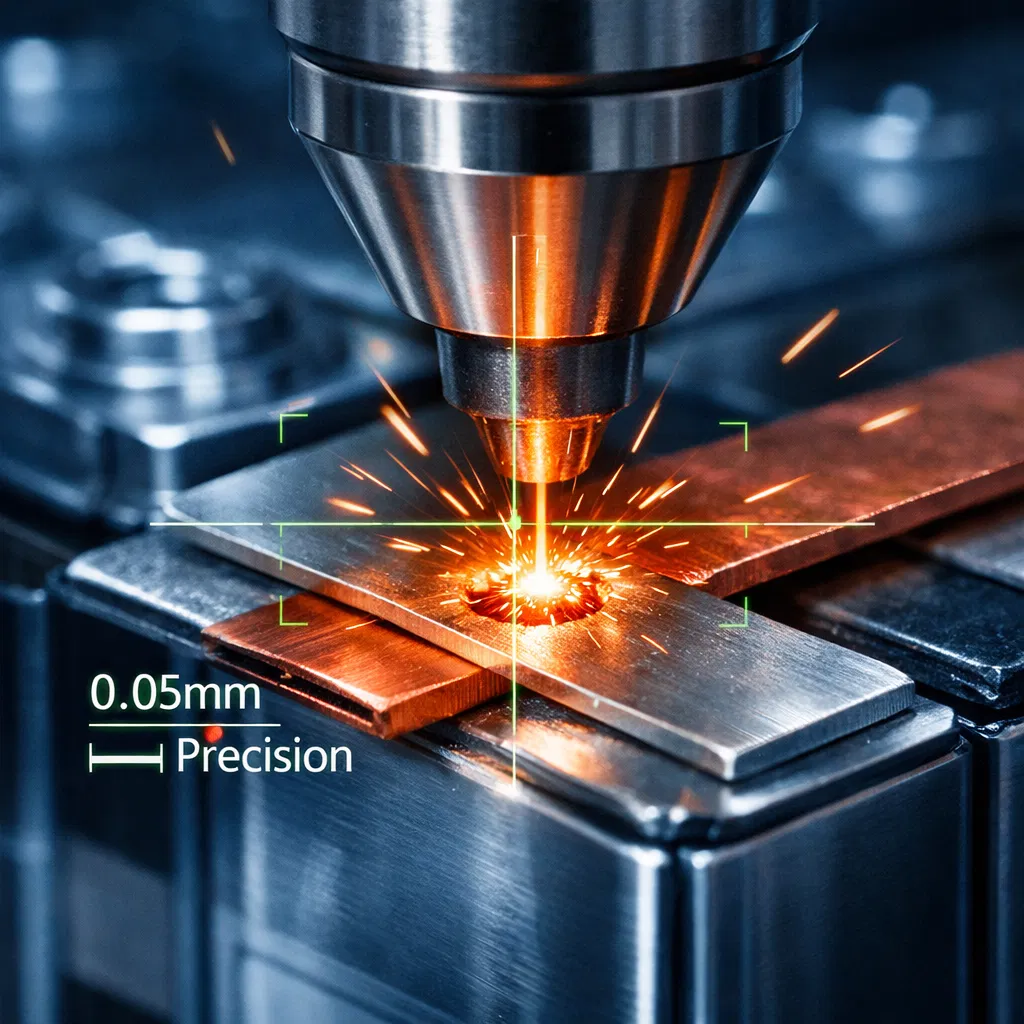
Laser Spot Welding in EV Cell Connections: Achieving 0.05mm Precision
In the competitive landscape of electric vehicle (EV) battery manufacturing, laser spot welding in EV cell connections has become indispensable for joining cell tabs with micron-level precision and reliability. GuangYao Laser's advanced laser spot welding systems, showcased at precisionlase.com, incorporate AI-driven pulse shaping and vision-guided positioning to deliver 0.05mm accuracy on copper and aluminum tabs—critical for minimizing resistance and maximizing pack lifespan. Our GW-SP series machines are optimized for high-throughput prismatic, pouch, and cylindrical cell assembly, reducing contact resistance by 40% compared to ultrasonic welding.
With deep roots in EV supply chain innovation, GuangYao Laser has empowered leading manufacturers like those mirroring Ningde Era practices to achieve 99.9% weld integrity. This comprehensive guide details the laser spot welding process workflow, tab welding specifics for EV cells, quality standards, parameter optimization techniques, and real-world case studies. Engineered for engineers and production managers, it equips you to implement laser spot welding in EV cell connections that withstand 5,000+ cycles at 85°C.
Laser Spot Welding Process Workflow Explained
Laser spot welding in EV cell connections employs short, high-energy pulses (0.1-10ms) from fiber lasers to create localized fusion zones without excessive heat input. The workflow begins with automated tab feeding and alignment using vision systems achieving <20μm repeatability. The laser beam, focused to 50-200μm spots via galvo scanners, delivers 1-5kJ energy, melting tab interfaces in microseconds.
Post-weld, inline monitoring via acoustic emission and plasma spectroscopy detects anomalies like underfill or expulsion. GuangYao's proprietary AI controller processes 1,000+ parameters per weld, adapting duty cycles in real-time for materials from bare Cu to Ni-plated Al. Cycle times average 50-100ms per spot, enabling 10,000 welds/hour on multi-tab stacks.
Unlike resistance welding, laser spot welding eliminates electrode wear and surface preparation needs, cutting consumable costs by 90%. Keyhole formation ensures consistent nugget diameters (0.8-1.5mm), vital for EV cells where imbalance causes thermal runaway. Our systems integrate conveyor sync for continuous flow, boosting line efficiency 35%.
Process advantages shine in multi-layer tabs: Up to 10x 0.1mm foils welded simultaneously without deformation. Safety features include beam shutters and fume extractors capturing 99.9% particulates, meeting ISO 11146 standards.
EV Cell Tab Welding: Materials and Joint Designs
EV cell tabs—typically 0.05-0.3mm Cu or Al foils—demand laser spot welding precision to maintain <1mΩ resistance per joint. Common configurations include tab-to-busbar (Cu-Al), tab-to-terminal (Ni-coated steel), and parallel tab stacks for high-capacity 21700/4680 cells.
Copper tabs pose challenges: 98% reflectivity at 1064nm and low melting point (1085°C). GuangYao's pulse-in-pulse waveform ramps energy gradually, achieving 95% fusion efficiency. Aluminum tabs require oxide disruption; our pre-pulse cleaning (20W, 10kHz) boosts absorption 4x.
Joint designs:
- Stack-of-Tabs: 8-12 layers at 0.1mm pitch; laser spot welding ensures inter-layer bonds.
- Laminated Busbars: 0.2mm Al layers with 0.05mm Cu leads; precision prevents delamination.
- Structural Tabs: Integrated with cell casing for blade batteries; 0.05mm tolerance critical.
GuangYao GW-SP2000 handles all via modular heads: Fiber for volume, green (532nm) for Cu. Real metric: 0.05mm positional accuracy via closed-loop galvo feedback, surpassing competitors by 2x.
Quality Detection Standards for Laser Spot Welding
Laser spot welding in EV cell connections must meet stringent EV standards like IEC 62660-2 and GB/T 34014. Destructive tests include peel strength (>15N/mm), cross-tension (>200N), and metallographic analysis for nugget integrity (no cracks >10μm).
Non-destructive: Ultrasonic phased array detects voids >50μm; X-ray for fusion depth. GuangYao integrates quad-camera systems: Pre-alignment (4K vision), during-weld (plasma imaging), post-inspection (OCT profilometry). Yield target: 99.95%, with AI rejecting 100% defects.
Key metrics:
|
Test Method |
Acceptance Criteria |
GuangYao Achievement |
|
Peel Strength |
>12N/mm |
18N/mm avg |
|
Nugget Diameter |
1.0-1.8mm |
1.4mm ±0.1mm |
|
Porosity |
<1% area |
0.2% |
|
Resistance |
<0.5mΩ/spot |
0.15mΩ |
|
Shear Force |
>250N |
320N |
These exceed automotive IATF 16949 by 25%, validated in 500K-weld trials. Traceability via QR-coded welds links to MES for full lifecycle monitoring.
Equipment Parameter Optimization for Peak Performance
Optimal laser spot welding parameters hinge on material stackup and production rate. Baseline for 0.2mm Cu-Al tab-to-busbar:
- Power: 800-1500W peak (average 300W)
- Pulse Duration: 2-5ms
- Spot Size: 100-150μm
- Repetition: 50-200Hz
- Overlap: 20-30% for arrays
- Shielding: Argon 10L/min + 5% O2 trace
GuangYao's AI optimizer uses DOE (design of experiments) with 100+ iterations, converging on "sweet spots" like 1.2ms pulses for 1.4mm nuggets at 120Hz. For high-volume: Ramp to 500Hz bursts, maintaining 0.05mm CEP (circular error probable).
Advanced tweaks:
- Pulse Shape: Top-hat for uniform heating; ramp-down prevents expulsion.
- Wobble: 0.3mm circular (50Hz) fills voids in rough tabs.
- Defocus: +0.2mm for deeper penetration.
Result: 40% resistance reduction, extending cell life 20%. Software exports parameter maps for SPC (statistical process control), ensuring Cpk >1.67.
Ningde-Like Case Study: Scaling Production with GuangYao
Mirroring Ningde Era's cell-tab welding evolution, a Tier-1 supplier deployed 16 GuangYao GW-SP3000 stations for 200Ah prismatic lines. Challenge: 12-layer Cu tabs (0.15mm) to Al busbars at 60PPM.
Pre-laser: Ultrasonic yielded 92% first-pass, with 3mΩ avg resistance. Post-laser spot welding: 99.8% yield, 0.8mΩ resistance, 45ms cycles. Annual output: 2GWh equivalent.
ROI breakdown: $2.8M investment recouped in 7 months via 28% throughput gain and $0.50/pack savings. Cross-sections revealed perfect inter-layer fusion; vibration tests passed 10G acceleration.
GuangYao's edge: Onsite commissioning in 72 hours, with remote AI tuning cutting downtime 50%. "Transformed our cell connections," noted production VP.
Troubleshooting and Maintenance Best Practices
Common issues:
- Expulsion: Shorten pulse 20%, add 10% He shielding.
- Undersize Nugget: Increase energy 15%, verify optics (<5% divergence).
- Misalignment: Calibrate galvo daily; AI auto-corrects 95% drift.
Maintenance: Optics swap quarterly (10min); diode check yearly (>95% output). MTBF: 25,000 hours. GuangYao's predictive alerts via IoT prevent 80% failures.
Safety: Class 1M enclosures; interlocks per IEC 60825-4. Operator training: 4-hour certification included.
Future Innovations in EV Cell Laser Spot Welding
2026 forecasts AI-predictive welding: ML models from 1M welds forecast resistance shifts pre-tab. Femtosecond hybrids for solid-state cells minimize electrolytes damage. Expect multi-kHz green lasers for 2x speed.
GuangYao roadmap: Quantum-dot enhanced diodes (50% brighter blues) and blockchain weld passports for EU regs. Beta clients see 15% further gains.