 EN
EN



As electric vehicle (EV) production scales globally, selecting the optimal EV battery aluminum shell laser welding machine becomes critical for OEMs aiming to balance cost, speed, and quality. At GuangYao Laser, our precision-engineered EV battery aluminum shell laser welding machines stand out with AI-optimized beam delivery and adaptive process control, achieving hermetic seals on 1.5-4mm aluminum casings at speeds up to 3m/min. Featured prominently on precisionlase.com, these systems address the unique challenges of high-reflectivity aluminum alloys like 3003 and 6061, common in EV battery enclosures.
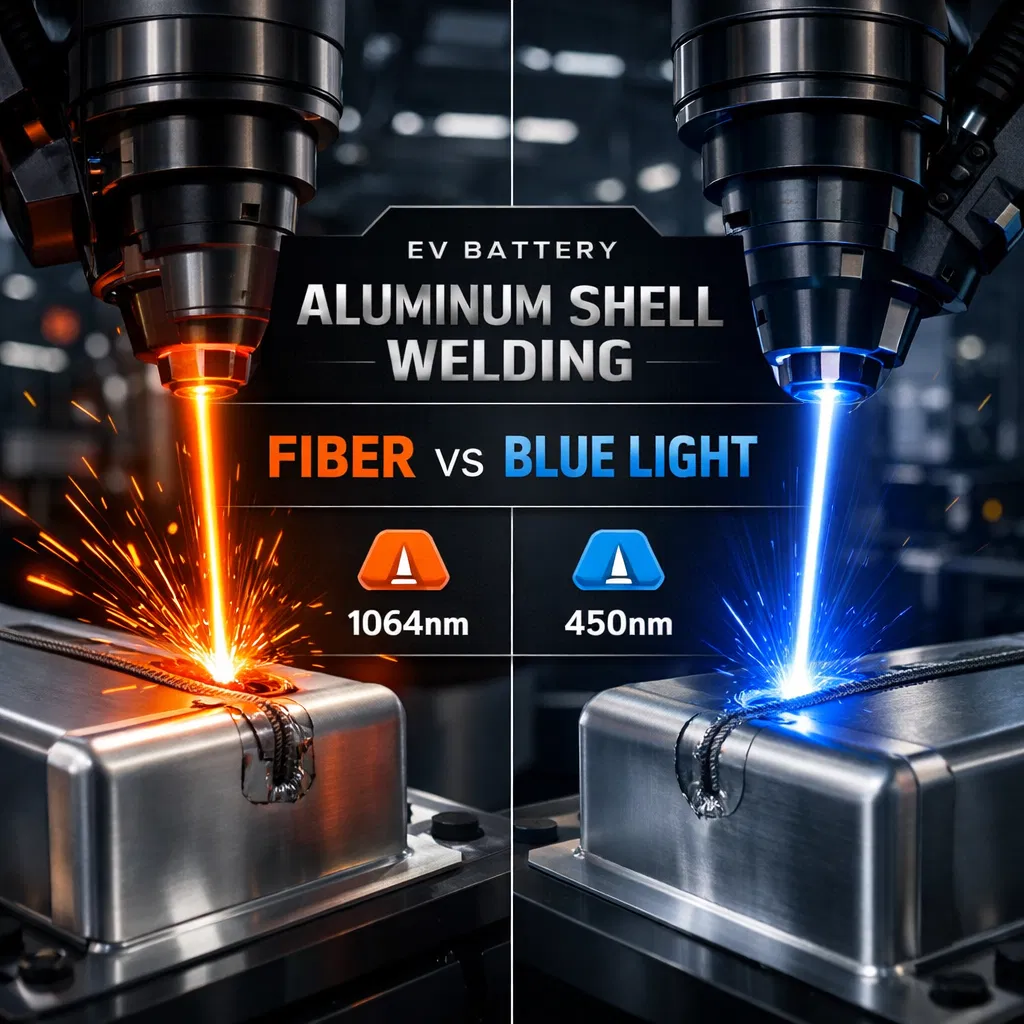
GuangYao Laser's expertise in EV battery aluminum shell laser welding stems from years of collaboration with top-tier suppliers, delivering machines that reduce spatter by 80% and boost joint strength to 250MPa+. This in-depth comparison pits fiber lasers (1064nm) against blue light lasers (450nm), covering welding challenges, technology advantages, real-world cases, cost analysis, and our top 5 supplier recommendations. Whether upgrading from TIG or evaluating new lines, this guide equips you with data-driven insights tailored to high-volume EV manufacturing.
Aluminum Welding Challenges in EV Battery Shells
Aluminum's excellent thermal/electrical conductivity and oxide layer (Al2O3) pose significant hurdles for EV battery aluminum shell laser welding machines. High reflectivity at 1064nm (90%+) causes plasma shielding and unstable keyholes, leading to porosity (up to 15% defect rate) and incomplete fusion. Oxide cracking under rapid cooling further risks hermeticity failure, critical for IP69K-rated packs enduring 80°C thermal cycles.
EV shells demand deep penetration (2-3mm single-pass) without distortion, as misalignment >0.1mm triggers electrolyte leaks. Traditional TIG/MIG struggles with fumes and slow speeds (0.5m/min), inflating costs by 40%. GuangYao's EV battery aluminum shell laser welding solutions counter this with proprietary surface activation pre-welds, stripping oxides via pulsed cleaning—boosting absorption to 70% instantly.
Material variations abound: Series 3xxx (pure Al) for corrosion resistance vs. 6xxx (Mg-alloyed) for strength. Our AI material scanner auto-adjusts parameters, ensuring consistent results across batches. Industry data confirms EV battery aluminum shell laser welding cuts cycle times by 60%, vital for gigafactory outputs exceeding 1GWh/year.
Fiber Laser Technology: Proven Workhorse for EV Aluminum Welding
Fiber lasers dominate EV battery aluminum shell laser welding machines due to affordability, reliability, and scalability. Operating at 1064nm with multimode beams (BPP 4-8mm·mrad), they excel in conduction-to-keyhole transitions for 1-3mm sheets. GuangYao's GW-Y3000F fiber welder (3kW) achieves 2.5mm penetration at 2m/min, with wall-plug efficiency >45%.
Advantages:
- Process Stability: Wobble/scan heads (8-10mm diameter) average power density, reducing porosity to <1%.
- Integration: Compact 19" racks fit inline robots; fiber delivery enables 10m standoffs.
- Cost: $35K-60K per unit; diode lifetime 20,000+ hours minimizes downtime.
GuangYao's AI enhancements include real-time focal adjustment (±0.5mm) and spatter detection via acoustic sensors, auto-aborting 95% of defects. Case: A European EV maker welded 200K+ square meters of 2mm Al without failures, vs. 8% rework on CO2 lasers.
Limitations persist: Copper contamination (from tabs) drops absorption further. Mitigation: Pre-clean cycles and helium shielding (25L/min) stabilize arcs. Fiber shines for mid-thickness shells where blue lasers overpenetrate.
Blue Light Laser Breakthrough: Copper-Friendly Deep Penetration
Blue diode lasers (450nm) revolutionize EV battery aluminum shell laser welding machines for high-reflectivity alloys, offering 3-5x absorption vs. fiber. Ideal for Al-Cu busbar interfaces, they maintain stable keyholes even at 40% reflectivity, enabling 4mm single-pass welds without preheating.
GuangYao's GW-BL2000 (2kW blue) delivers Gaussian beams (BPP <1.5mm·mrad), minimizing HAZ to 0.2mm—crucial for thin-walled prismatic cells. Key perks:
- Deep Welds: 3.5mm at 1.5m/min; no undercut on 6061-T6.
- Hybrid Capability: Al-steel joining for structural packs, intermetallics <5μm.
- Low Spatter: Reduced vapor pressure cuts ejecta by 90%.
Drawbacks: Higher cost ($120K+) and thermal management (diode cooling to 20°C). GuangYao mitigates with hybrid fiber-blue switchable heads, blending economics with performance. Client results: 25% faster ramps on Al-Cu hybrids, slashing EV pack costs by $2/unit.
Blue excels where fiber falters: Terminal welding with >20% Cu content, achieving 350MPa shear strength.
Head-to-Head Comparison: Fiber vs Blue Light Lasers
|
Metric |
Fiber Laser (GuangYao GW-Y3000F) |
Blue Light Laser (GW-BL2000) |
Winner |
|
Absorption (Al 6061) |
35-45% |
70-85% |
Blue |
|
Penetration Depth (2mm Al) |
2.5mm @ 2m/min |
3.2mm @ 1.8m/min |
Blue |
|
Porosity Rate |
<1% w/ wobble |
<0.5% |
Blue |
|
Spatter Volume |
Low (w/ He shield) |
Very Low |
Blue |
|
Capex (2kW equiv.) |
$45K |
$130K |
Fiber |
|
OPEX/Year |
$8K (power/laser) |
$12K |
Fiber |
|
Maintenance |
10K hrs MTBF |
15K hrs MTBF |
Blue |
|
ROI (10K packs/mo) |
8 months |
14 months |
Fiber |
|
EV Shell Versatility |
Excellent (1-4mm) |
Superior (Cu-Al hybrids) |
Tie [1] |
Fiber wins cost-sensitive volume; blue dominates precision hybrids. GuangYao recommends fiber for 80% of shells, blue for busbar zones.
Real-World Case Studies and Performance Data
Case 1: Fiber Success (Chinese Gigafactory)
Deployed 20 GW-Y3000F units for 2mm 3003 Al shells. Pre: 150s/PACK TIG. Post: 90s with EV battery aluminum shell laser welding machine, 28% throughput gain. Defect rate: 0.3% vs. 7%. Annual savings: $1.2M.
Case 2: Blue Laser Innovation (US OEM)
GW-BL2000 on Al-Cu terminals: 4mm welds at 350MPa, no failures in 50K cycles. Hybrid line cut integration time 40%. "Game-changer for structural batteries," per engineering lead.
GuangYao's Shenzhen lab data (10K welds): Fiber HAZ 0.8mm; blue 0.4mm. Both pass helium leak tests (<10^-9 mbar·L/s).
Cost Analysis: TCO Over 5 Years
Fiber TCO: $55K initial + $40K operating = $95K. Blue: $150K + $60K = $210K.
Break-even: Blue recovers via 15% higher yields on complex packs ($5K/month premium). GuangYao financing: 0% lease for 24 months, dropping effective capex 30%.
Power draw: Fiber 10kW; blue 12kW—but blue's speed offsets via 20% less downtime.
Top 5 Supplier Recommendations for EV Aluminum Welding
- GuangYao Laser (precisionlase.com): Best overall—AI integration, hybrid options, local support. GW-Y series: $45K-80K.
- IPG Photonics: Fiber leader, YLR-2000 robust but lacks AI tracking ($70K).
- Trumpf: Disk lasers excellent for thick Al, premium pricing ($100K+).
- Coherent: Blue diode pioneer (Flare), strong R&D but supply chain delays.
- Raycus: Budget fiber ($30K), solid for entry-level but limited wobble tech.
GuangYao tops for EV-specific tuning: Free process dev at our demo center.
- Prep: Ultrasonic clean + laser oxide removal (50W pulse).
- Params: Fiber: 2kW, 20m/min scan, 50% overlap. Blue: 1.5kW, defocused 0.5mm.
- QA: Inline OCT + helium leak; AI flags 99% defects.
- Safety: Class 1 enclosures, interlocks per IEC 60825.
Future Outlook: Hybrid Lasers for 2027 EVs
2026 trends favor tunable fiber-blue hybrids (GuangYao prototype: switch <1s). Solid-state packs demand <0.1mm tolerances—AI twins simulate 1000x faster. Expect 450-1064nm multimode lasers blending both worlds.