 EN
EN



The 2026 National Standard: Core Requirements and Technical Scope of Laser Safety Certification
Heightened laser safety certification demands under the 2026 framework mandate rigorous technical validation across all industrial and medical applications.
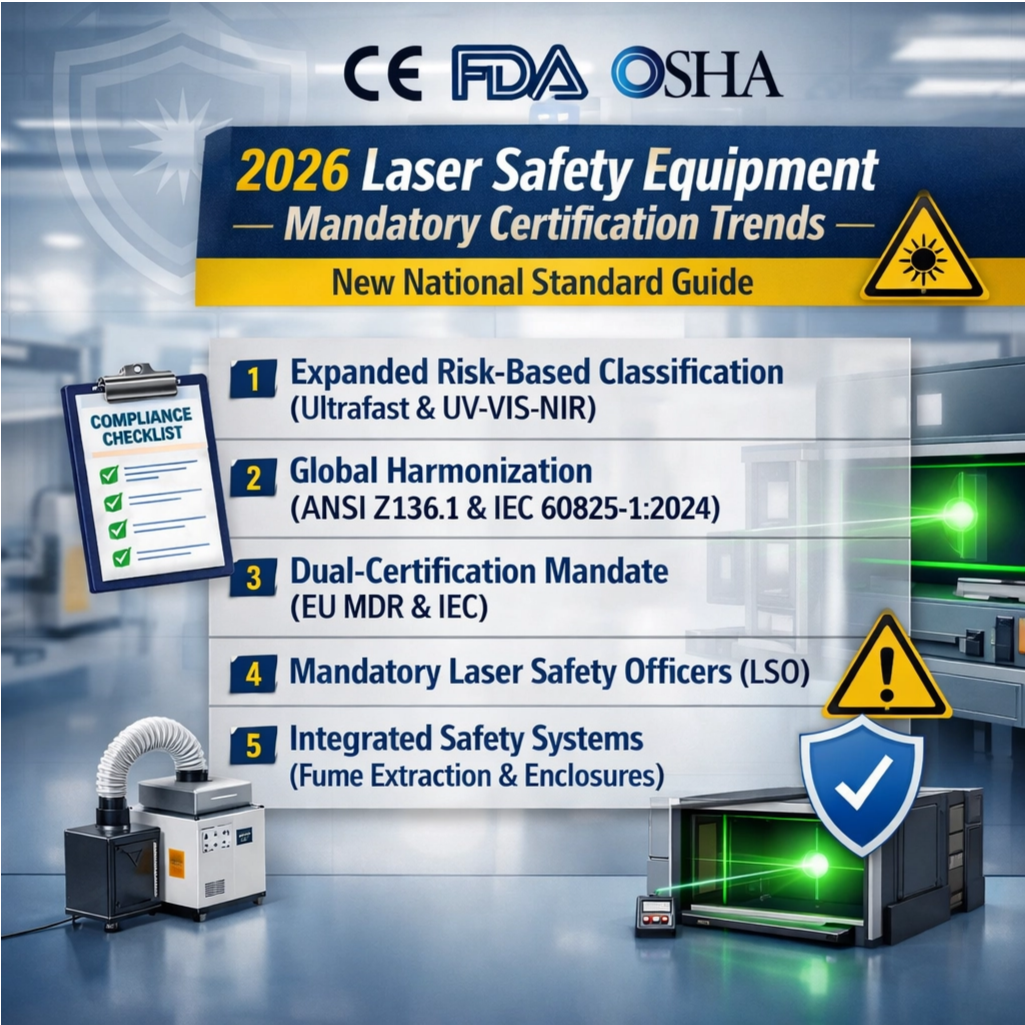
Expanded Risk-Based Laser Classification (Including Ultrafast & UV-VIS-NIR Hybrid Systems)
The new laser classification system looks at things like wavelength ranges (think ultraviolet, visible light, and near infrared), how long each pulse lasts, and the actual energy output from the beam. Systems that fire pulses under one picosecond get special attention during safety checks since they pose different dangers altogether. What's changed compared to older versions? Well, manufacturers now have to worry about those hidden risks too - stuff like unexpected plasma radiation when materials break down, or dangerous vapors coming off heated surfaces. This means testing isn't just about blocking light anymore; companies need proper protection against both what comes out of the laser itself and whatever gets released into the air around it. Looking at industry numbers, about a quarter of mixed wavelength systems couldn't pass basic compliance tests last year because their ventilation wasn't good enough. Makes sense why experts keep pushing for better overall risk analysis these days.
Harmonization with ANSI Z136.1 and IEC 60825-1:2024: Key Alignment Points
Core technical requirements are now fully harmonized across North American and international frameworks specifically ANSI Z136.1 and IEC 60825-1:2024 to eliminate conflicting interpretations and streamline global compliance. Critical alignment points include:
- Unified Class 4 enclosure specifications, mandating dual interlock redundancy and full beam path containment
- Standardized maximum permissible exposure (MPE) calculations for pulsed and ultrafast operations
- Identical documentation templates for safety audits and regulatory submissions
This convergence reduces duplication in testing and reporting while strengthening enforcement consistency across jurisdictions.
Global Jurisdictional Alignment: CE, FDA, and OSHA Requirements for Laser Safety Certification
EU MDR + IEC 60825-1:2024 Dual-Certification Mandate for Laser Equipment OEMs
For laser equipment makers looking at the European market these days, there's this new dual certification thing they need to handle. They have to comply with both the EU Medical Device Regulation (MDR) and the latest IEC 60825-1:2024 standards. What does this mean? Well, companies are now required to do thorough checks on emission levels, establish proper risk management protocols, and prepare detailed technical docs. The paperwork includes biocompatibility tests specifically for medical grade lasers, plus EMC validation following EN 55011 guidelines. The newest version of IEC 60825-1 from 2024 brings in special rules about ultrafast laser dangers too. Industry reports suggest around three quarters of current laser enclosures will need some kind of redesign because of these changes. Companies that fail to meet these requirements won't just get slapped with big fines (sometimes over half a million dollars), their products simply won't be allowed into the European market at all, according to the European Commission's 2025 enforcement plan.
OSHA's Revised Enforcement Protocol and LSO Certification Expectations
Under its updated 29 CFR 1910 enforcement protocol, OSHA now requires certified Laser Safety Officers (LSOs) at all facilities operating Class 3B or Class 4 lasers. Facilities must demonstrate:
- Real-time exposure monitoring using NIST-traceable dosimeters
- Annual third-party safety audits with documented corrective actions
- Incident reporting including near-misses within 24 hours
The penalties for breaking the rules shot up by three times in 2025 compared to previous years, and companies that deliberately ignore regulations face fines as high as $156,000 for each incident. According to research published by NIOSH last year, more than half of all accidents involving industrial lasers happen because workers aren't properly certified. This clearly shows why having standard laser safety certifications is so important these days. The training programs have also started including information about how lasers create nanoparticles when they interact with materials during operation. This addition makes sense given how much additive manufacturing has grown and the increasing use of lasers in delicate surgical procedures where even tiny particles can cause problems.
Beyond Eyewear: Integrated Safety Systems Requiring Laser Safety Certification
Fume Extraction, Enclosures, and Air Filtration Under Multi-Standard Validation (IEC 60204-1, ISO 14644-1, ANSI Z136.8)
Laser safety today isn't just about goggles and gloves anymore. The real action happens with engineered controls that need checking against several different standards at once. Take fume extraction systems for instance. These bad boys have to grab all those dangerous particles and gases created when lasers meet materials. They get tested according to ISO 14644-1 for clean air levels and also checked against IEC 60204-1 rules about electrical safety. Safety enclosures are another story entirely. They need to hold back stray radiation and handle whatever mechanical stress comes their way, which means passing the ANSI Z136.8 tests for proper containment in controlled spaces. And don't forget about air filters either. Independent labs actually test how well they remove those super tiny particles. This matters a lot in hospitals especially since there's evidence showing nanoparticles can cause breathing problems over time. Starting in 2026, new regulations will make sure all these three areas airborne stuff, electrical safety, and physical containment are properly addressed as part of getting certified for laser operations. Shops that install these complete systems tend to see around 40% fewer days lost to safety issues compared to places that just fix things after accidents happen. Plus, everything lines up better between factories, clinics, and what the regulators expect.
Strategic Advantage: How Proactive Laser Safety Certification Drives Market Differentiation
Getting laser safety certification ahead of schedule gives manufacturers a real edge in today's tough industrial market. Companies that get their equipment certified before the 2026 cutoff build trust right away with buyers who care deeply about safety, especially since regulations keep getting more complicated all the time. Being compliant early shows real commitment to managing risks. Industry data from 2025 suggests this approach can cut liability problems by around three quarters. Plus, it protects products when new global standards inevitably come along. Equipment with proper certification often sells for higher prices too, and plant managers tend to make buying decisions faster because they know exactly what safety level they're getting compared to those without certification. For original equipment manufacturers, the period before 2026 represents a golden chance to stand out as reliable partners rather than just someone checking boxes on compliance requirements, turning what could be seen as mere paperwork into actual business advantages.
FAQs
What is laser safety certification under the 2026 framework?
Laser safety certification under the 2026 framework refers to the rigorous technical validation required across all industrial and medical applications, ensuring compliance with updated safety standards.
Why do ultrafast laser systems require special attention?
Ultrafast laser systems require special attention due to their unique pulse duration and potential hidden risks, such as unexpected plasma radiation and dangerous vapors, necessitating proper risk management and testing.
What are the new requirements for laser equipment makers in the European market?
Laser equipment makers targeting the European market must comply with dual certification mandates, including both the EU MDR and IEC 60825-1:2024 standards, requiring thorough checks on emission levels and risk management protocols.
Why is OSHA's revised enforcement protocol important?
OSHA's revised enforcement protocol is important as it requires certified Laser Safety Officers at facilities operating powerful lasers, with heightened penalties for non-compliance, emphasizing the significance of proper certification and safety practices.
Table of Contents
- The 2026 National Standard: Core Requirements and Technical Scope of Laser Safety Certification
- Global Jurisdictional Alignment: CE, FDA, and OSHA Requirements for Laser Safety Certification
- Beyond Eyewear: Integrated Safety Systems Requiring Laser Safety Certification
- Strategic Advantage: How Proactive Laser Safety Certification Drives Market Differentiation
- FAQs