
 EN
EN



Why EV Laser Welders Depreciate Faster: Core Drivers in the Used Laser Equipment Trading Market
Battery Assembly Automation Demands and OEM Lock-in Accelerating Obsolescence
The production of electric vehicle batteries is now heavily dependent on laser welding setups that are extremely specialized to handle automation needs, keep up with production speeds, and maintain quality standards across different models. Car makers typically push their own unique software systems, specific calibration methods, and closed loop monitoring processes which makes it really hard for other companies to integrate their equipment. The result? Interoperability issues galore. Systems set up for one manufacturer's factory floor usually need expensive revalidation work before they can function properly somewhere else. This includes not just adjusting hardware settings but also updating firmware code. According to Automotive Manufacturing Insights from last year, around 70% of all new EV battery factories planned for 2025 will need AI based monitoring systems built right into their operations. That means any system that can't be upgraded will become outdated much faster than traditional industrial lasers, probably going obsolete about two years earlier than expected.
Process Validation Burden and Regulatory Shifts Reducing Secondary Market Viability
The market for used EV laser welders has hit some serious roadblocks when it comes to meeting regulatory requirements around the world. Getting these machines recertified for battery work usually means going through several expensive steps. First there's thermal management validation which can cost anywhere from $15,000 to $40,000 per system. Then companies need to update their safety documents according to different region's rules like UL 62368-1 and IEC 60204-1 standards. They also have to test materials compatibility with newer battery technologies such as silicon anodes or solid state cells. Things get even trickier with the EU's Battery Passport Directive coming into effect in 2026. This new regulation requires complete digital tracking of all welding parameters, which basically makes about two thirds of systems made before 2023 obsolete since they don't have built in logging features (according to Electrification Standards Report 2024). Because of all these requirements, the cost to bring old equipment up to standard now eats up between 45% and 60% of what the machine was originally worth. That kind of expense just doesn't make financial sense anymore for people looking at buying second hand equipment.
2025 Depreciation Benchmarks: Used Laser Equipment Trading Data by Technology and Region
Fiber vs. Disk vs. Hybrid Lasers: Three-Year Resale Value Decay in EV Battery Welding Applications
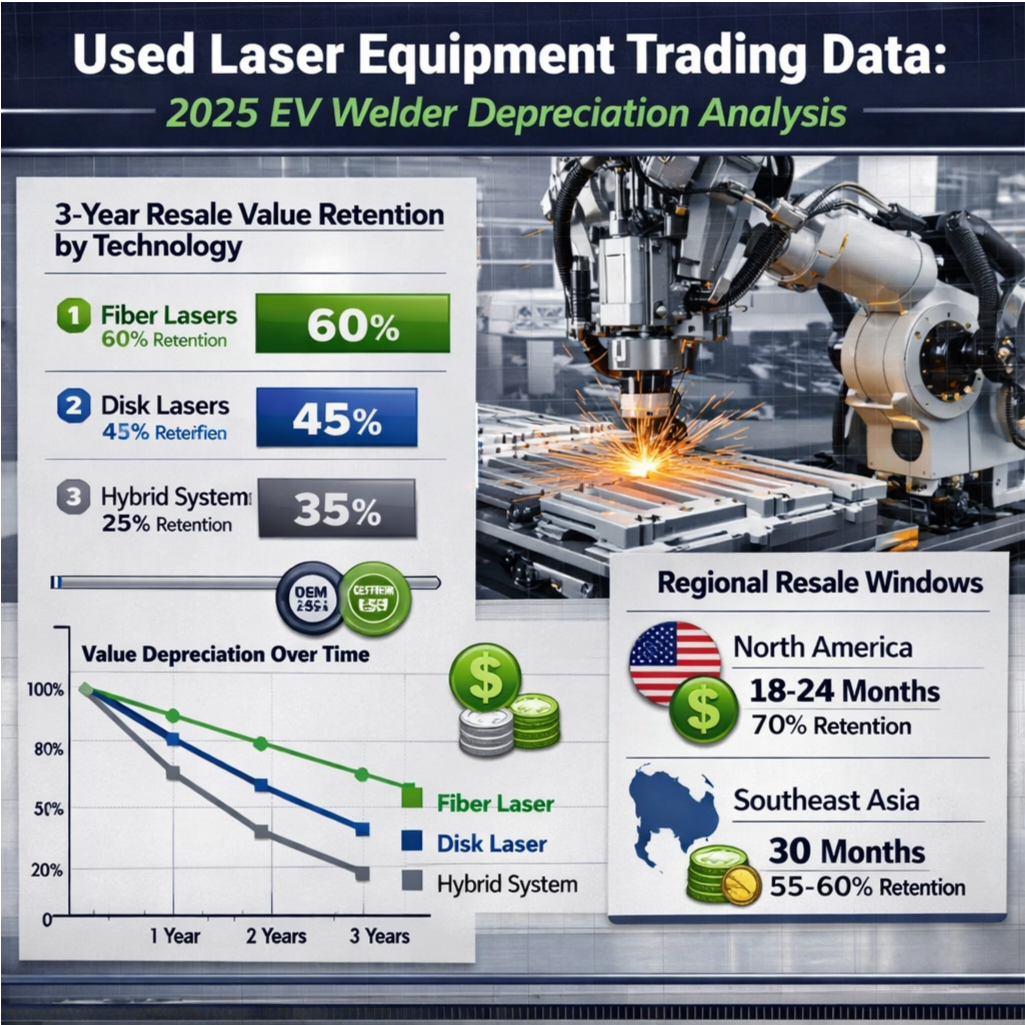
The way different technologies specialize has created some pretty big gaps when it comes to what equipment retains in value over time. Take fiber lasers for instance these tend to hold around 60% of their initial worth after about three years working on electric vehicle batteries because they can handle so many different jobs from cell tabbing all the way through to busbar joining and sealing operations. Disk lasers don't fare quite as well though, usually dropping down to about 45% of their original price tag within the same timeframe. This happens mainly due to problems with thermal lensing and keeping the laser beam stable during long periods of high power usage inside those massive gigafactories. Hybrid systems actually lose value even quicker at around 35% retention rates. Why? Because newer Cell-to-Pack (CtP) design trends are making companies less interested in having machines that work with two different wavelengths. And then there's the whole issue of OEM lock-in which makes things worse for everyone involved. When manufacturers use proprietary calibration methods and limit who gets access to service information, it becomes really hard to fix or upgrade older equipment especially disk and hybrid models. This restriction basically shrinks the market where people might want to buy used gear since nobody wants to deal with the hassle of getting parts or support for outdated systems.
U.S./EU vs. Asian Secondary Markets: Geographic Arbitrage and Optimal Resale Timing Windows
Different regions have their own unique rules and practices that affect when equipment resells best. Take North America for example - most machines hit their highest resale value around 18 to 24 months after purchase, with about 70% of original cost retained. This timing matches up nicely with typical equipment leases and those nice Section 179 tax breaks companies love. Things look different across Europe though. Recovery rates there tend to be about 15% lower because of all those strict CE conformity checks and the need for certified bodies to get involved. Meanwhile down in Southeast Asia, especially Indonesia and Vietnam, people actually pay extra for systems that are already 30 months old. These older units fetch between 55% and 60% of their original price because they work well enough for older LFP production lines where exact measurements aren't so critical. Right now, the sweet spot for making money off this arbitrage happens at around 22 months. American made fiber lasers that come with proper OEM certification can still sell for roughly 20% more in Indonesia compared to what they'd fetch back home. But watch out - this price difference isn't going to last forever as countries in ASEAN start bringing their safety standards and tracking requirements more in line with each other.
EV-Specific Design Shifts Reshaping Used Laser Equipment Trading Liquidity
Cell-to-Pack and Structural Battery Integration Invalidating Legacy Welding Configurations
We're seeing a big move across the industry toward Cell-to-Pack technology and structural battery designs, which means many older laser welding systems are becoming obsolete pretty fast. The new battery architectures don't use traditional modules or housings anymore. Instead they need welds that penetrate deeper, create smaller heat affected areas, and can reach joints integrated into vehicle frames from multiple angles. Systems built back when flat module seams were standard simply don't have features like adaptive optics, dynamic beam shaping capabilities, or real time temperature monitoring that handle these complicated shapes. According to the latest data from the 2025 EV Welder Depreciation Report, welding equipment from the modular era loses value at around 40% faster rate compared to regular industrial lasers. Most buyers now want upgraded fiber lasers or hybrid systems that work well with CtP setups, particularly ones equipped with real time monitoring of molten pools and automatic power adjustments. Meanwhile, older pulse and lamp powered units aren't selling as quickly anymore and sit on dealer shelves for much longer periods before finding new owners.
Market Signals from Used Laser Equipment Trading Activity: Saturation, Refurbishment Trends, and Forward Outlook
The market is getting flooded with inventory, putting serious strain on older generation systems these days. Resale values for entry level fiber lasers that are five years old or older have taken a hit, dropping around 22% compared to last year in early 2025 figures. On the flip side, certified refurbishment programs are fetching about 38% more than regular used equipment right now. Why? Because they come with proper OEM calibration, detailed maintenance records, and actual performance testing against those important ISO 13849-1 safety standards. At the same time, changes in battery design keep shrinking how long machines stay useful. Those first wave pulse welders from a few years back are losing value twice as fast as the newer solid state models hitting the market. The arbitrage opportunity still exists across different regions but it's getting trickier to pull off. Manufacturers in Southeast Asia continue to pick up mid range equipment that costs less than buying new, particularly when there are at least three good years left on the clock and the thermal management checks out. According to Ponemon Institute research from 2023, companies can save roughly $740,000 per unit by going this route. But watch out after 2026 because countries like those in the EU will start cracking down harder on imports of secondhand gear through stricter tracking requirements such as their Battery Passport system.
FAQ
Why do EV laser welders depreciate faster than other industrial lasers?
EV laser welders depreciate quicker due to the specialized demands of electric vehicle battery production, unique software and hardware systems pushed by OEMs, and frequent regulatory changes that make older models quickly obsolete.
How do regional differences impact the resale value of used laser equipment?
Resale value is influenced by regional regulations, with North America performing better due to tax incentives, while Europe faces lower values due to strict CE checks. Asian markets, like Southeast Asia, are favorable for older equipment due to less stringent specifications.
What is the impact of cell-to-pack technology on used laser equipment?
Cell-to-pack technology requires deeper welds and more advanced features not present in older equipment, leading to faster obsolescence as these older machines cannot meet the demands of newer battery designs.
Table of Contents
- Why EV Laser Welders Depreciate Faster: Core Drivers in the Used Laser Equipment Trading Market
- 2025 Depreciation Benchmarks: Used Laser Equipment Trading Data by Technology and Region
- EV-Specific Design Shifts Reshaping Used Laser Equipment Trading Liquidity
- Market Signals from Used Laser Equipment Trading Activity: Saturation, Refurbishment Trends, and Forward Outlook
- FAQ