
 EN
EN



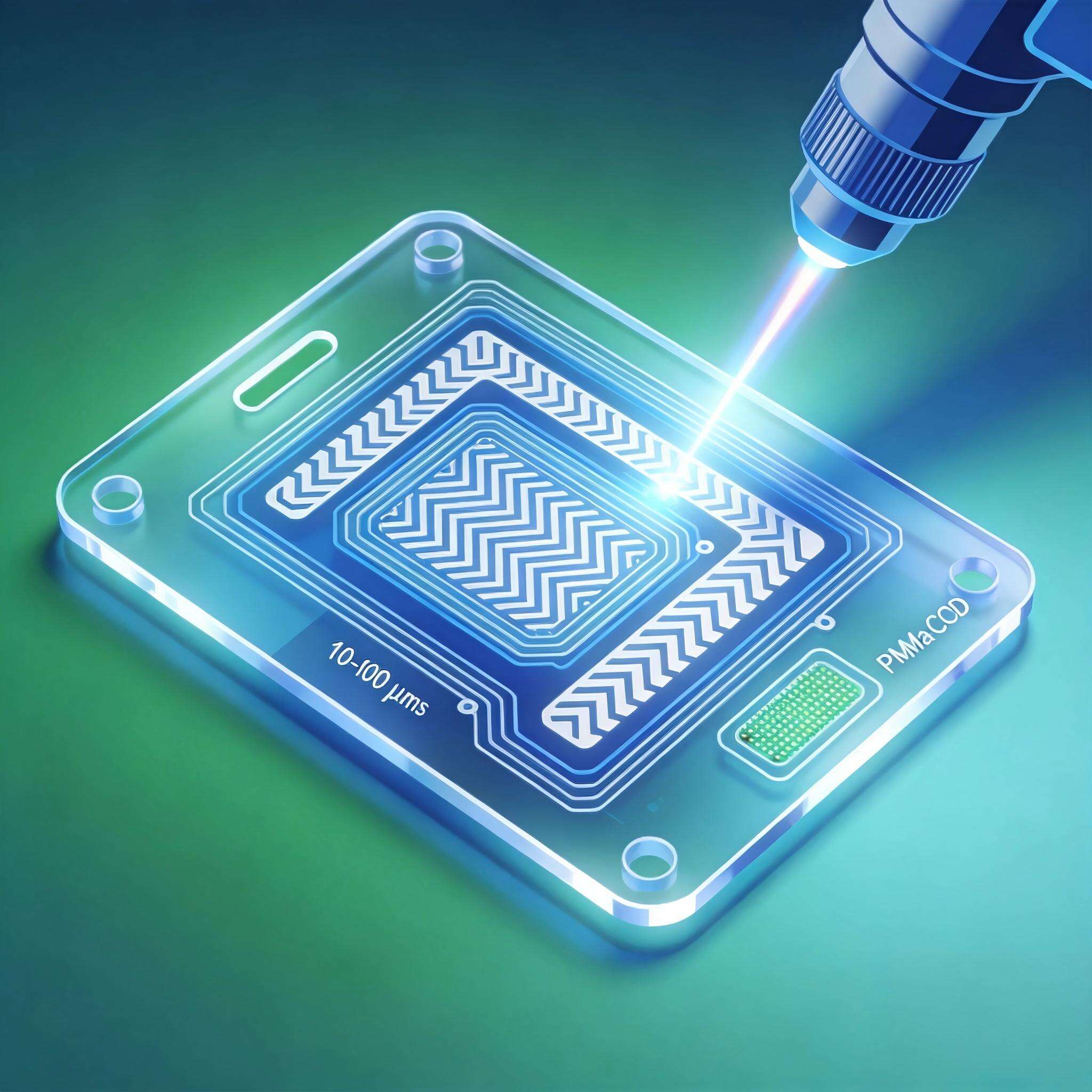
The Micro-World Inside Lab-on-a-Chip Devices
Lab-on-a-chip (LOC) technology compresses entire diagnostic labs into credit-card-sized devices, enabling rapid point-of-care testing for blood analysis, pathogen detection, or genetic sequencing. At their core are microfluidic channels — often just 10-100 µm wide — that guide tiny fluid volumes with capillary precision.
Fabricating these channels demands sub-micron accuracy to control flow rates, mixing efficiency, and reagent isolation. Etching errors as small as 5 µm can cause laminar flow disruptions or dead volumes, ruining assay reliability. Traditional cleanroom methods like photolithography excel in silicon but struggle with polymers like PDMS or PMMA, which dominate disposable LOC production.
GuangYao Laser's PrecisionLase MediMark and MediCut systems bridge this gap, using ultrafast laser micro-engraving to pattern complex microfluidics directly on polymer substrates — accelerating development from prototype to clinical validation without masks or molds.
Chip Design Fundamentals: Channels, Valves, and Integration
A typical LOC integrates:
- Microchannels for sample transport (50-200 µm depth).
- Mixing chambers with herringbone or zigzag patterns.
- Valves/gates using pneumatic or hydrogel actuation.
- Detection zones for optical or electrochemical readout.
Designers balance fluid dynamics (Reynolds number <1 for laminar flow) with manufacturability. Laser micro-engraving supports this by enabling true 3D channel geometries — tapered inlets, multi-level interconnects, or embedded optics — that molding can't replicate without multi-step assembly.
GuangYao Laser's workstations handle common LOC substrates: PMMA, COC (cyclic olefin copolymer), PDMS, and glass-PDMS hybrids. The non-contact process avoids stress cracks, preserving optical clarity essential for fluorescence detection.
Micro-Engraving Process: Laser as the Master Etcher
Ultrafast lasers (femtosecond/picosecond) ablate polymer layer-by-layer via nonlinear absorption, creating smooth channels without carbonization or swelling. The workflow:
- CAD import — channel geometry as vector paths.
- Substrate fixturing — vacuum chuck with Z-axis focus control.
- Layered engraving — multiple passes build depth, with 20-50% overlap.
- Inline inspection — camera verifies width/depth uniformity.
- Sealing — thermal bonding or adhesive lamination.
Key advantages over wet etching:
- No chemicals — eliminates hazardous photoresists and developers.
- Rapid iteration — design changes take minutes, not days.
- 3D capability — sloped walls, undercuts, integrated lenses.
GuangYao systems typically operate at 515 nm (frequency-doubled) for polymer absorption, yielding channel roughness (Rz) under 0.5 µm — smooth enough for droplet-free flow.
Process Parameters for Microfluidic Precision
|
Parameter |
Typical Setting |
Impact on Chip Performance |
|
Wavelength |
515 nm (green) or 1030 nm |
Optimal polymer multiphoton absorption |
|
Pulse Duration |
200-500 fs |
Clean ablation, no heat-affected zone |
|
Fluence |
0.5-2 J/cm² |
Controls ablation depth per pass |
|
Repetition Rate |
80-500 kHz |
Throughput vs. surface quality balance |
|
Scan Speed |
50-200 mm/s |
Defines channel wall taper (5-15°) |
|
Channel Resolution |
5-20 µm features |
Supports droplet microfluidics and valves |
|
Typical Throughput |
10-50 chips/hour |
Prototype to pilot scale |
These ranges support everything from simple T-junctions to complex spiral mixers. GuangYao Laser engineers collaborate on parameter mapping, ensuring chips meet fluidic tolerances (±10% cross-section variation).
Application Case Studies: Real-World Deployments
Case 1: Blood Plasma Separation Chip
A diagnostics firm needed spiral channels (150 µm wide) to separate plasma from whole blood via centrifugal force. Laser engraving on PMMA achieved 95% purity separation at 2000 rpm, with no clogging over 100 runs. Production scaled to 500 chips/week.
Case 2: CRISPR Diagnostic Cartridge
LOC for SARS-CoV-2 detection required 8 parallel reaction chambers with optical windows. Multi-layer engraving created hermetic seals around 50 nl volumes, enabling isothermal amplification with 98% sensitivity vs. PCR gold standard.
Case 3: Organ-on-Chip Perfusion
PDMS chip with vascular channels (30 µm) and pillar arrays mimicked capillary flow. Laser-patterned surface chemistry gradients guided endothelial cell attachment, supporting 14-day perfusion cultures.
These examples show how GuangYao Laser's precision enables diverse LOC applications — from IVD to drug screening.
Integration Challenges and Solutions
Fluidic Performance: Smooth channels minimize Taylor dispersion, preserving sample gradients. Laser control over wall angle prevents beading in low-surface-tension fluids.
Optical Quality: Minimal debris ensures clear windows for absorbance/fluorescence. Post-annealing removes subsurface stress for better light transmission.
Sealing Reliability: Precise depth control (±2 µm) guarantees leak-free bonding. GuangYao systems include pressure testing fixtures for 100% validation.
Scalability: Galvo scanners handle high-volume sheets (A4+), with roll-to-roll options emerging for disposables.
From Prototype to GMP Production
LOC development follows a clear path:
- Rapid prototyping — single chips, design tweaks overnight.
- Pilot validation — 100-1000 units with analytical characterization.
- Process qualification — IQ/OQ/PQ per ISO 13485.
- Volume manufacturing — automated loading, 10k+ units/month.
GuangYao Laser supports the full cycle with turnkey workstations, process recipes, and validation documentation. Digital control eliminates tooling costs, making LOC economically viable even at moderate volumes.
Regulatory and Biocompatibility Considerations
LOC devices face IVDR Class C/D scrutiny in Europe and FDA 510(k) or De Novo pathways. Laser micro-engraving aids compliance:
- Extractables/leachables: No metal catalysts, minimal particulates.
- Cytotoxicity: Clean ablation surfaces pass ISO 10993-5.
- Traceability: Logged parameters support design history files.
PCR-grade polymers combined with laser precision yield devices rivaling silicon cleanroom quality — at fraction of the cost.
Frequently Asked Questions
Q: Can laser engraving replace photolithography entirely for LOC?
For polymer chips, yes. It matches resolution while eliminating masks and chemicals. Silicon still favors litho for ultra-high density.
Q: What substrates work best with GuangYao Laser systems?
PMMA, COC, PDMS, PC, and hybrids. Glass works with adjusted parameters. We test customer materials during application trials.
Q: How do you achieve leak-free channel sealing?
Precise depth control ensures flat bonding surfaces. Thermal/UV lamination follows, validated by burst pressure testing (>2 bar typical).
Q: What's the smallest reliable feature size?
5 µm pillars and 10 µm channels routinely. Droplet digital PCR geometries push toward 2-3 µm limits.
The LOC Horizon: Integration and Intelligence
Tomorrow's chips will fuse microfluidics with electronics — embedded sensors, wireless data, AI-driven analysis. Laser microfabrication scales to these hybrids, patterning conductors alongside channels in single workflow.
GuangYao Laser's PrecisionLase platforms deliver this future today: micro-engraving precision that turns diagnostic concepts into deployable reality, powering personalized medicine one chip at a time.
Table of Contents
- The Micro-World Inside Lab-on-a-Chip Devices
- Chip Design Fundamentals: Channels, Valves, and Integration
- Micro-Engraving Process: Laser as the Master Etcher
- Process Parameters for Microfluidic Precision
- Application Case Studies: Real-World Deployments
- Integration Challenges and Solutions
- From Prototype to GMP Production
- Regulatory and Biocompatibility Considerations
- Frequently Asked Questions
- The LOC Horizon: Integration and Intelligence
