
 EN
EN



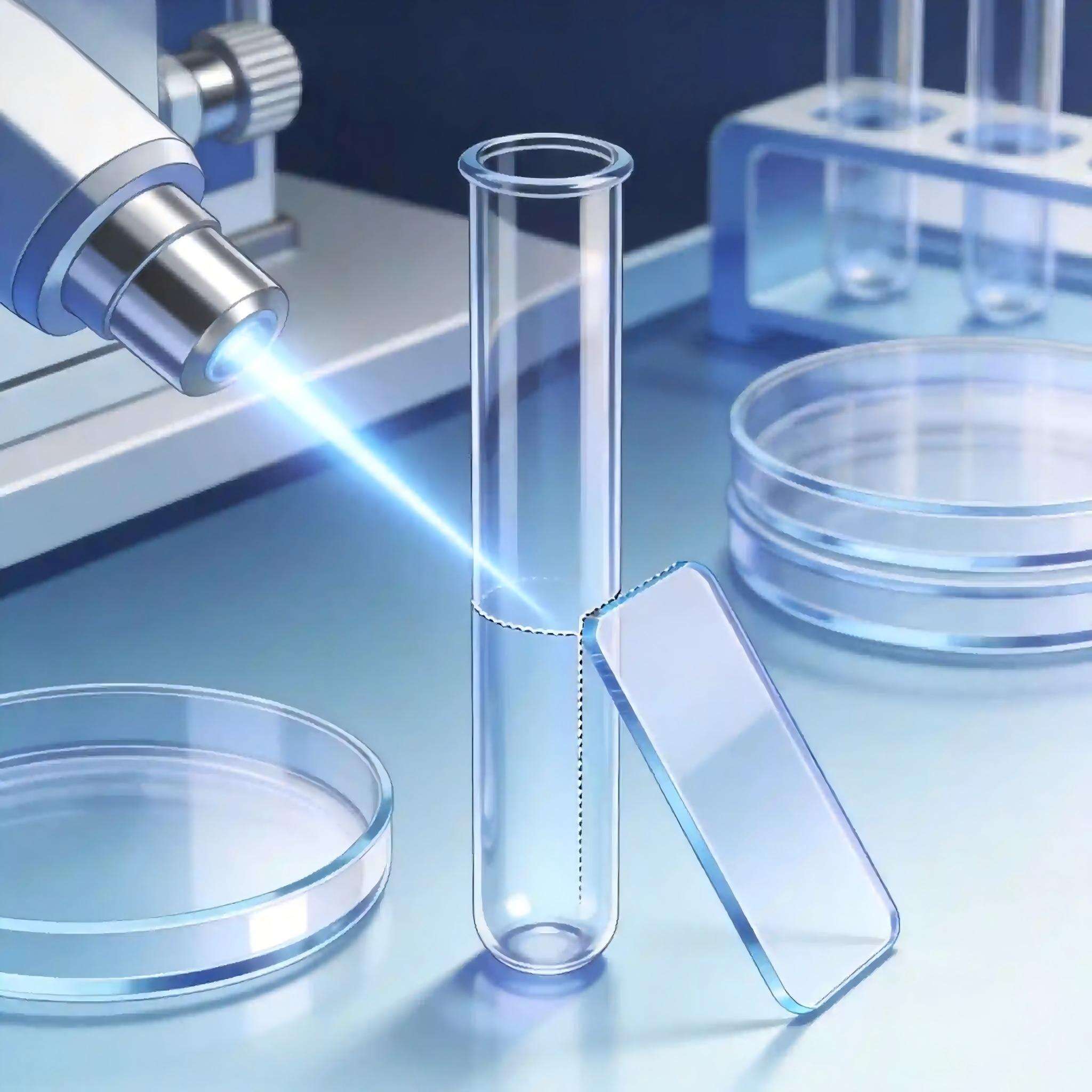
Glass in the Medical Lab: Precision Under Pressure
In diagnostic labs and research facilities worldwide, borosilicate glass test tubes, vials, and coverslips form the backbone of sample handling. Their chemical inertness, thermal stability, and optical clarity make them irreplaceable for PCR, microscopy, and cell culture. But traditional glass cutting — diamond wheels, scribes, or thermal shock — often leaves chips, microcracks, and inconsistent edges that contaminate samples or fail under autoclave cycles.
The solution lies in controlled laser cutting, which scores and separates glass with micron-level precision and zero mechanical contact. GuangYao Laser's PrecisionLase MediCut systems, adapted for brittle materials, deliver clean breaks on thin-walled glass (0.1-2 mm) without debris or stress fractures — ideal for high-throughput production of sterile labware.
Understanding Medical Glass: Properties and Cutting Challenges
Medical glass typically means borosilicate (Type 1) or soda-lime compositions:
- Borosilicate: Low expansion coefficient (3.3×10⁻⁶/K), withstands 500°C thermal shock.
- Soda-lime: Cost-effective for disposable vials, but more prone to chipping.
- Specialty: Fused silica for UV spectroscopy, thin coverslips (#1.5, 0.17 mm).
Challenges include:
- Brittleness: Knoop hardness ~500, fractures propagate easily.
- Thermal sensitivity: Even 50°C gradients cause spontaneous breaks.
- Edge quality: Chips >50 µm harbor bacteria or interfere with pipetting.
Laser cutting circumvents these by inducing a controlled thermal stress line along the cut path. A focused beam creates localized melting, followed by rapid cooling that forms tensile stress below the surface. A gentle mechanical tap or vibration then separates along this predictable weak plane — yielding pristine edges.
Optimized Process for Chip-Free Results
GuangYao Laser's glass cutting workflow combines CO₂ or green lasers (9.3-10.6 µm or 532 nm) with precise beam shaping:
- Scoring pass: Continuous wave or modulated pulse heats a 20-50 µm line.
- Cooling phase: Air jet or cryogenic assist solidifies the stress layer.
- Separation: Ultrasonic vibration or roller shear (force <1 N).
- Edge inspection: Camera checks for chips (<10 µm tolerance).
For thin coverslips, a single-pass full cut vaporizes a narrow kerf. Thicker tubes use helical scoring around circumference. The non-ablative approach preserves bulk strength, unlike ablation methods that weaken surrounding glass.
Process Parameters: Glass Type vs. Laser Settings
|
Glass Type |
Wall Thickness |
Laser Type |
Power/Spot Size |
Feed Rate |
Edge Quality Achieved |
|
Borosilicate Tube |
0.8-1.5 mm |
CO₂ 10.6 µm |
50-100 W / 100 µm |
50-200 mm/s |
Chip-free, Ra<1 µm |
|
Soda-lime Vial |
0.5-1.0 mm |
CO₂ 9.3 µm |
30-70 W / 80 µm |
100-300 mm/s |
Perpendicular break |
|
#1.5 Coverslip |
0.15-0.2 mm |
Green 532 nm |
5-15 W / 20 µm |
200-500 mm/s |
Full cut, no polish |
|
Fused Silica |
0.3-1.0 mm |
10.6 µm |
80-150 W / 120 µm |
30-100 mm/s |
Sterile-ready edge |
These settings minimize subsurface damage (typically <5 µm), ensuring tubes survive 100+ autoclave cycles at 121°C. GuangYao systems allow recipe storage for rapid material switching.
Production Efficiency: Speed, Yield, and Cost
Laser cutting transforms labware manufacturing economics:
|
Metric |
Traditional (Wheel/Scribe) |
Laser Cutting (PrecisionLase) |
Improvement |
|
Cycle Time/Tube |
8-15 seconds |
2-5 seconds |
3-4x faster |
|
Edge Chip Rate |
2-5% |
<0.1% |
Near-zero waste |
|
Yield per Hour |
200-400 units |
800-2000 units |
4-5x throughput |
|
Post-Processing |
Grinding + inspection |
Inline check only |
70% less labor |
|
Tooling Cost/Year |
$10k+ (diamond wheels) |
Near-zero (no consumables) |
Dramatic savings |
High-speed galvo scanners process tube arrays or sheet stock, feeding directly into washing/packaging lines. For 10M+ annual volumes, per-unit cost drops below $0.02 — competitive with injection molding while retaining glass advantages.
Quality Control: From Edge to Autoclave
Post-cut validation focuses on:
- Microscopy: SEM confirms no median cracks or hackles.
- Strength testing: 4-point bend exceeds 50 MPa (2x specification).
- Cleanliness: Particle count <10 per cm² edge length.
- Dimensional: OD/ID tolerance ±20 µm, perpendicularity <1°.
Laser-cut glass routinely passes USP <660> Type I classification and ISO 12775 for labware. The chip-free edges reduce sample loss during pipetting and minimize fluorescence background in imaging applications.
GuangYao Laser's inline systems integrate laser micrometers and AI defect detection, flagging outliers before packaging for 99.9% first-pass yield.
Application Scenarios: Beyond Standard Tubes
High-Content Screening: Uniform coverslips with laser-cut reference notches enable automated microscopy alignment.
Cryo-Vials: Precise thread scoring prevents cap slippage under liquid nitrogen expansion.
Microfluidic Manifolds: Glass plates with laser-drilled ports feed polymer chips, combining durability with optics.
Custom Formats: 8-strip PCR tubes or 96-well glass plates, cut and separated in single workflow.
These adaptations position GuangYao Laser as a partner for next-gen lab consumables, where glass performance meets production scale.
Cleanroom and Regulatory Compliance
Medical glass production demands ISO 7/8 cleanrooms. Laser systems excel here:
- No particulates from tool wear or grinding slurry.
- Contactless — eliminates cross-contamination risks.
- HEPA-integrated exhaust captures all ablation vapors.
Process validation follows ISO 13485 and GMP Annex 1, with electronic batch records capturing laser power, position data, and environmental parameters. Flame polishing or silanization stations integrate downstream for surface functionalization.
Frequently Asked Questions
Q: Does laser cutting weaken glass strength long-term?
No — controlled stress lines preserve bulk properties. Bend tests show laser-cut glass equals or exceeds scribed material after etching.
Q: Can PrecisionLase systems handle colored or coated glass?
Yes, with wavelength tuning. Amber vials or frosted tubes process cleanly; coatings like silicone release layers survive intact.
Q: What's the minimum diameter for tube cutting?
Reliable down to 3 mm OD. Smaller requires specialized fixturing, available as custom options.
Q: How does this scale for 24/7 production?
Multi-axis automation and recipe memory support continuous runs. Typical uptime exceeds 95% with minimal intervention.
Glass Renaissance: Labware 2.0
Automation, miniaturization, and point-of-care diagnostics revive demand for precision glass. Laser cutting unlocks formats impossible with legacy methods — ultra-thin walls, complex profiles, hybrid assemblies.
GuangYao Laser's PrecisionLase platforms deliver this evolution: chip-free medical glass at production speeds, bridging traditional material excellence with modern manufacturing realities. Clean edges today build reliable science tomorrow.
Table of Contents
- Glass in the Medical Lab: Precision Under Pressure
- Understanding Medical Glass: Properties and Cutting Challenges
- Optimized Process for Chip-Free Results
- Process Parameters: Glass Type vs. Laser Settings
- Production Efficiency: Speed, Yield, and Cost
- Quality Control: From Edge to Autoclave
- Application Scenarios: Beyond Standard Tubes
- Cleanroom and Regulatory Compliance
- Frequently Asked Questions
