 EN
EN



GS1 Medical Device Compliance: Why Laser-Marked QR Codes Must Meet Level H Error Correction
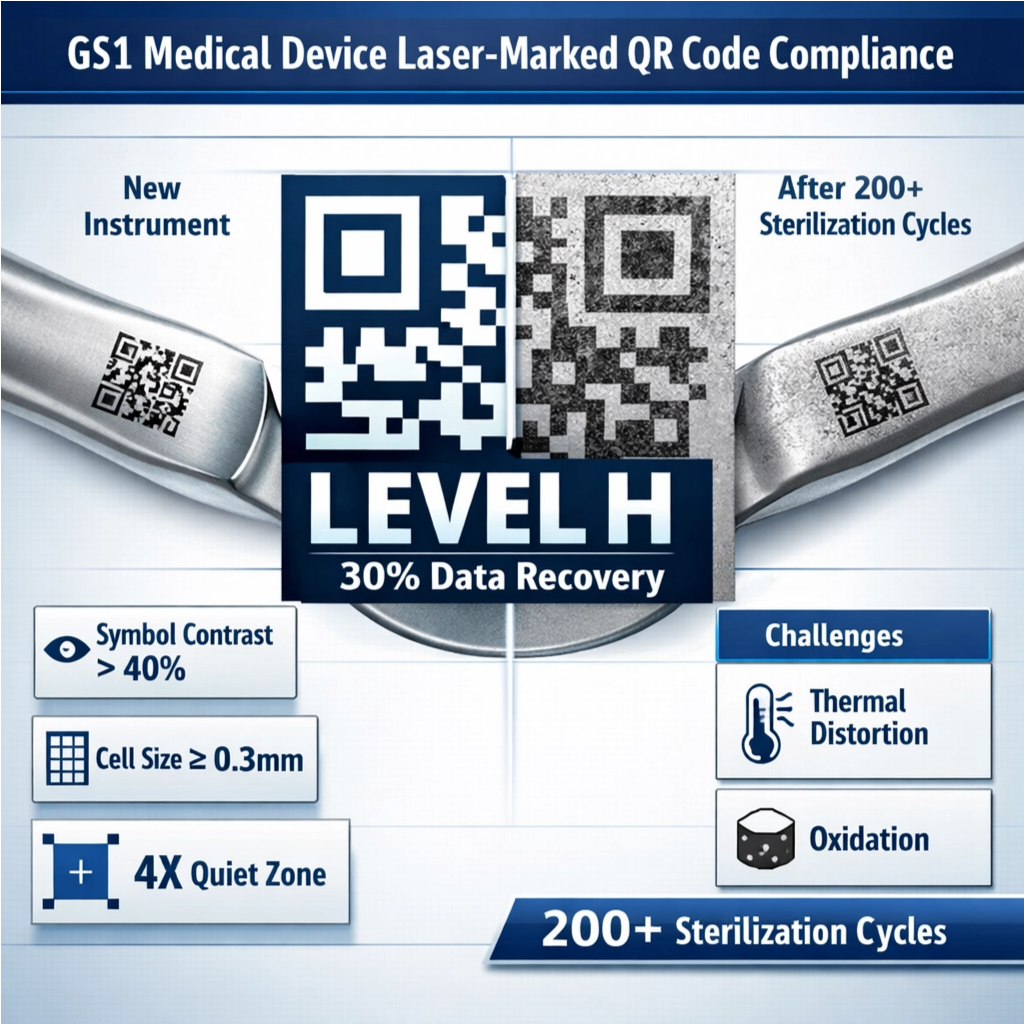
For GS1 compliant laser marked QR codes on medical devices, Level H error correction is absolutely essential since it can recover up to 30% of damaged data. When marking medical devices, thermal changes often lead to problems like oxidation or cracks forming beneath the surface, especially on materials such as stainless steel. This affects how well the symbols show up and makes those tiny cells look uneven. After manufacturing, sterilization processes really take their toll too. All those cycles expose surfaces to chemicals again and again while also causing wear from physical contact. Since UDI traceability matters so much for keeping patients safe, if the code becomes hard to read there's serious risk of running afoul of regulations. What makes Level H stand out is its ability to handle all these issues with materials and manufacturing processes, making sure codes stay readable even when markings start looking pretty beat up over time.
The average medical instrument goes through over 200 autoclave cycles each year, which gradually wears away at the markings until they become unreadable. When we don't have Level H's built-in redundancy, important information like batch numbers and expiration dates disappears completely when recalls happen. This higher level actually holds up against everyday wear and tear from handling or exposure to corrosive substances, keeping those crucial FDA and MDR tracking requirements intact. Companies that opt for basic correction levels like Level L with only 7% recovery capability end up facing serious problems down the line. Damaged codes make it impossible to identify devices properly throughout the supply chain. That's why using laser marked QR codes with Level H error correction isn't just about following rules anymore. It turns compliance into something much more practical and life saving, making sure hospitals can always track their equipment no matter how many times it gets sterilized or moved around between facilities.
How Laser Marking Impacts QR Code Integrity: Thermal, Surface, and Material Challenges
Thermal Distortion and Oxidation Effects on Symbol Contrast and Cell Uniformity
When lasers mark surfaces, they create a lot of concentrated heat that can mess up the shape of QR code cells. The materials tend to warp as they expand from the heat, which changes where the cells are positioned and makes them harder to read accurately. During the marking process, oxidation happens too, leading to uneven color spots on metal surfaces. This actually cuts down on the contrast needed for reading codes by about 40%, something that definitely runs against what GS1 requires for proper UDI readability. Heat isn't distributed evenly either, so sometimes we end up with cells that are all different sizes. Industry tests show this problem leads to failed decodes around 25% of the time. To combat these issues, manufacturers need to develop specific cooling methods for each material type and carefully control how long the laser pulses last, though even then there's always some tradeoff between speed and quality.
Subsurface Cracking and Reflectance Margin Degradation in Stainless Steel Instruments
When high power lasers mark surgical tools, they create tiny cracks beneath the surface that scatter light in unpredictable ways. This scattering cuts down on reflective properties by roughly 30 to 50 percent, making it really hard for scanners to tell apart dark from light areas, especially when contrast levels are already low in operating rooms. Stainless steel has a crystal structure that just doesn't handle heat well at all. When exposed to laser energies over 20 joules per square centimeter, it starts developing those annoying stress cracks. These surface problems lead to reflection inconsistencies that go beyond what AIM DPM standards allow, which puts products at risk of failing GS1 compliance checks. Smart manufacturers now run preliminary tests using digital microscopes and reflectometers to catch these issues early in the process. Spotting them before full scale production saves everyone headaches later on with FDA inspections and Medical Device Regulation requirements.
Verifying Compliance: ISO/IEC TR 29158 (AIM DPM) Grading for Laser-Marked QR Codes
Key Grading ParametersâSymbol Contrast, Modulation, and Decodability in Low-Contrast Environments
ISO/IEC TR 29158 (AIM DPM) establishes critical grading metrics for laser-marked QR codes in medical devices. Symbol contrastâmeasuring reflectance difference between dark and light modulesâmust exceed 40% to ensure readability despite oxidation or subsurface cracking. Low contrast (<30%) causes 68% of scanning failures in clinical environments, per 2023 traceability studies.
Modulation evaluates edge sharpness between cells; thermal distortion from laser marking can reduce scores below Grade B thresholds (â¥0.60), directly increasing scan time by 200ms in automated systems.
Decodability in suboptimal lighting remains the most stringent parameter. Medical devices require minimum Grade B performance (per GS1 v22) to maintain functionality in OR shadows or sterilization rooms. Level H error correction compensates for environmental challenges, sustaining data integrity even when contrast falls below 45%.
| Parameter | Minimum Grade | Failure Risk if Unmet | Common Laser Impact |
|---|---|---|---|
| Symbol Contrast | B (â¥40%) | 68% scan failure rate | Oxidation reduces reflectance |
| Modulation | B (â¥0.60) | 200ms decoding delay | Thermal distortion blurs edges |
| Low-Contrast Decode | B (â¥70% success) | Inventory tracking errors | Material reflectance variance |
Rigorous AIM DPM verification prevents FDA non-compliance by validating all three parameters simultaneously. Batch testing protocols should replicate real-world low-light conditions, as 30% of medical device recalls stem from inadequate environmental grading.
Practical Implementation Guide: Designing Robust Laser-Marked QR Codes for UDI and Traceability
Optimizing Quiet Zone, Cell Size, and Print Growth Tolerances per GS1 General Specifications v22
The GS1 General Specifications version 22 sets out specific requirements for laser marking so that everything remains scannable when needed. There needs to be at least a 4X quiet zone or blank space around each mark to keep things from getting confused with whatever might be next to them on the device. Medical tools require cells larger than 0.3mm because these markings need to survive multiple rounds of sterilization without losing their readability. When working with stainless steel, finding the right balance between how deep the mark goes (at least 0.02mm is recommended) and how much heat gets applied during the process helps prevent those annoying cracks forming underneath the surface. Following these guidelines ensures compliance with industry standards while keeping functionality intact across different applications.
| Parameter | Requirement | Laser Setting Adjustment |
|---|---|---|
| Quiet Zone | â¥4X cell size | Increase border offset |
| Cell Size | â¥0.3mm | Reduce focal point size |
| Print Growth | â¤10% deviation | Calibrate power + speed |
Thermal modeling simulations verify compliance pre-production, reducing rework by 32% (ISO/TR 29158:2020).
Mitigating FDA/MDR Regulatory Risk Through Pre-Verification and Batch Validation Protocols
Before starting production runs, companies should run some preliminary checks based on AIM DPM grading standards to catch problems before they become real issues. When checking symbols, make sure the contrast is at least forty percent and modulation hits around point six or better in roughly ten percent of each batch produced. The automated optical inspection systems we've been using lately are pretty good at spotting when those reflective properties start breaking down over time. Some research out there suggests that firms with solid validation processes get hit with about forty one fewer FDA warnings related to UDI requirements compared to others. Keep detailed records of every step taken during these verification processes since regulators will want to see them during MDR audits. Technicians need proper training too, especially regarding environmental impacts like what happens to materials when exposed to different sterilization methods. Understanding these factors helps maintain reliable tracking from manufacturing right through to end of life for medical devices.
FAQ
What is Level H error correction in QR codes?
Level H error correction in QR codes refers to the ability of the code to recover up to 30% of the data if the code is damaged.
Why is laser marking challenging for QR codes?
Laser marking creates concentrated heat that can warp materials, cause oxidation, and lead to thermal and reflective inconsistencies, all of which can render QR codes unreadable.
What is ISO/IEC TR 29158 (AIM DPM)?
It is a set of grading standards for laser-marked QR codes in medical devices, focusing on symbol contrast, modulation, and decodability to ensure they meet certain criteria for reliability and performance.
What is the importance of pre-verification and batch validation?
Pre-verification and batch validation are crucial in identifying potential issues before full-scale production, thereby reducing compliance risks and ensuring quality and traceability of medical devices.
Table of Contents
- GS1 Medical Device Compliance: Why Laser-Marked QR Codes Must Meet Level H Error Correction
- How Laser Marking Impacts QR Code Integrity: Thermal, Surface, and Material Challenges
- Verifying Compliance: ISO/IEC TR 29158 (AIM DPM) Grading for Laser-Marked QR Codes
- Practical Implementation Guide: Designing Robust Laser-Marked QR Codes for UDI and Traceability
- FAQ