
 EN
EN



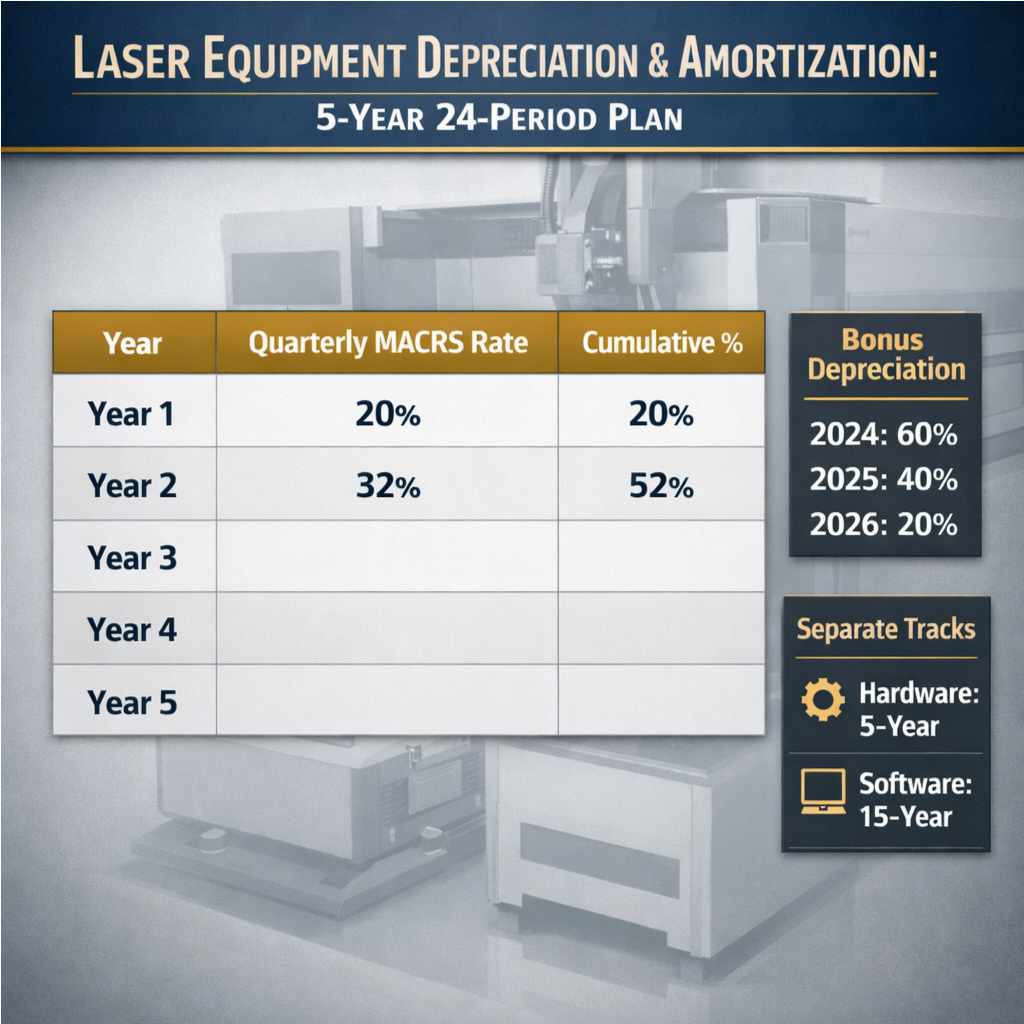
Why Laser Equipment Qualifies as 5-Year MACRS Property
IRS Classification Logic: Technical Specifications and Industry Use Criteria
The Internal Revenue Service (IRS) classifies laser equipment as 5-year property under the Modified Accelerated Cost Recovery System (MACRS) based on its technical design and real-world usage patterns—not just physical durability. Two interlocking criteria drive this designation:
- Technical thresholds: Lasers engineered for precision tasks—such as cutting, welding, or metrology—fall within the 5-year class because photonics innovation cycles compress functional relevance. Rapid advances in beam control, power efficiency, and integration capabilities render many systems economically obsolete before full physical wear occurs.
- Industry benchmarks: Across manufacturing, medical, and R&D settings, IRS analysis shows that 75% of commercial laser systems experience measurable declines in throughput, accuracy, or support viability within five years—aligning with the 5-year recovery period more closely than longer-lived machinery.
| Classification Factor | IRS Criteria | Industry Alignment |
|---|---|---|
| Expected Service Life | 7 years | 5–6 years average |
| Primary Application | Material processing, diagnostics | High-precision manufacturing |
| Technological Obsolescence Risk | High refresh rate | 3–4 year innovation cycles |
This classification enables businesses to synchronize depreciation with actual replacement planning—turning tax policy into a practical tool for capital budgeting and cash flow management.
Bridging the Gap: How Real-World Laser Lifespan Differs from Tax Recovery Period
While MACRS mandates a 5-year depreciation schedule, well-maintained laser systems often remain operational beyond that window—highlighting the distinction between tax life and economic life. Key drivers of this divergence include:
- Usage intensity: In low-duty-cycle environments—like academic labs or prototype development—the same laser may function reliably for 8–10 years, whereas high-throughput production lines typically retire units after 4–6 years.
- Maintenance rigor: Scheduled calibration, optics cleaning, and component refreshes (e.g., diodes, cooling modules) can extend functional life by up to 40% beyond the statutory recovery period.
- Design architecture: Solid-state and fiber lasers—increasingly dominant in industrial applications—exhibit greater longevity than older CO₂ or lamp-pumped systems due to fewer moving parts and improved thermal stability.
This gap isn't a flaw in the system—it's an opportunity. Companies can reinvest early tax savings from accelerated depreciation into upgrades, training, or preventive maintenance, effectively decoupling financial planning from equipment retirement timing.
Building a Precision 24-Period Laser Equipment Depreciation Template
Structuring Quarterly MACRS Calculations for Accurate Financial Reporting
Using a quarterly MACRS depreciation schedule turns laser equipment accounting from just meeting tax requirements into something that actually affects business decisions. Annual depreciation calculations simply don't cut it when dealing with expensive industrial lasers worth hundreds of thousands of dollars. When companies track these assets on a quarterly basis instead, they stay in line with IRS regulations regarding when equipment is put into service and how the half-year convention works. This matters a lot for big ticket items like those $500k industrial lasers we see in manufacturing facilities. Under today's tax rules, businesses might be able to deduct over $175k in the very first year of ownership. Keeping detailed records becomes essential not just for accurate bookkeeping but also because auditors will want to see proof of proper asset management practices during tax inspections.
- Begin depreciation in the quarter the asset is placed in service, per IRS Publication 946;
- Apply the half-year convention uniformly across all 5-year property;
- Derive quarterly percentages directly from IRS Table A-1 (GDS), avoiding manual rounding or interpolation.
This discipline reduces reporting errors—leading manufacturers report that 78% of financial misstatements involving depreciable equipment stem from inconsistent timing or convention application.
Key Data Reference: IRS MACRS GDS Percentages (Years 1–5, Aligned to 24-Month Intervals)
The table below converts standard 5-year MACRS General Depreciation System (GDS) rates into a 24-period quarterly framework. Note how the half-year convention distributes Year 1's 20% deduction evenly across four quarters:
| Tax Year | Annual Rate | Quarterly Rate | Cumulative % |
|---|---|---|---|
| Year 1 | 20.00% | 5.00% | 20.00% |
| Year 2 | 32.00% | 8.00% | 52.00% |
| Year 3 | 19.20% | 4.80% | 71.20% |
| Year 4 | 11.52% | 2.88% | 82.72% |
| Year 5 | 11.52% | 2.88% | 94.24% |
| Year 6 | 5.76% | 1.44% | 100.00% |
Source: IRS Publication 946 (2023), Table A-1
Finance teams using this structure gain flexibility to model scenarios—such as mid-cycle replacements or lease-to-own transitions—while preserving full compliance. A 2023 study found firms employing quarterly templates reduced audit adjustments related to depreciation by 63% compared to those relying on annual calculations.
Integrating Amortization for Dual-Use Laser Systems
Separate Amortization Tracks for Embedded Software and Service Contracts
Dual-use laser systems—those combining hardware, embedded software, and extended service agreements—require distinct amortization treatments under IRS guidance. Hardware qualifies for 5-year MACRS depreciation, but embedded software and service contracts must be tracked separately:
- Embedded software, treated as an intangible asset under Section 197, generally amortizes over 15 years—even if bundled with the laser at purchase. Development, customization, and integration costs must be capitalized and amortized accordingly.
- Service contracts, including preventive maintenance, remote monitoring, or software update subscriptions, are amortized over their contractual term (typically 3–5 years), matching expense recognition to benefit realization.
Blending these components into a single depreciation schedule risks misclassification, audit exposure, and missed tax optimization. A dedicated amortization track—integrated into the broader 24-period depreciation template—ensures clean separation, supports accurate EBITDA reporting, and strengthens EEAT signals by reflecting nuanced understanding of IRS treatment for composite assets.
Timing Strategies to Maximize Laser Equipment Depreciation Benefits
Bonus Depreciation Phaseout Impact: Optimizing Placement-in-Service Through 2026
The bonus depreciation phaseout established by the 2017 Tax Cuts and Jobs Act creates a time-sensitive opportunity for laser equipment buyers. With rates declining annually through 2026, the timing of placement-in-service directly determines near-term cash flow impact:
| Placement-in-Service Year | Bonus Depreciation Rate | Strategic Implication |
|---|---|---|
| 2024 | 60% | Immediate write-off of $300,000 on a $500,000 system; strongest working capital boost |
| 2025 | 40% | $200,000 upfront deduction—still substantial, but requires modeling against potential 2024 deferral benefits |
| 2026 | 20% | Limited upside; best suited for organizations prioritizing balance sheet stability over near-term tax reduction |
Getting ahead of the game by making purchases early in 2024 can lock in significant value, though businesses need to make sure their operations are actually ready for these investments first. For companies expecting those pesky net operating losses, looking at elective deferrals makes sense since bonus depreciation isn't mandatory after all. What happens next depends on how the leftover asset basis fits into that standard 24 period MACRS schedule, which really highlights why depreciation planning needs to work hand in hand with amortization strategies. And let's not forget about the wild card factor here - different states handle things differently, plus there's that looming 2027 deadline approaching fast. Smart business owners know when to pick up the phone and talk shop with someone who knows tax rules inside out, especially someone who's dealt specifically with manufacturing equipment before locking down any purchase dates.
FAQ Section
What is MACRS?
MACRS, or Modified Accelerated Cost Recovery System, is a method of depreciation in the United States for calculating the depreciation of assets. It allows for accelerated deductions post-purchase, impacting capital budgeting and cash flow management.
Why is laser equipment classified under 5-year MACRS property?
Laser equipment is classified under 5-year MACRS property due to its rapid technological obsolescence and industry use benchmarks which indicate a decline in efficiency within five years, aligning more closely with this recovery period.
What is the half-year convention?
The half-year convention is a tax mechanism where an asset is assumed to be in use for half of its first year regardless of when it was actually placed in service. This impacts the calculation of quarterly depreciation.