
 EN
EN



Keywords: medical laser etching trends, biodegradable etching 2026, medical materials trends, degradable materials processing, biocompatible etching, future medical laser
2026: The Year Biodegradable Implants Go Mainstream
Medical device engineering stands at an inflection point. After years of dominance by permanent metals and polymers, biodegradable materials — think magnesium alloys, PLGA copolymers, and zinc-based stents — are surging toward clinical adoption. These implants perform their job (vascular support, bone fixation, drug delivery) then harmlessly dissolve, eliminating revision surgeries and long-term imaging artifacts.
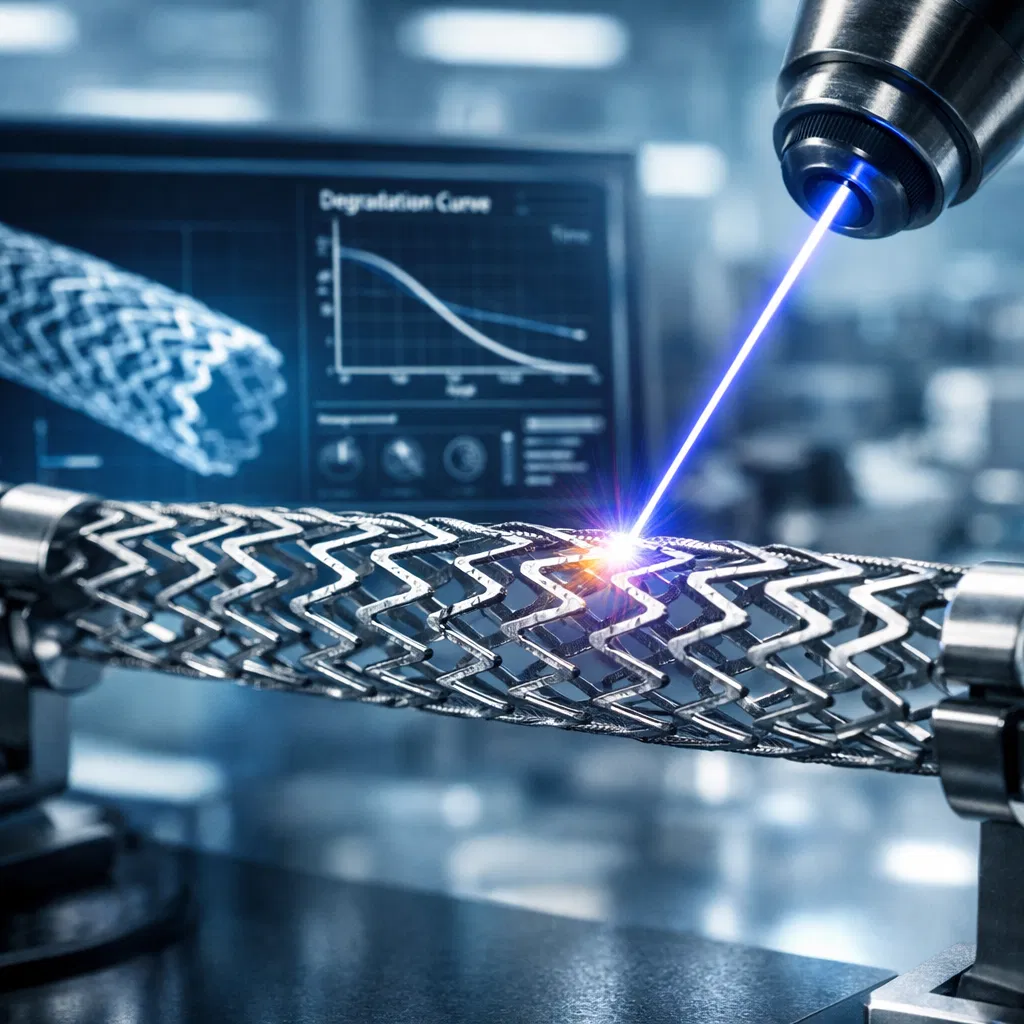
The catch? Processing them without compromising degradation profiles or introducing cytotoxic residues. Laser etching, with its contactless precision, emerges as the ideal manufacturing partner. GuangYao Laser's PrecisionLase MediMark and MediCut platforms already demonstrate this capability, and 2026 forecasts point to exponential growth in bioresorbable device production.
This trend report synthesizes insights from recent medtech conferences, material science advances, and production scaling realities — positioning laser etching as the manufacturing backbone for tomorrow's temporary implants.
Material Trends: What's Degrading (and When)
Magnesium alloys lead the charge, offering mechanical strength comparable to titanium (yield strength 150-300 MPa) with controlled corrosion in physiological environments. Recent formulations achieve 6-12 month resorption timelines, perfect for coronary stents or orthopedic screws.
Polylactic-co-glycolic acid (PLGA) dominates polymer bioresorbables, with tunable degradation (weeks to years) via lactide:glycolide ratios. New 3D-printed PLGA scaffolds incorporate laser-etched microchannels for vascular ingrowth.
Zinc alloys emerge as magnesium alternatives, corroding 5-10x slower while maintaining flexibility for peripheral vascular applications.
Polydioxanone (PDS) and polycaprolactone (PCL) round out the portfolio, each optimized for specific resorption windows:
Material Resorption Time Key Applications Laser Processing Challenge
Mg-Y-Zn-RE 6-12 months Coronary stents, bone screws H₂ evolution control
PLGA 50:50 1-3 months Drug-eluting scaffolds Thermal degradation
Zn-Cu 12-24 months Peripheral vessels Surface passivation
PDS 3-6 months Sutures, soft tissue Crystallinity preservation
PCL 2-4 years Long-term orthopedic Low glass transition
Laser etching must navigate each material's thermal sensitivity while creating functional microstructures (stents lattices, scaffold porosity, drug reservoirs).
Etching Technology Evolution: Cold Ablation for Warm Materials
2026 sees ultrafast lasers (sub-500 fs pulses) become standard for bioresorbables. These "cold ablation" systems remove material faster than heat conducts, preventing:
·Polymer chain scission in PLGA/PCL
·Grain coarsening in magnesium alloys
·Passivation layer disruption in controlled-corrosion metals
Dual-wavelength platforms (IR + green) optimize coupling: 1064 nm penetrates metals, 532 nm excels on polymers. GuangYao Laser's enhanced PrecisionLase systems incorporate adaptive fluence mapping, automatically adjusting pulse energy based on material feedback from inline spectroscopy.
Hybrid scanning combines galvo speed (bulk features) with trepanning (fine details), yielding stent struts as thin as 75 µm in magnesium tubing. Gas assist evolves too — humidified argon prevents magnesium flash rust while enabling polymer swelling control.
2026 Process Innovations
In-situ degradation profiling: Laser-induced breakdown spectroscopy (LIBS) monitors alloy composition post-etch, flagging oxidation or element migration.
Multi-material etching: Single-platform processing of polymer-coated metal stents, preserving delicate drug-polymer interfaces.
Microfluidic integration: Laser-etched resorbable scaffolds with embedded channels for cell media perfusion during tissue engineering.
Surface texturing at scale: Sub-micron patterns accelerate bio-integration while controlling degradation initiation sites.
Throughput jumps 3x via parallel beam delivery — critical as bioresorbable stent volumes approach traditional stainless steel production.
Clinical Applications: Where Trends Meet Patients
Cardiovascular: Bioresorbable vascular scaffolds (BVS) gain second-life traction after early deployment stumbles. Laser-etched magnesium scaffolds with 100 µm struts show 12-month patency rivaling permanent stents, then dissolve without late thrombosis risk.
Orthopedics: Temporary fixation plates/screws eliminate hardware removal surgeries (15% of cases today). PLGA screws with laser-defined resorption gradients match bone healing timelines.
Drug Delivery: Fully bioresorbable implants with zero-order release profiles. Laser-patterned micro-reservoirs in PDS matrices deliver chemotherapeutics for 90 days, then vanish.
Tissue Engineering: 3D-printed scaffolds with laser-etched porosity gradients (50-500 µm pores) guide stem cell differentiation patterns.
Market forecasts peg bioresorbables at $4.2B by 2028, with laser processing capturing 60% of precision manufacturing share.
Regulatory Landscape: FDA's Green Light for Dissolving Devices
2025's FDA breakthrough designations accelerated bioresorbable approvals. Key 2026 milestones:
·Resorbable stent PMA for magnesium platforms (Q2 expected)
·Combination product guidelines clarifying polymer-coated metal hybrids
·Degradation product limits (Mg: <10 ppm daily systemic)
ISO 10993-15 updates standardize long-term degradation testing, emphasizing manufacturing consistency. Laser etching supports this through process analytical technology (PAT) — real-time fluence/depth monitoring ensures every implant degrades as designed.
GuangYao Laser positions customers for compliance with pre-qualified recipes and degradation validation protocols, streamlining 510(k) and PMA submissions.
Production Scale-Up Challenges
Volume ramp: From 1,000 to 100,000 stents/month requires automated tube loading, multi-station cells. Laser platforms scale linearly via beam multiplexing.
Cost targets: Permanent stents cost $800-1200; bioresorbables target $1200-1600 initially. Laser eliminates tooling, amortizing over higher volumes.
Supply chain: Magnesium powder quality varies; laser processes compensate via adaptive parameters. PLGA copolymer consistency improves with new suppliers.
Waste stream: Resorbable swarf requires specialized disposal (no heavy metals, but volume grows with production).
Competitive Technology Landscape
Technology Resolution Materials Scale Cost Degradation Control
Laser Etching 10-50 µm All $$$ Excellent
FDM 3D Printing 100+ µm Polymers $$ Fair
Electrospinning 1-10 µm Polymers $$ Poor
Injection Molding 200+ µm Polymers $ None
Laser holds the precision/scale sweet spot, especially for hybrid metal-polymer devices.
Frequently Asked Questions
Q: Will bioresorbables fully replace permanent implants?
Not entirely — each has niches. Bioresorbables excel where temporary support suffices; titanium/zirconia remain for load-bearing permanence.
Q: How does laser etching preserve degradation kinetics?
Cold ablation avoids altering polymer molecular weight or metal passivation. Inline spectrometry verifies surface chemistry post-process.
Q: What are realistic 2026 production volumes?
Coronary stents: 500k-1M units globally. Ortho screws: 2-5M. Niche drug delivery: 100k+.
Q: Can existing laser systems handle the transition?
Most need parameter libraries and gas handling upgrades. GuangYao Laser's PrecisionLase platforms offer retrofit kits for bioresorbable workflows.
2026 Investment Signals
Venture funding tilts heavily toward bioresorbables: $1.2B in 2025, targeting manufacturing enablers. OEMs like Boston Scientific and Abbott license laser tech for in-house lines. China leads magnesium alloy innovation; Europe dominates polymer scaffolds.
Strategic moves for manufacturers:
Validate laser processes now for first-mover regulatory advantage
Partner with material suppliers for co-optimized alloys/polymers
Build hybrid polymer-metal capability for combo devices
Invest in degradation analytics (beyond simple mass loss)
The Bigger Picture: Implants That Disappear
2026 marks when bioresorbables transition from "interesting research" to "standard care option." Patients gain freedom from lifelong hardware; physicians gain tools that match intervention duration to healing biology; payers save on revisions.
GuangYao Laser's PrecisionLase ecosystem — from etching hardware to process validation — positions medtech innovators to capture this shift. Laser precision isn't following the trend; it's defining it. When your implant dissolves perfectly, every micron etched today made that possible tomorrow.
