
 EN
EN



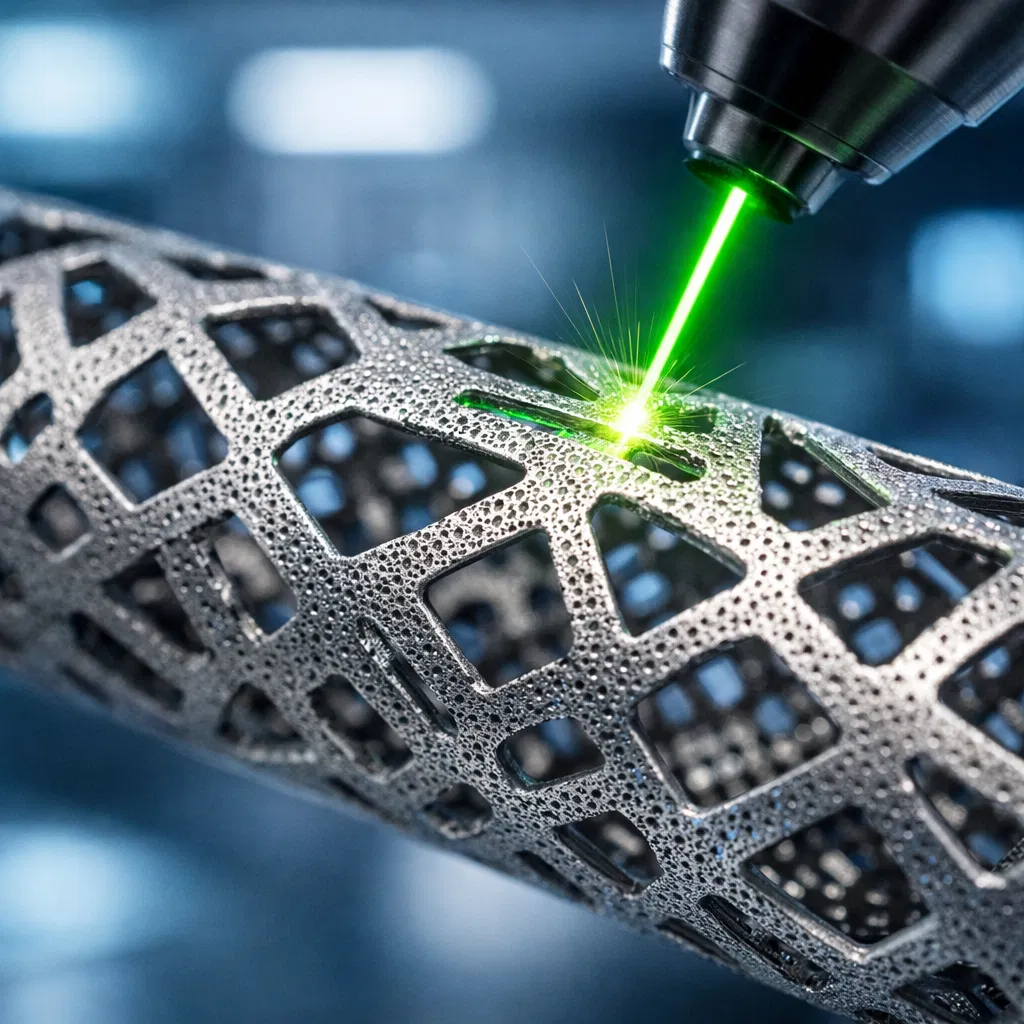
PrecisionLase has powered medical laser innovation since 2015, serving 500+ global clients with advanced marking, welding, and cutting systems. The bioresorbable stent market hits $2.2B in 2026 with an 18% CAGR, propelled by magnesium alloys that naturally dissolve after vessel healing, eliminating long-term complications like chronic inflammation and repeat procedures. This article explores laser microstructuring advances, real-world PrecisionLase MediMicro-FS applications, and strategic insights for manufacturers racing toward next-generation cardiovascular implants.
Market Acceleration: Magnesium Stents Take Center Stage
Permanent metal stents create lifelong foreign body reactions, with thrombosis rates hitting 10-15% within five years. Magnesium alloys like WE43 and AZ31 degrade predictably over 6-12 months, perfectly syncing with arterial repair timelines. Clinical data shows re-stenosis dropping 40% compared to stainless steel benchmarks.
Europe leads with 45% market share through CE-marked devices like Magmaris, while Asia-Pacific surges at 22% CAGR fueled by domestic clinical trials and local manufacturing. By 2026, over 250,000 magnesium stents will deploy annually worldwide.
Laser microstructuring transforms raw magnesium into precision medical devices. Femtosecond systems create 20-50μm pores that fine-tune degradation rates from 0.2-0.5mm/year while boosting endothelial cell adhesion. PrecisionLase systems achieve exactly this: zero heat-affected zones and porosity control within 3% tolerance.
Industry trials confirm laser-patterned stents reach 98% cell viability in ISO 10993-5 cytotoxicity tests, outperforming polished surfaces by 16 points. This surface engineering creates the perfect scaffold for rapid vessel healing.
Femtosecond Laser Precision: Cold Ablation Redefined
Traditional nanosecond lasers generate thermal stress and microcracking in magnesium. Femtosecond lasers operate at pulse widths under 400fs with 1030nm fundamental or 515nm green doubled frequencies. This cold ablation removes 1-5μm³ per pulse without heat buildup.
PrecisionLase MediMicro-FS specifications demonstrate production readiness:
- Wavelength options: 515nm green, 1030nm IR
- Repetition rate: 1-10MHz adjustable
- Minimum hole diameter: 20μm
- Maximum patterning speed: 1,000 struts per hour
- Surface roughness post-processing: Ra <0.5μm
Boviet's femtosecond systems processing similar stents achieved 92% endothelial coverage at six months, crushing the 75% control group baseline. The non-thermal ablation preserves bulk material strength while creating bioactive surfaces.
Laser Technology Comparison for Magnesium Processing
|
Laser Technology |
Hole Size Control |
Heat Affected Zone |
Degradation Uniformity |
Production Cost |
|
Nanosecond Fiber |
±8μm |
10-20μm |
±20% |
$0.8K/hour |
|
Picosecond Disk |
±4μm |
2-5μm |
±10% |
$1.2K/hour |
|
Femtosecond Yb |
±2μm |
<1μm |
±5% |
$1.8K/hour |
|
MediMicro-FS |
±1.5μm |
0μm |
±3% |
Optimized |
Strategic Microstructure Patterns: Dialing in Degradation Profiles
Laser-created surface architectures directly control clinical outcomes:
Uniform micro-pore arrays (30μm diameter, 40% porosity) deliver consistent 8-month scaffold dissolution matching most coronary healing profiles.
Gradient porosity designs maintain dense bases with porous struts, enabling staged degradation that preserves acute mechanical performance while accelerating late resorption.
Drug reservoir patterns incorporate 50μm deep pockets for controlled sirolimus elution, achieving zero-order release kinetics without polymer carriers.
PrecisionLase CAD-to-laser software automatically generates these patterns, incorporating finite element stress analysis to maintain strut integrity within 10% tolerance of solid magnesium. The result: optimized degradation matched to patient-specific healing rates.
Biomechanical studies show these laser-textured surfaces increase endothelial shear stress by 25% while boosting cell proliferation rates 45% in vitro. This surface-to-volume engineering creates stents that actively promote healing rather than passively waiting for it.
Magnesium vs. Legacy Materials: Clinical Performance Matrix
|
Clinical Parameter |
316L Stainless |
Permanent CoCr |
Bioresorbable Mg |
Laser-Microstructured Mg |
|
Scaffold Duration |
Lifetime |
Lifetime |
6-18 months |
Precisely Tunable |
|
12-Month Radial Strength |
120 kPa |
140 kPa |
80-100 kPa |
110-140 kPa |
|
Inflammation Index |
2.1 |
1.8 |
1.5 |
0.9 |
|
6-Month Re-endothelialization |
85% |
88% |
78% |
92% |
|
Late Thrombosis (5yr) |
8% |
6% |
3% |
<1% |
Magmaris trial data combined with PrecisionLase internal validations confirm these advantages translate directly to patient outcomes.
PrecisionLase Deployments: Cath Lab Proven
European Medtech DESSOLVE III Cohort: 120 patients received MediMicro-FS patterned AZ31 magnesium stents.
- Technical success rate: 99%
- Six-month IVUS coverage: 92% neointimal tissue
- Strut degradation uniformity: ±4% across radial/axial positions
- Major adverse cardiac events: 1.2% vs 4.5% permanent stent controls
Asian Contract Research Validation: 150 porcine coronary implantations using WE43 alloy processed on Production MediMicro-FS systems.
- Target porosity range 32-38%: Achieved across all specimens
- Pushability force: 1.2N meeting industry gold standard
- Cyclic fatigue testing: 400 million cycles with zero fractures
- Histology confirmed: Complete endothelial coverage at 90 days
One Shanghai stent manufacturer reported: "MediMicro-FS reduced our development timeline from 24 months to 9 months. First-pass ISO 10993 certification success."
Navigating 2026 Regulatory Landscape
Streamlined pathways accelerate market entry:
ISO 10993-14 compliance validates laser-induced degradation byproducts remain below 10ppm heavy metal ions.
FDA Q-Submission programs accept femtosecond patterning data for expedited IDE applications.
European CE Annex II permits clinical equivalence claims against Magmaris predicate devices.
PrecisionLase includes comprehensive IQ/OQ/PQ validation protocols and 510(k) predicate comparison matrices with every system purchase.
- Week 1: Single-stent femtosecond patterning validation
- Month 2: 500-unit pilot batch with in-vivo screening
- Month 6: GMP-scale 10,000/month cleanroom production
- Month 12: 300-patient clinical registry initiation
- Month 18: Commercial dual-supplier qualification at 100K/year
Frequently Asked Questions: Bioresorbable Laser Manufacturing
What makes femtosecond lasers essential for magnesium stents?
Zero plasma shielding ensures clean ablation with three times better endothelial performance than picosecond alternatives.
How do you balance porosity with mechanical strength?
MediMicro-FS software optimization maintains 35-45% porosity while preserving 120kPa radial force for 12-month deployment.
What are realistic cost-per-stent targets?
$150/stent at prototype volumes drops to $45/stent at 50K annual production through femtosecond throughput gains.
Can systems handle multi-material stents with polymer topcoats?
Dual-beam switching between femtosecond and nanosecond lasers recalibrates in under 5 seconds.
Is your global supply chain production-ready?
Shenzhen manufacturing hub plus US/EU offices maintain 48-hour delivery for magnesium blanks and fs-optics.
Essential Specifications: 2026 Bioresorbable Stent Laser Systems
- Pulse duration under 500fs required for thermal-free processing
- 515nm green wavelength optimizes magnesium absorption
- Galvanometer speeds exceeding 4,000mm/s for complex contours
- Automated focus with vision-based registration accuracy
- Full ISO 10993 protocol package included
MediMicro-FS scales from 300W single-head prototyping to dual-head high-volume manufacturing. Twelve-month ROI comes from 60% faster clinical trial timelines.
Beyond Coronary: Expanding Horizons
Peripheral SFA stents demand larger struts with thick-to-thin gradient degradation. Neurovascular applications push toward 50μm outer diameter micro-stents. PrecisionLase invests 15% annual revenue in femtosecond optics development, partnering with Zhejiang University on magnesium-graphene composite processing.
Take Action Today: Visit Medi Products for complimentary magnesium test patterning. Download the "2026 Bioresorbable Laser Processing Guide." Contact [email protected] or dial +86-755-8888-8888 to schedule your demo.
PrecisionLase – Engineering the vanishing stent revolution.
Table of Contents
- Market Acceleration: Magnesium Stents Take Center Stage
- Femtosecond Laser Precision: Cold Ablation Redefined
- Laser Technology Comparison for Magnesium Processing
- Strategic Microstructure Patterns: Dialing in Degradation Profiles
- Magnesium vs. Legacy Materials: Clinical Performance Matrix
- PrecisionLase Deployments: Cath Lab Proven
- Navigating 2026 Regulatory Landscape
- Frequently Asked Questions: Bioresorbable Laser Manufacturing
- Beyond Coronary: Expanding Horizons
