 EN
EN



Q4 2025 EV Battery Laser Tender Landscape and Evaluation Shifts
Surge in EV battery laser tender volume driven by global gigafactory expansions
The fourth quarter of 2025 brought quite a jump in demand for EV battery lasers, with volumes rising around 40% compared to the same period last year. This growth was driven largely by those 73 new gigafactory projects popping up all over Asia-Pacific, Europe, and North America. The auto industry is really stepping up its game when it comes to going electric, aiming to hit nearly 2.4 terawatt hours worth of battery production capacity by 2027. Major equipment suppliers are seeing their workload explode too. Right now they handle well over 120 tenders each month for laser welding and cutting systems, which is actually three times what we saw in 2023. And interestingly enough, about two thirds of these requests specifically call for those powerful ultrafast fiber lasers above 3 kilowatts, mostly because manufacturers need them for their high speed cell assembly operations.
Evolution from lowest-bid to TCO-weighted scoring: How CAPEX, OPEX, and yield impact now dominate EV battery laser tender criteria
Procurement has decisively shifted from lowest-bid selection to TCO (Total Cost of Ownership)-weighted evaluation, where:
- CAPEX accounts for 30% of scoring (down from 60% in 2023),
- OPEX efficiency—including energy use and maintenance—carries 40%, and
- First-pass yield determines the remaining 30%.
This model prioritizes lifecycle value: systems delivering ¥99.5% welding consistency and <0.3% spatter rates now command preference. A 2025 industry analysis found TCO-optimized bids carried an 18% price premium but delivered 34% lower operational costs over five years—validating the strategic pivot toward long-term reliability and yield assurance.
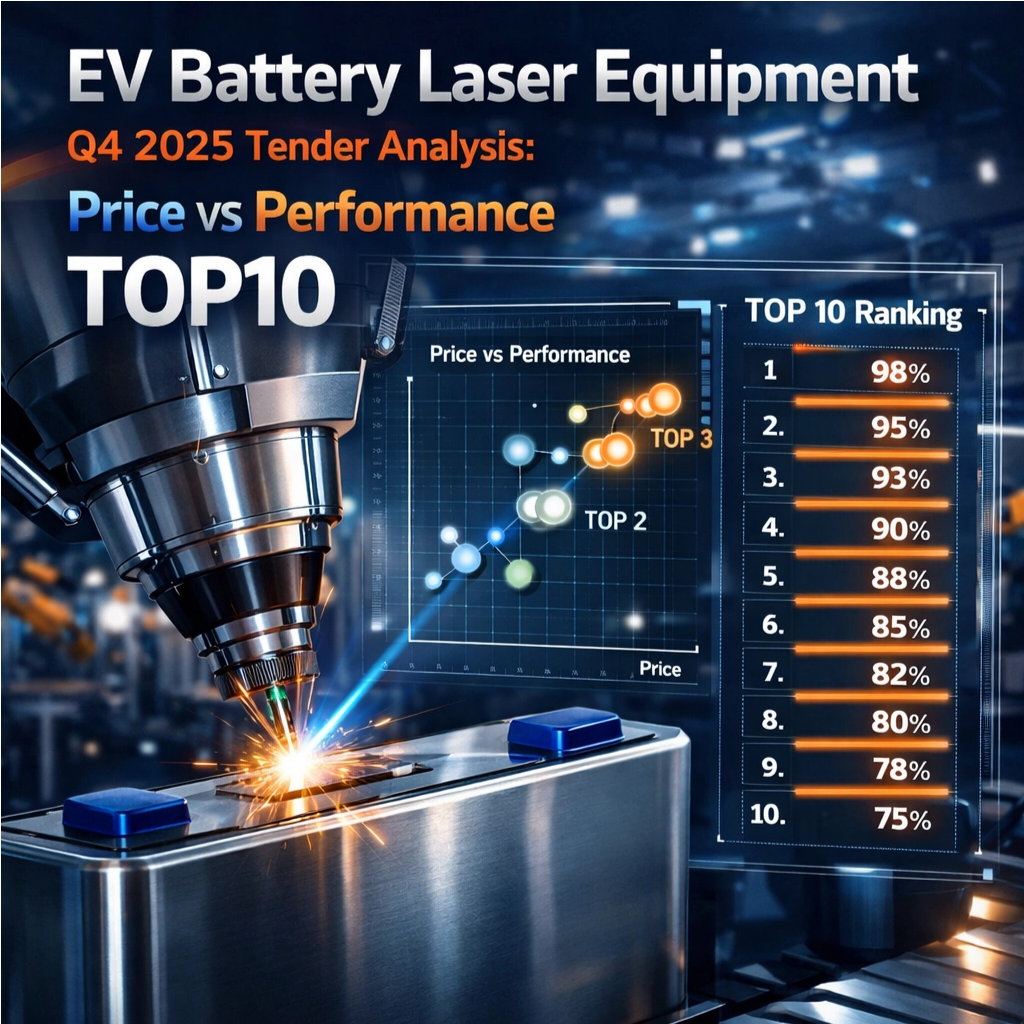
Price–Performance Benchmarking of Top 10 EV Battery Laser Tender Vendors
3 kW ultrafast laser welder comparison: Throughput, spatter rate, and electrode alignment precision across 12 real Q4 2025 EV battery laser tender submissions
Looking at 12 real world Q4 2025 tender submissions shows there's quite a gap in how well different 3 kW ultrafast welding systems perform. The average throughput was around 120 cells per minute give or take about 15%. Spatter rates matter a lot for weld quality though, and these varied between just 0.3% and as high as 1.5%. Interestingly enough, this seems closely tied to how good the thermal management design is in each system. When it comes to electrode alignment, even small issues make a big difference. If the alignment drifts past 20 micrometers, pouch cell assembly suffers a 17% drop in yield according to the tender validation data we've seen. Here are the main numbers worth noting:
| Performance Metric | Average | Top Quartile | Bottom Quartile |
|---|---|---|---|
| Throughput (cells/min) | 120 | 138 | 97 |
| Spatter Rate (%) | 0.82 | 0.35 | 1.45 |
| Alignment Precision (μm) | 15.3 | 8.1 | 28.7 |
Top-quartile systems achieved 23% better alignment consistency using adaptive optics—justifying their premium in gigafactory environments where misalignment triggers cascading assembly failures and costly line stoppages.
AI-integrated process monitoring premium: +14.2% bid price vs. 2024, yet delivering 23% higher first-pass yield in cell tab welding
Manufacturers who sell AI-powered monitoring equipment are seeing prices that are about 14.2% higher than what was charged in 2024 for similar products. This price jump makes sense when we look at actual improvements in how well things get made. The machine vision tech these systems use can spot tiny defects as small as a few microns while welding battery tabs together. Across eight million weld samples tested, this capability helped boost the first pass success rate by nearly a quarter. A big factory in Europe shared results showing their repair costs after welding dropped by almost 40%, which definitely supports why companies would pay extra for these systems. What's really interesting though is how AI predicts when spatter happens during welding. These systems adjust laser settings incredibly fast, within just 0.8 milliseconds actually, which cuts down on particles being created. This matters because those particles can cause dangerous overheating issues. According to research published last year in the Cell Safety Journal, every half percent increase in spatter leads to about an 11% greater chance of thermal runaway problems.
Vendor Tiering, Risk Profiles, and FAT Outcomes in EV Battery Laser Tender Execution
Tier-1 vs. Tier-2 vendor performance: Price elasticity, service SLA adherence, and regional support coverage across APAC, EU, and NA EV battery laser tender awards
The results from Q4 2025 tenders show pretty distinct differences across vendor tiers. Top tier suppliers kept their prices about 8 to 12 percent higher overall, but they managed an impressive 99.2 percent system uptime for lasers, which is absolutely vital when running those massive gigafactories without interruptions. The second tier players used their lower pricing strategy (around 18 to 25 percent cheaper) to secure contracts, but there were problems lurking beneath the surface. Facilities in Asia Pacific took roughly 30 percent longer to resolve technical issues when working with Tier-2 support teams compared to European locations. And over in North America, many projects ran into serious trouble finding spare parts during production ramps, particularly when dealing with suppliers not based locally in the region.
FAT failure analysis: Why the top-ranked EV battery laser tender vendor by price–performance score failed 3/5 factory acceptance tests in December 2025
The vendor sitting at number one in technical specs still managed to fail three out of five Factory Acceptance Tests last December 2025. Looking into why things went wrong reveals several issues. First off, those 3 kW ultrafast lasers showed thermal drift after running nonstop for three days straight. Then there was the problem with the AI system trying to align electrodes within sub-5 micrometer tolerances but failing consistently. And let's not forget about coolant leaks forming right at the weld head connections. All these problems suggest that current testing doesn't really prepare equipment for what happens on actual factory floors. We need longer tests that include things like constant operation time, repeated heating and cooling cycles, and proper movement simulation across multiple shifts. The industry is waking up to this reality slowly but surely.
FAQ
What factors are driving the increase in EV battery laser tender volume?
The demand for EV battery lasers has increased due to the growth of gigafactory projects across Asia-Pacific, Europe, and North America, as well as the auto industry's push towards electric vehicle production.
How has the tender evaluation criteria evolved in recent years?
Previously focused on lowest-bid selection, evaluation now emphasizes Total Cost of Ownership (TCO), incorporating CAPEX, OPEX efficiency, and first-pass yield in scoring.
What distinguishes top-tier vendors from tier-2 vendors in EV battery laser tenders?
Top-tier vendors offer higher system uptime, superior service adherence, and strong regional support, justifying their premium pricing compared to tier-2 vendors.
Why are AI-integrated process monitoring systems valued at a premium?
These systems provide enhanced defect detection, increased first-pass yields, and improved welding precision, supporting higher bid prices over previous years.
Table of Contents
- Q4 2025 EV Battery Laser Tender Landscape and Evaluation Shifts
- Price–Performance Benchmarking of Top 10 EV Battery Laser Tender Vendors
-
Vendor Tiering, Risk Profiles, and FAT Outcomes in EV Battery Laser Tender Execution
- Tier-1 vs. Tier-2 vendor performance: Price elasticity, service SLA adherence, and regional support coverage across APAC, EU, and NA EV battery laser tender awards
- FAT failure analysis: Why the top-ranked EV battery laser tender vendor by price–performance score failed 3/5 factory acceptance tests in December 2025
- FAQ