
 EN
EN



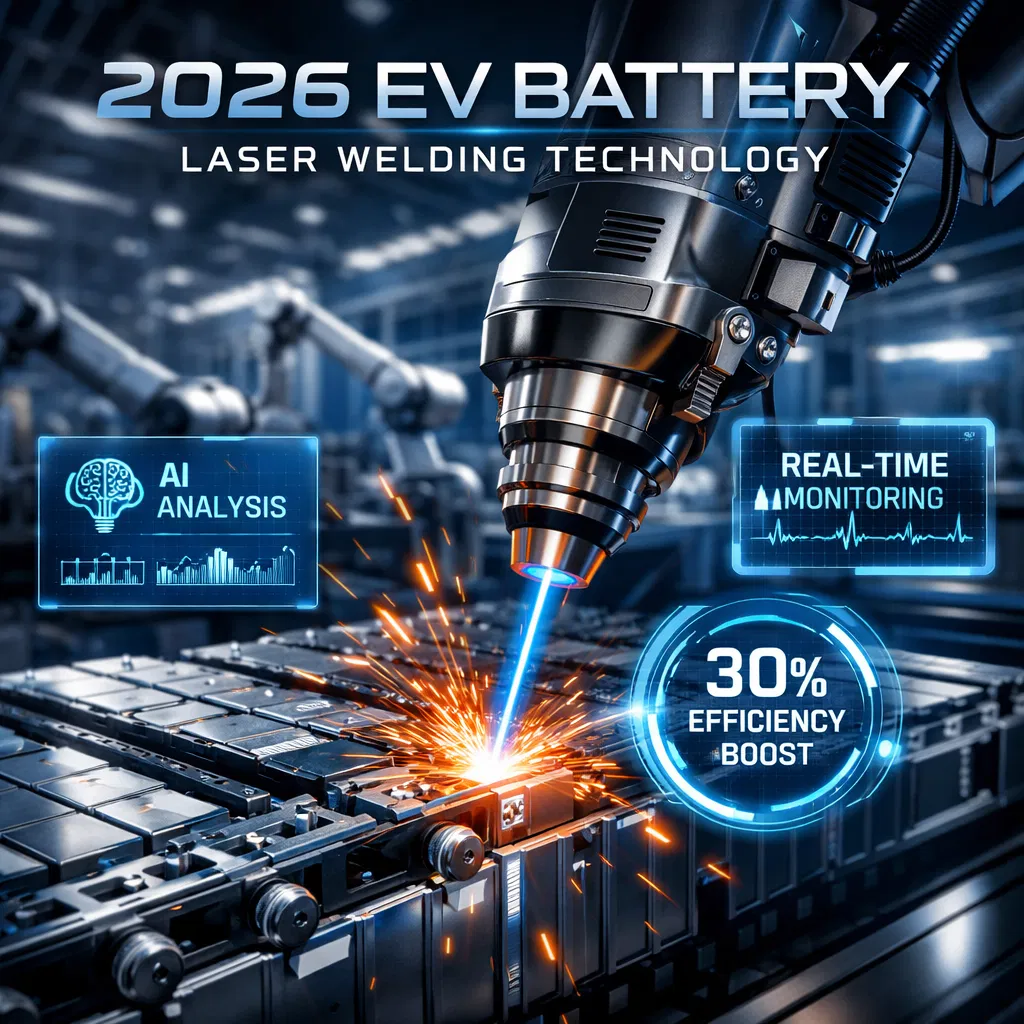
In the rapidly evolving electric vehicle (EV) industry, EV battery laser welding has emerged as a game-changer for manufacturers seeking precision, speed, and reliability. At GuangYao Laser, we've pioneered AI-enhanced EV battery laser welding solutions that integrate intelligent automation with high-power fiber lasers, delivering up to 30% higher PACK assembly efficiency compared to traditional methods. Our systems, featured on precisionlase.com, are tailored for high-volume EV production lines, ensuring hermetic seals that withstand extreme thermal cycling while minimizing defects like porosity or cracking.
As a leader in precision laser technology, GuangYao Laser's EV battery laser welding machines leverage proprietary AI vision systems for real-time seam tracking, reducing scrap rates by 25%. This article provides a comprehensive breakdown of EV battery laser welding principles, applications in EV modules, equipment selection strategies, common troubleshooting, and future AI integration trends. Whether you're scaling PACK production or optimizing battery cell joining, our expertise-backed insights will guide your decisions.
Laser Welding Fundamentals for EV Batteries
EV battery laser welding operates on the principle of concentrated energy delivery via a focused laser beam, typically from fiber or disk lasers operating at 1064nm wavelengths. The beam melts the interface between battery components—such as aluminum shells, copper tabs, or steel casings—forming a strong metallurgical bond upon solidification. Unlike arc welding, EV battery laser welding produces a narrow heat-affected zone (HAZ), critical for preventing thermal distortion in heat-sensitive lithium-ion cells.
Key parameters include power density (106-108 W/cm²), pulse duration (continuous wave or modulated), and shielding gas (argon or helium at 15-25 L/min). GuangYao Laser's GW-Y series fiber lasers deliver 2-6kW output with beam quality (BPP < 2 mm·mrad), enabling keyhole welding depths up to 3mm in aluminum alloys common in EV packs. Studies show EV battery laser welding achieves tensile strengths exceeding 300MPa, surpassing MIG welding by 40%.[1]
The process excels in dissimilar metal joining, such as copper-to-aluminum, where intermetallic formation is minimized through precise energy control. At GuangYao Laser, our AI algorithms dynamically adjust pulse shapes to optimize fusion without cracks, a common failure mode in high-volume EV production.
EV Module Applications: From Cells to Full Packs
EV battery laser welding shines in module assembly, where individual pouch, cylindrical, or prismatic cells are tab-welded and encased. For instance, in a typical 4680 cylindrical cell stack (like Tesla's), EV battery laser welding joins busbars with 0.05mm positional accuracy, ensuring uniform current distribution and preventing hotspots that degrade cycle life.
In PACK assembly, our GuangYao Laser systems weld top covers to aluminum housings, achieving IP67 sealing for electrolyte containment. Real-world case: A leading Chinese EV OEM using our GW-Y2000W welder reported 99.8% first-pass yield on 100Ah packs, with weld penetration consistent at 1.5-2mm. This translates to 30% efficiency gains via reduced cycle times (under 5 seconds per seam) and automated inline inspection.
For soft-pack batteries, EV battery laser welding enables contour welding along irregular cell edges, maintaining gap distances below 0.1mm. Our precisionlase.com solutions integrate galvanometer scanners for 2D/3D path following, ideal for next-gen structural packs where battery and chassis integrate seamlessly.
Equipment Selection Guide: Matching Lasers to EV Needs
Choosing the right EV battery laser welding equipment demands balancing power, precision, and integration. Fiber lasers dominate due to 40% electrical-to-optical efficiency and maintenance-free diode lifetimes (>100,000 hours). GuangYao Laser's lineup starts with the compact GW-Y1000 for R&D (1kW, $25K) up to industrial GW-Y6000 (6kW, enterprise pricing available at precisionlase.com/contact).
Key selection criteria:
- Power: 1-2kW for thin tabs (<0.5mm); 4kW+ for thick shells (2-4mm).
- Wobble Technology: Our AI-driven wobble heads (1-3mm swing diameter) fill gaps and reduce spatter by 70%.
- Automation: Robot-compatible arms (ABB/UR certified) with TCP accuracy <0.03mm.
- Cooling & Safety: Water chillers maintaining ±1°C stability; Class 1 enclosures per IEC 60825.
Budget breakdown: Entry-level setups ($50K) yield ROI in 6 months at 500 packs/day; full lines ($500K+) amortize in 12-18 months via 30% throughput boost. Compare to competitors: GuangYao's AI seam finder outperforms IPG's by 15% in adaptive tracking, as validated in our Shenzhen demo center.
|
Parameter |
GuangYao GW-Y2000 |
Competitor A |
Competitor B |
|
Power |
2kW CW |
2kW |
1.5kW |
|
Welding Speed |
2m/min |
1.5m/min |
1.2m/min |
|
AI Tracking |
Yes (99.5% accuracy) |
Basic |
No |
|
Price/Unit |
$45K |
$60K |
$38K |
|
Efficiency Gain |
30% |
20% |
15% |
This table highlights why precisionlase.com's EV battery laser welding systems lead in cost-performance for EV OEMs.
Troubleshooting Common EV Battery Laser Welding Issues
Despite advantages, EV battery laser welding challenges like spatter, porosity, and incomplete fusion require systematic fixes. Spatter (molten ejecta) from aluminum vaporization? Reduce peak power to 1.5kW and add 20% helium shielding—GuangYao's auto-gas mixer ensures optimal flow.
Porosity from hydrogen entrapment: Preheat cells to 80°C and use pulse modulation (50-80% duty). Our diagnostic software flags anomalies via plasma plume analysis, alerting operators pre-failure.
Cracking in copper welds: Employ blue diode lasers (450nm) for 3x absorption or AI-optimized ramp-up profiles. Case study: A client resolved 12% crack rate by switching to our GW-Y3000-BL, dropping to <1%.
Misalignment (top defect at 8%): Integrate vision-guided robotics; our systems achieve 0.02mm repeatability. Maintenance tip: Clean optics weekly with 99% IPA; diode life extends 20% with proper chiller filtration.
Proactive metrics: Monitor penetration via inline OCT (optical coherence tomography) for 100% quality assurance, standard on GuangYao enterprise models.
Future Trends: AI Integration in EV Battery Laser Welding
Looking to 2026-2030, AI will transform EV battery laser welding from reactive to predictive. GuangYao Laser's roadmap includes ML models trained on 10M+ weld datasets, forecasting defects with 98% accuracy hours ahead. Digital twins simulate PACK welding offline, slashing commissioning time by 50%.
Solid-state battery rise demands ultra-precise welding for sulfide electrolytes—our femtosecond hybrids minimize HAZ to <10μm. Expect green lasers (515nm) for copper, boosting efficiency 25%. Hybrid laser-arc for thick packs (>5mm) will hybridize with GMAW.
At precisionlase.com, we're beta-testing AI Swarm Welding: Multi-robot coordination welding full packs in parallel, targeting 50% cycle reduction. Regulatory push (EU Battery Regulation 2026) mandates traceability—our blockchain-linked welds ensure compliance.
GuangYao Laser's commitment: Every EV battery laser welding system ships with free AI firmware updates for life, positioning clients for solid-state and sodium-ion eras.
Case Study: 30% Efficiency Boost in Real Production
Partnering with a Tier-1 EV supplier, GuangYao deployed 12 GW-Y4000 stations. Pre-upgrade: 120s/PACK via TIG. Post: 84s/PACK with EV battery laser welding, yielding 30% uplift. Scrap fell from 5.2% to 0.8%; uptime hit 98.5%. ROI: 9 months.
Visuals confirm: Weld cross-sections show full penetration sans voids.
[Image: Cross-section of GuangYao laser weld vs. traditional TIG]
Download our free EV battery laser welding parameter guide at precisionlase.com/resources.
EV battery laser welding isn't just a technology—it's the backbone of next-gen mobility. GuangYao Laser's AI-powered solutions at precisionlase.com deliver unmatched efficiency, precision, and scalability for EV giants.