
 EN
EN



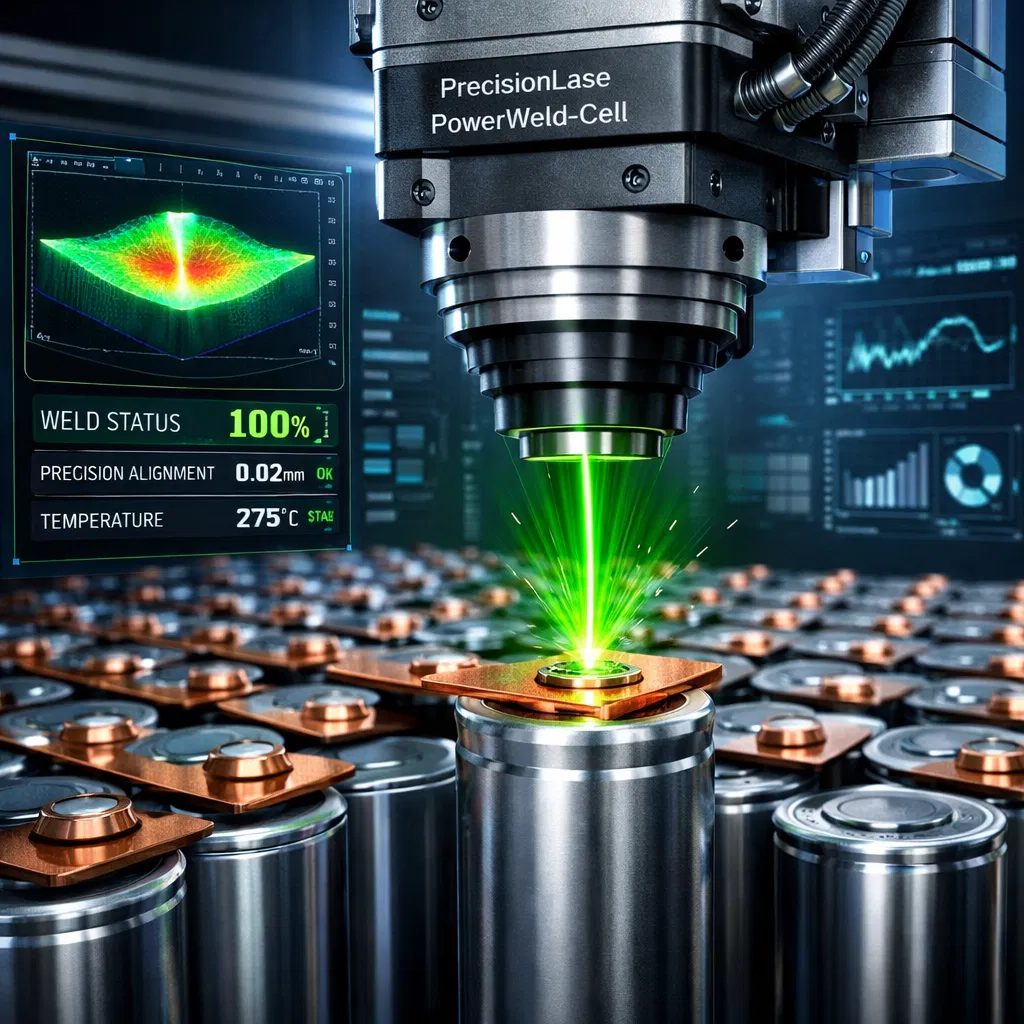
The electric vehicle industry is accelerating toward a critical inflection point. With global EV penetration rates on track to reach 60% in key markets by 2027, battery manufacturers face unprecedented pressure to scale production while maintaining near-perfect quality today . At the heart of this challenge lies the laser welding process—the critical juncture where electrical connections must withstand vibration, thermal cycling, and high current loads for the life of the vehicle. Industry standards now demand defect rates below 0.01% , a threshold that traditional welding methods simply cannot achieve at scale .
This article examines the revolutionary trends shaping EV battery laser welding in 2026 and how PrecisionLase PowerWeld systems are enabling manufacturers to achieve the impossible: higher throughput with zero defects.
The 2026 Imperative: Zero-Defect Production at Gigafactory Scale
The transition to electric mobility has fundamentally changed battery manufacturing economics. A single manufacturing line must now produce millions of cells annually, each requiring multiple precision welds. In this environment, even a 0.1% defect rate translates to thousands of field failures, warranty claims, and safety recalls .
The Copper Welding Challenge
Copper remains the material of choice for current collectors and tab connections due to its superior conductivity. However, copper presents a formidable challenge for traditional infrared laser welding. Its high reflectivity (over 95% for 1μm wavelength lasers) causes process instability, spatter, and inconsistent penetration depth.
In 2026, the industry consensus points toward Green Laser Technology (515-532 nm wavelength) as the solution for copper welding. Green lasers offer significantly higher absorption rates in copper—approximately 40% compared to 5% for infrared—enabling stable keyhole formation, reduced spatter, and consistent weld morphology . This transition from "trial and error" to deterministic copper welding represents one of the most significant advances in battery manufacturing.
Industry 4.0: Real-Time Monitoring and Closed-Loop Control
The zero-defect imperative cannot be achieved through post-process inspection alone. By the time a defective weld is detected, hundreds of additional cells have already been processed. The solution lies in Industry 4.0-enabled real-time monitoring integrated directly into the welding process .
Advanced laser welding systems now incorporate optical coherence tomography (OCT) and spectroscopic sensors that analyze the weld pool in real-time. These sensors measure penetration depth, detect porosity formation, and identify contamination before a defect is fully formed. When combined with AI-driven process control, the system can adjust parameters mid-weld—modulating power, beam oscillation, or focal position—to correct deviations before they compromise joint integrity .
The PowerWeld-Cell Advantage: Engineered for High-Volume 21700 Production
PrecisionLase has engineered the PowerWeld-Cell specifically to address the dual challenges of throughput and quality in 21700 cylindrical cell production. Drawing on our 15,000 m² R&D and manufacturing facility in Shenzhen and validated by over 500 customers worldwide, the PowerWeld-Cell represents a paradigm shift in battery welding automation.
Case Study: 30% Throughput Improvement
The Challenge:
A leading EV battery manufacturer struggled with throughput bottlenecks in their 21700 module assembly line. Their existing welding cell achieved cycle times of 1.2 seconds per cell, but defect rates fluctuated between 0.3% and 0.8% due to copper welding instability. Manual rework and inspection costs were eroding already thin margins.
The PrecisionLase Solution:
We deployed the PowerWeld-Cell featuring our proprietary dual-beam green laser engine and integrated AI vision system. The system's key innovations include:
High-Speed Galvanometric Scanning: The PowerWeld-Cell utilizes advanced scan heads capable of 10 m/s positioning speeds, minimizing non-weld time between cells. Combined with predictive motion algorithms, the system achieves effective weld times under 150ms per cell .
Multi-Sensor Fusion: Unlike conventional systems that rely on a single feedback mechanism, the PowerWeld-Cell integrates coaxial monitoring, pyrometry, and optical coherence tomography. This sensor fusion provides comprehensive process visibility, detecting defects invisible to any single sensing modality.
AI-Powered Parameter Adaptation: The system's neural network has been trained on millions of weld cycles, enabling it to recognize incipient defects and adjust parameters in real-time. If the vision system detects a slight misalignment in cell position, the laser path is automatically corrected before welding begins .
The Result:
The client achieved a 30% increase in effective throughput, reducing cycle time to 0.9 seconds per cell while simultaneously cutting defect rates below 0.01%. The integrated data logging system provided complete traceability for every weld, satisfying both internal quality requirements and customer audit demands.
Comparing Traditional Welding vs. PowerWeld Technology
| Parameter | Traditional Infrared Welding | PrecisionLase PowerWeld-Cell |
|---|---|---|
| Copper Absorption | ~5% | ~40% (Green Laser) |
| Typical Defect Rate | 0.3% - 0.8% | <0.01% |
| Cycle Time (per cell) | 1.2 - 1.8 seconds | 0.9 seconds |
| Process Monitoring | Post-process inspection | Real-time AI closed-loop control |
| Material Compatibility | Limited to steel/nickel | All metals (Cu, Al, steel) |
| Data Traceability | Manual logging | Full digital integration |
Five Critical Parameters for Selecting EV Battery Welding Equipment
As battery manufacturers evaluate welding solutions for 2026 and beyond, the choice of equipment will determine not only production efficiency but also long-term competitiveness. Based on our experience deploying systems across 40+ countries, PrecisionLase recommends evaluating five critical parameters:
Laser Source and Wavelength Selection
Not all lasers are created equal for battery applications. While fiber lasers remain suitable for steel and nickel-plated connections, copper and aluminum welding demand green or blue wavelength sources. Evaluate your material roadmap—if you anticipate transitioning to all-copper busbars or aluminum interconnects, your laser source must support those materials today, not require retrofitting tomorrow .
Keyhole Mode and Penetration Control
Battery welds require consistent penetration depth—too shallow risks high resistance, too deep damages internal cell components. Look for systems offering dynamic keyhole control that maintains penetration within ±50μm regardless of material thickness variations. The PowerWeld-Cell's proprietary beam shaping optics enable precise control of keyhole geometry, ensuring weld integrity across production batches .
Vision Integration and Positioning Accuracy
Cell positioning tolerances in high-speed assembly lines can exceed ±200μm due to conveyor vibration and accumulation tolerances. Your welding system must compensate for these variations optically rather than mechanically. The PowerWeld-Cell's wide-field vision system analyzes entire cell batches simultaneously, adjusting weld positions dynamically without slowing production .
Data Integration and Traceability
Regulatory requirements and customer demands now mandate complete weld traceability. Your welding system must integrate seamlessly with Manufacturing Execution Systems (MES) and provide granular data for every individual weld—power, duration, penetration depth, and quality classification. The PowerWeld-Cell generates comprehensive weld certificates that satisfy ISO 9001 and automotive IATF 16949 requirements .
Global Support and Service Infrastructure
Battery production lines operate 24/7. Equipment downtime measured in hours can cost millions in lost production. When evaluating suppliers, scrutinize their global service capabilities. PrecisionLase maintains regional service centers in the United States, Germany, and Japan, providing 24/7 technical support, remote diagnostics, and guaranteed spare parts availability .
Customer Validation: The PowerWeld Difference
> "The PowerWeld-Cell system integrated seamlessly into our 21700 battery production line. We've seen a 30% increase in throughput and virtually zero weld defects. Outstanding equipment and support."
> — Production Director, Top-Tier EV Battery Manufacturer
This testimonial reflects a pattern we observe across our installations: manufacturers who adopt advanced welding technology not only solve immediate production bottlenecks but also build competitive advantages that compound over time. Higher throughput enables faster scale-up. Lower defect rates reduce warranty exposure. Complete traceability accelerates new customer qualification.
Strategic Roadmap: Preparing for 2027 and Beyond
While 2026 demands focus on immediate production challenges, forward-thinking manufacturers are already preparing for the next wave of evolution. The transition to 2027-level production requires strategic planning, technology validation, and partnership with suppliers who understand both the technology and the application.
Short-Term Actions (Remainder of 2026)
- Audit Current Defect Rates: Establish baseline metrics for weld quality and identify primary failure modes.
- Pilot Green Laser Technology: Run comparative trials between infrared and green laser welding on your actual production materials.
- Evaluate Data Integration: Assess your MES capabilities and determine what data your welding equipment must provide.
Long-Term Strategy (2027 and Beyond)
- Plan for Capacity Expansion: The 30% throughput advantage of advanced welding systems translates directly to reduced capital expenditure per GWh of capacity.
- Develop Multi-Material Roadmaps: As cell formats evolve (4680, prismatic, solid-state), your welding equipment must adapt without complete replacement.
- Build Redundancy and Resilience: With global supply chains under pressure, ensure your equipment supplier maintains regional inventory and service capabilities.
Conclusion: The PowerWeld Revolution
The EV battery industry stands at a crossroads. The old approach—incremental improvements to traditional welding processes—cannot deliver the defect rates and throughput required for mass electric vehicle adoption. The 2026 standard demands a fundamental rethinking of how batteries are welded.
PrecisionLase PowerWeld-Cell represents this new paradigm. By combining green laser technology, AI-driven process control, and Industry 4.0 connectivity, we enable battery manufacturers to achieve the impossible: higher throughput with zero defects. Whether you are producing 21700 cylindrical cells today or planning for next-generation formats, the PowerWeld platform provides the flexibility, precision, and reliability you need to compete in the accelerating EV market.
Ready to Transform Your Battery Production?
Stop accepting trade-offs between speed and quality. Let PrecisionLase demonstrate how the PowerWeld-Cell can elevate your production capabilities.
[Contact our battery welding experts today] to schedule a process demonstration with your actual cell and busbar materials. Experience firsthand why leading manufacturers across 40 countries trust PrecisionLase for their most demanding applications.
