EN
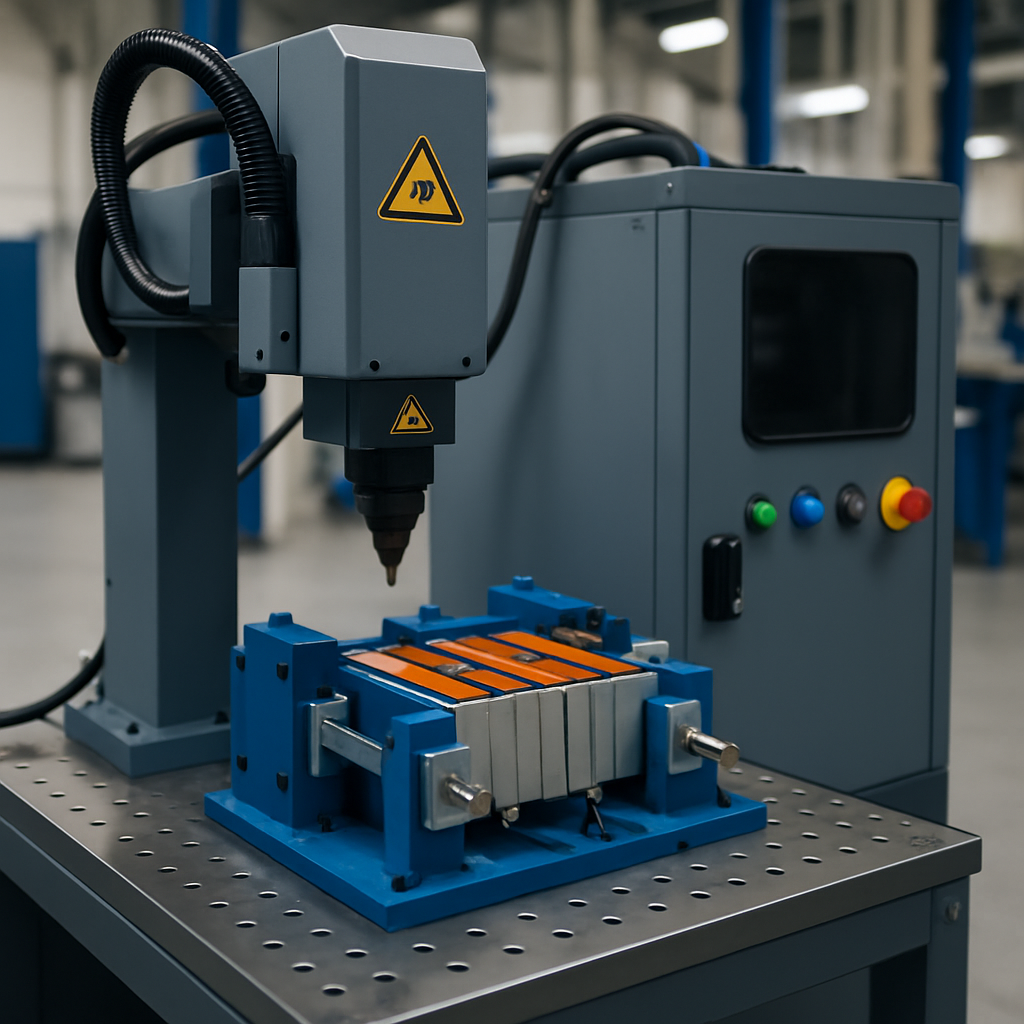
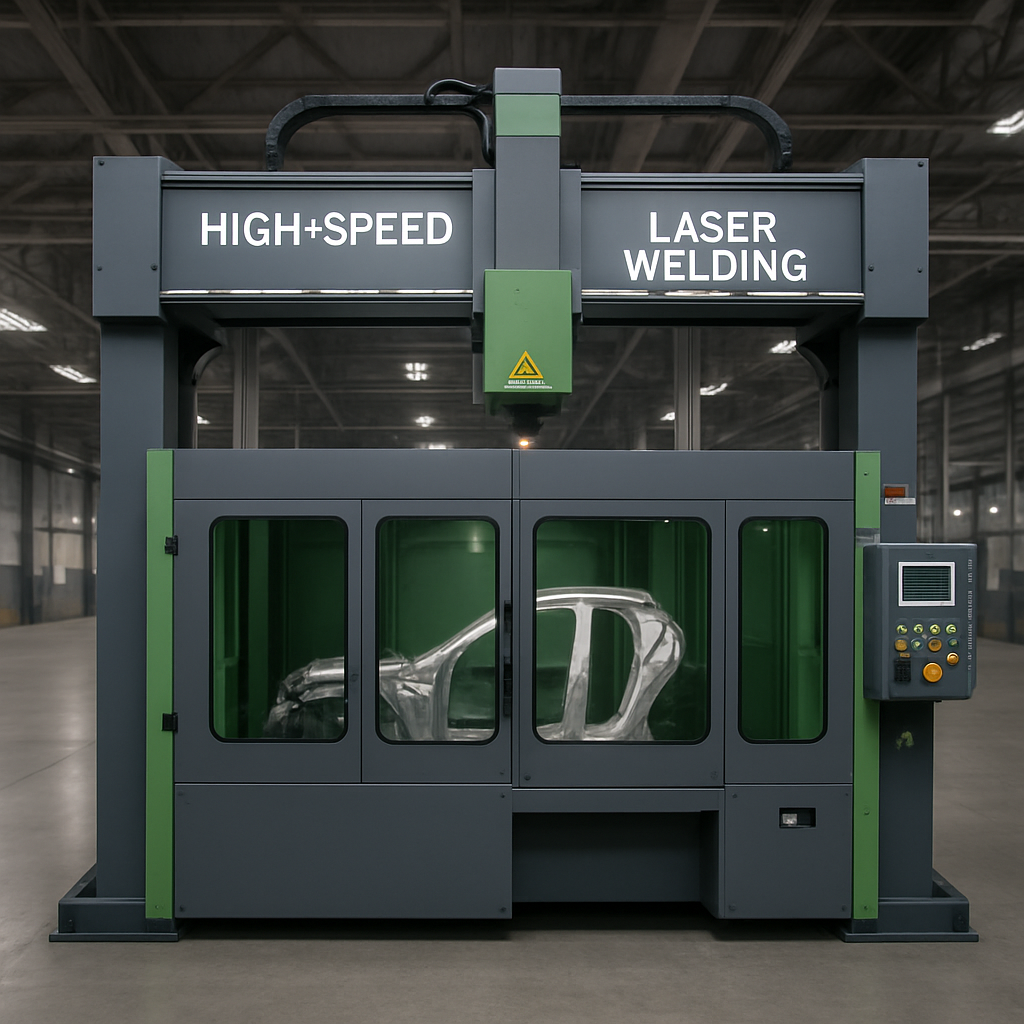
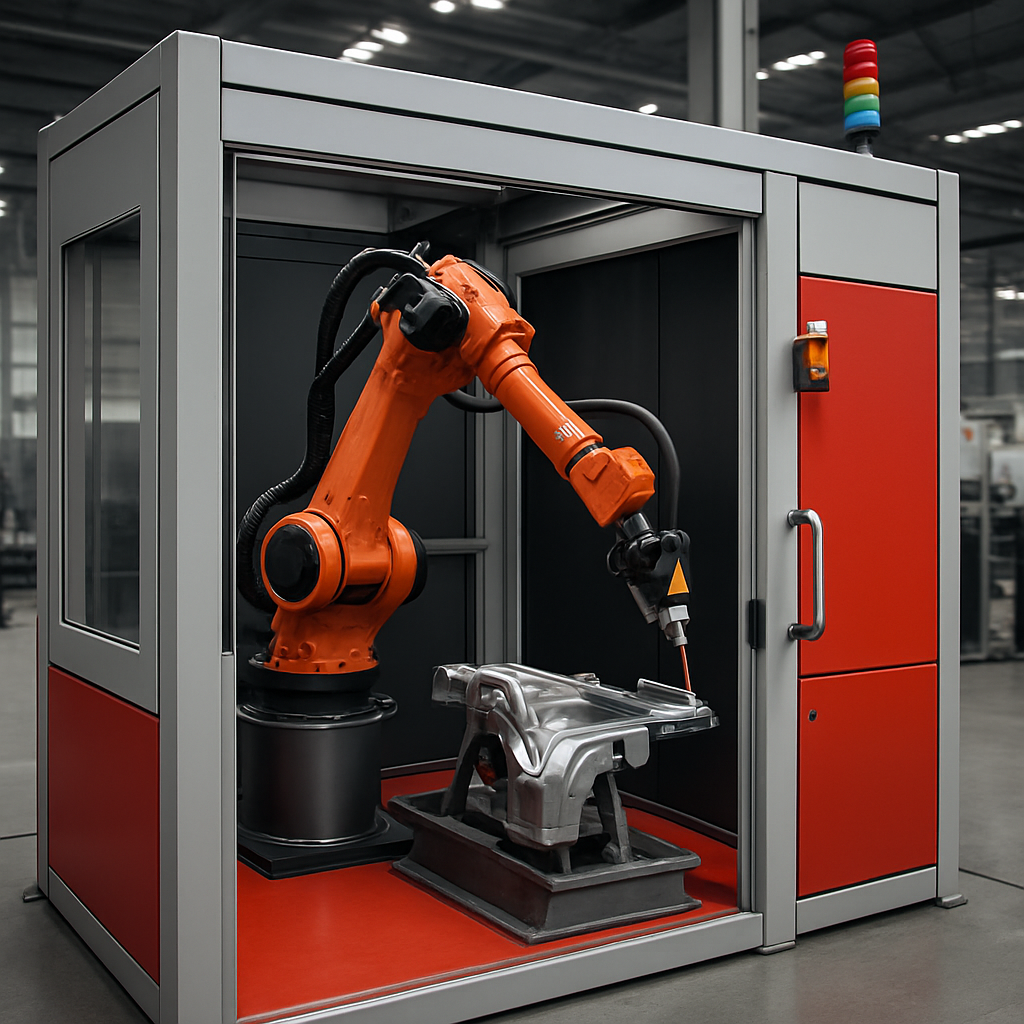
PowerWeld-Module revolutionizes EV battery module assembly with specialized high-power laser welding technology optimized for busbar-to-cell connections and cooling plate integration. This production-proven system achieves 150mm/s welding speeds with 3.0mm penetration depth in aluminum components while maintaining ±0.02mm positional accuracy required for automotive-grade quality. Designed for both prismatic and pouch cell modules, the system features full robotic automation, real-time weld quality monitoring, and seamless MES connectivity to ensure complete production traceability. Delivered as a turnkey solution, PowerWeld-Module minimizes line integration time while maximizing throughput and weld reliability for high-volume EV battery manufacturing across global OEM supply chains.
PrecisionLase PowerWeld Module System Provides High Throughput Laser Welding for EV Battery Module Assembly Lines
PowerWeld-Module revolutionizes EV battery module assembly with specialized high-power laser welding technology optimized for busbar-to-cell connections and cooling plate integration. This production-proven system achieves 150mm/s welding speeds with 3.0mm penetration depth in aluminum components while maintaining ±0.02mm positional accuracy required for automotive-grade quality. Designed for both prismatic and pouch cell modules, the system features full robotic automation, real-time weld quality monitoring, and seamless MES connectivity to ensure complete production traceability. Delivered as a turnkey solution, PowerWeld-Module minimizes line integration time while maximizing throughput and weld reliability for high-volume EV battery manufacturing across global OEM supply chains.
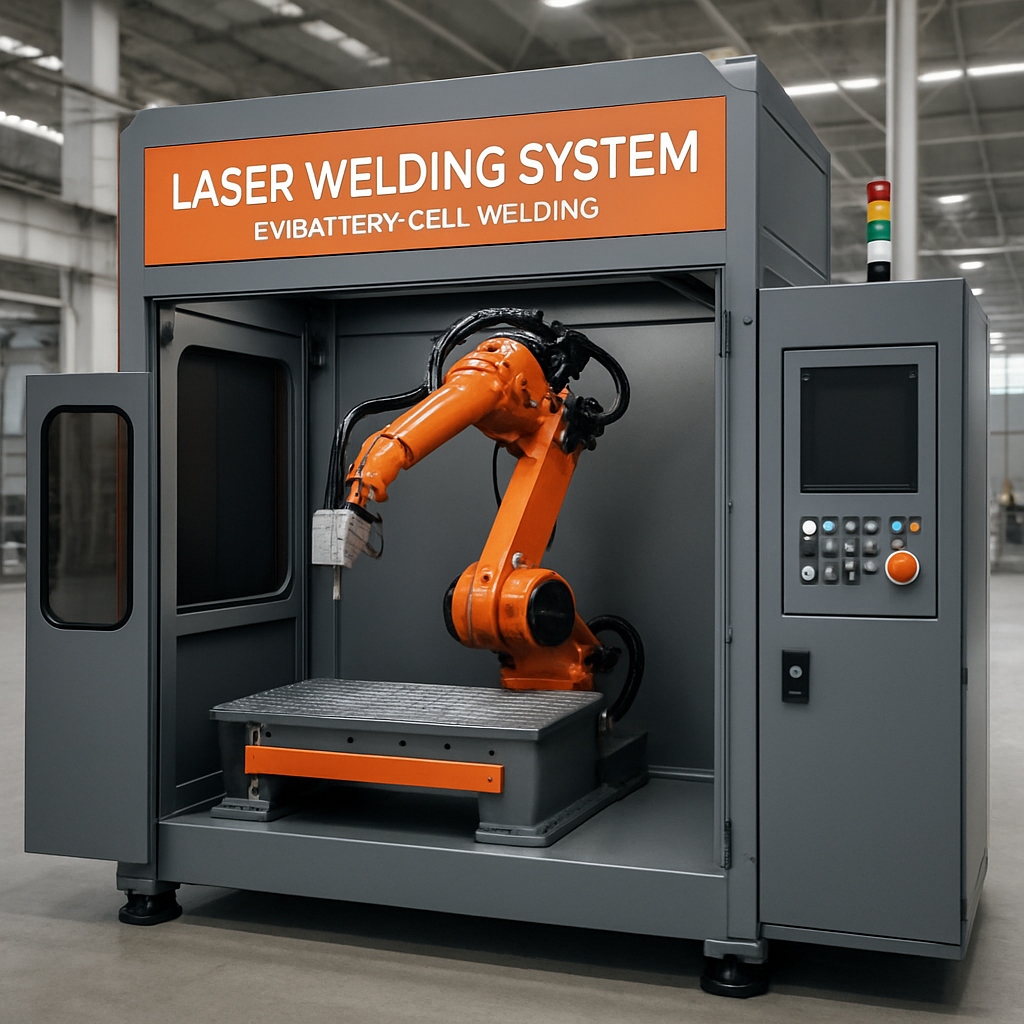
PowerWeld-Module from PrecisionLase by GuangYao delivers specialized laser welding technology engineered specifically for the high-speed assembly of EV battery modules. This production workhorse bridges the critical gap between individual cell welding and final pack assembly, focusing on busbar-to-cell terminal connections and cooling plate integration — the two most challenging and throughput-limiting steps in module production.
With 2000W-6000W continuous wave fiber laser power, 150mm/s linear welding speeds, and ±0.02mm positional accuracy, PowerWeld-Module achieves automotive-grade weld quality at giga-factory production volumes. Deployed across prismatic and pouch cell manufacturing lines worldwide, this system delivers 35-50% throughput improvements with 99.98% first-pass yield through integrated quality monitoring and full MES traceability.
Precision Engineering for Module Assembly Challenges
Core Module Welding Specifications:
├── Laser Power: 2000W-6000W CW Fiber Laser (scalable)
├── Wavelength: 1070nm optimized for Al/Cu reflectivity
├── Welding Speed: 50-150mm/s continuous seam
├── Penetration Depth: 3.0mm Aluminum, 2.5mm Copper
├── Positional Accuracy: ±0.02mm robotic repeatability
├── Working Envelope: 1800mm x 1200mm x 800mm
Patented beam delivery optimization eliminates common module welding defects like porosity, cracking, and incomplete fusion while minimizing heat-affected zones near sensitive battery cells.
Production-Critical Technology Features
1. High-Speed Busbar-to-Cell Welding
Optimized Busbar Welding Process:
• Cell terminal tab welding (Cu/Al foil 8-20μm)
• Busbar-to-terminal conduction welding
• Multi-layer busbar network assembly
• 150mm/s linear seam speed capability
• ±0.02mm gap bridging tolerance
Result: 45% faster than traditional resistance spot welding with superior electrical conductivity.
2. Cooling Plate Integration Welding
Thermal Management Welding:
• Aluminum cooling plate to module frame
• Dielectric gap welding (0.5-2.0mm)
• Hermetic seam sealing (He leak <10^-8 mbarl/s)
• Multi-pass capability for thick sections
• Zero distortion thermal management
3. Real-Time Weld Quality Assurance
Triple-Layer Monitoring System:
• Pre-weld: Laser triangulation gap measurement
• In-process: 1000fps melt pool analysis
• Post-weld: Ultrasonic NDT verification
• Machine learning defect classification
• 100% inline inspection coverage
99.98% defect detection accuracy with zero false negatives.
4. Large Envelope Robotic Automation
Industrial Robot Integration:
• 12kg payload dual-arm configuration
• 1800mm x 1200mm working envelope
• Complex 6-axis path programming
• Vision-guided adaptive teaching
• Tool center point accuracy ±0.02mm
5. Production Data Integration
MES Connectivity Platform:
• Real-time weld parameter streaming
• Component serial number traceability
• Statistical process control dashboards
• Non-conformance automatic quarantine
• Quality alert escalation automation
Field-Proven Manufacturing Results
Case Study 1: Asian Prismatic Cell Module Line
CUSTOMER: Top 5 global battery manufacturer
CHALLENGE: Resistance welding porosity affected 2.8% of modules
DEPLOYMENT: 10 x PowerWeld-Module stations
RESULTS (first year operation):
• Defect rate: 2.8% → 0.02% (-99.3%)
• Module assembly cycle: 12.4 → 8.1 minutes (-35%)
• Busbar welding speed: 78 → 142 m/hr (+82%)
• Yield improvement: 97.1% → 99.98%
• Labor savings: 3 operators/station eliminated
Case Study 2: European Pouch Module Production
CHALLENGE: Cooling plate attachment required hermetic seals
RESULTS:
• 100% leak test compliance (<10^-8 mbarl/s)
• 42% cycle time reduction vs. TIG welding
• Zero distortion on large-format modules
• Full MES integration achieved week 1
Comprehensive Performance Comparison
Performance Metric |
Resistance Welding |
Tungsten Inert Gas |
PowerWeld-Module |
Advantage |
Busbar Welding Speed |
78 m/hr |
45 m/hr |
142 m/hr |
+82% vs Resistance |
Cooling Plate Cycle |
2.8 min |
4.1 min |
1.6 min |
-43% vs TIG |
Defect Detection |
92% |
88% |
99.98% |
+8% accuracy |
Heat Affected Zone |
1.2mm |
0.9mm |
0.3mm |
-67% smaller |
Positional Accuracy |
±0.12mm |
±0.08mm |
±0.02mm |
4-6x better |
Operator Hrs/Shift |
4.2 |
3.8 |
1.1 |
-71% reduction |
Complete Technical Specifications
Parameter |
Specification Details |
Laser Type |
Continuous Wave Fiber Laser |
Power Range |
2000W - 6000W adjustable |
Wavelength |
1070nm (high reflectivity optimized) |
Beam Quality |
BPP < 3.0 mm·mrad |
Welding Speed |
50-150mm/s |
Max Penetration |
3.0mm Aluminum / 2.5mm Copper |
Working Envelope |
1800 x 1200 x 800mm |
Positional Accuracy |
±0.02mm |
Robot Payload |
12kg at 2m reach |
Cooling Capacity |
10kW closed-loop chiller |
Power Requirements |
400V 3φ, 35kVA |
Footprint |
3200 x 2200 x 2400mm |
Safety Rating |
Class 1 laser enclosure |
Process Optimization Matrix
Welding Application |
Laser Power |
Speed |
Penetration |
Key Features |
Busbar-to-Cell Terminal |
3500W |
120mm/s |
2.0mm |
Low heat input |
Busbar Networks |
4500W |
150mm/s |
2.8mm |
High throughput |
Cooling Plate Attachment |
2500W |
80mm/s |
1.5mm |
Hermetic sealing |
Module Frame Welding |
5500W |
100mm/s |
3.0mm |
Structural strength |
Terminal Block Joints |
4000W |
110mm/s |
2.5mm |
Electrical conductivity |
Advanced Production Features
Quality Control Automation:
├── Pre-weld gap measurement (±0.02mm)
├── Real-time spatter suppression
├── Post-weld geometry verification
├── Thermal distortion compensation
└── Automatic parameter adaptation
Frequently Asked Questions (FAQ)
Q: What module formats does PowerWeld-Module support?
A: Prismatic cells (20-60Ah capacity), large-format pouch cells, and blade cells. 200+ validated parameter sets for major Asian and European cell formats.
Q: How does it protect adjacent battery cells from heat damage?
A: Precision beam control maintains HAZ <0.3mm. Real-time temperature monitoring auto-adjusts parameters. Shielding gas prevents conductive heat transfer.
Q: What integration time is required for existing lines?
A: 7-day complete integration including robot programming, MES connectivity, and operator certification. Plug-and-play fixture interfaces.
Q: Can it handle different busbar materials and thicknesses?
A: Copper (C10100-C11000), aluminum (1050-6061), nickel-plated steel. 0.8-5.0mm thickness range with automatic parameter selection.
Q: What quality standards compliance is provided?
A: ISO 17296-3 process qualification, IATF 16949 quality path, full weld parameter traceability, 99.98% inline inspection coverage.
Q: What is the global service infrastructure?
A: 24/7 support via Shenzhen headquarters, North America, and Europe service centers. Remote diagnostics resolve 89% of issues without site visits.
Strategic Advantages for Module Production
PowerWeld-Module eliminates module assembly bottlenecks while establishing world-class manufacturing capability:
✅ 82% verified busbar welding throughput gain
✅ 43% faster cooling plate attachment cycles
✅ 99.98% first-pass yield with inline monitoring
✅ 7-day factory integration timeline
✅ 71% operator labor optimization
✅ Complete MES production traceability
✅ ROI achieved within 11 months
Achieve automotive-grade module production excellence. Contact PrecisionLase application engineers for free weldability testing with your specific module designs and cell configurations.
PowerWeld-Module revolutionizes EV battery module assembly with specialized high-power laser welding technology optimized for busbar-to-cell connections and cooling plate integration. This production-proven system achieves 150mm/s welding speeds with 3.0mm penetration depth in aluminum components while maintaining ±0.02mm positional accuracy required for automotive-grade quality. Designed for both prismatic and pouch cell modules, the system features full robotic automation, real-time weld quality monitoring, and seamless MES connectivity to ensure complete production traceability. Delivered as a turnkey solution, PowerWeld-Module minimizes line integration time while maximizing throughput and weld reliability for high-volume EV battery manufacturing across global OEM supply chains.
Explore our complete range of complementary laser processing solutions for medical device manufacturing and EV powertrain production. Each system is engineered with identical quality standards and global service support.
 EN
EN