
 EN
EN



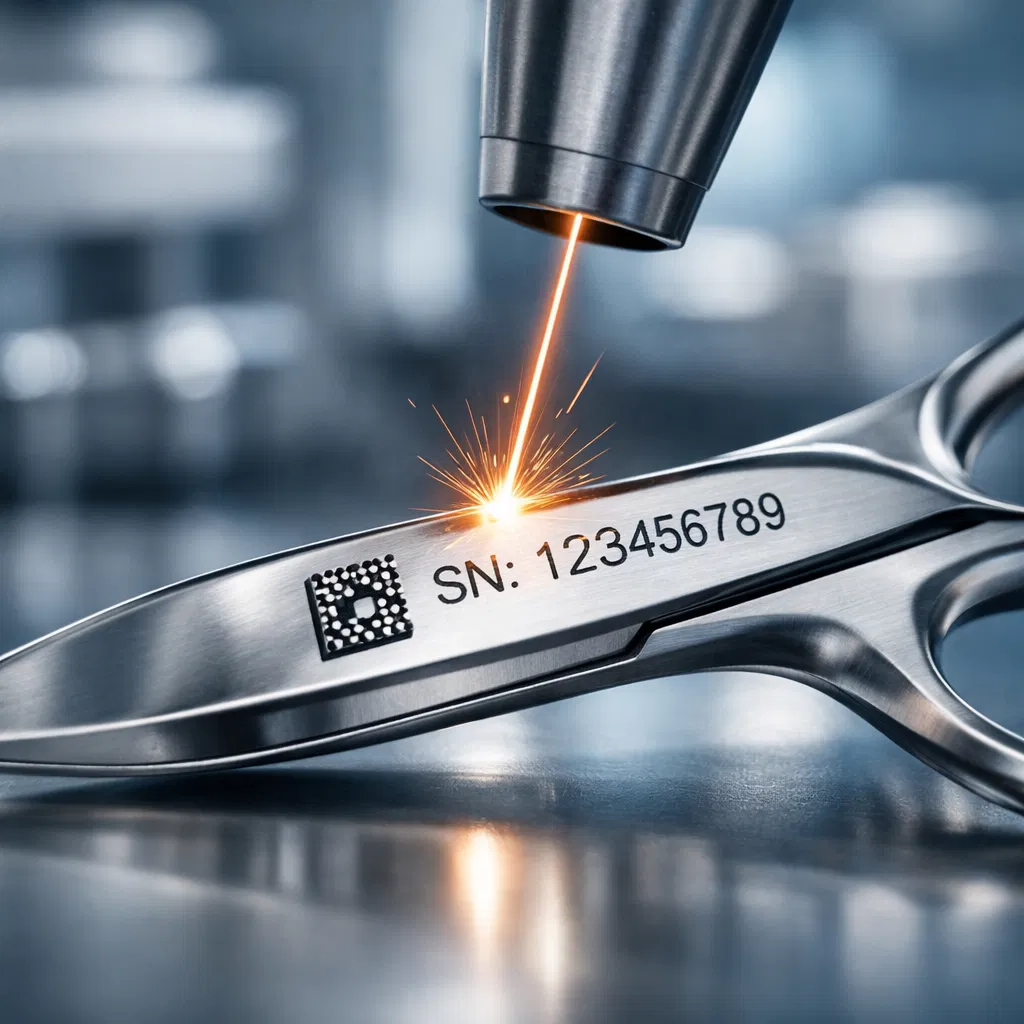
Medical UDI laser marking has become a core requirement for serious medical device manufacturers selling into the U.S. and other regulated markets. For reusable surgical instruments and long-life devices, the FDA expects a permanent, machine-readable UDI that survives cleaning, sterilization, and years of use. For a company like GuangYao Laser, which provides high-quality fiber laser solutions for the medical industry, understanding how to align laser UDI compliance with FDA rules is the difference between a simple marking step and a robust, traceable production process. This guide walks through the key regulations, fiber laser parameters, material compatibility, line integration, and template design that matter most on a real manufacturing floor.
Regulations First: What FDA Really Requires for UDI Direct Marking
Under the FDA Unique Device Identification (UDI) system, each covered medical device must carry a unique device identifier on its label and packaging, and in some cases directly on the device itself. The UDI typically consists of a Device Identifier (DI), which identifies the specific version or model, and one or more Production Identifiers (PI), which may include lot number, serial number, manufacturing date, or expiration date. For many reusable instruments and devices intended to be reprocessed between uses, the FDA requires a permanent direct marking of the UDI on the device body, not just on packaging.
The direct marking requirement is defined in 21 CFR 801.45, which states that a device that must bear a UDI on its label must also bear a permanent UDI mark if it is intended for more than one use and intended to be reprocessed before each use. FDA guidance clarifies that “reprocessed” means the device is intended to undergo high-level disinfection and/or sterilization before each use. There are specific exceptions, such as when direct marking would interfere with the safety or effectiveness of the device, or where size and design make any permanent marking impracticable. Manufacturers must document when they rely on such exceptions, and in all other cases design their laser UDI marking process to be permanent over the device’s expected service life.
Beyond the U.S., similar requirements exist under the EU MDR, where direct marking for reusable devices is being phased in with deadlines through 2027. In both systems, the UDI must appear in a human-readable form and in a machine-readable automatic identification and data capture (AIDC) format, typically a linear barcode or 2D DataMatrix symbol. That makes medical UDI laser marking an ideal solution: it can generate permanent alphanumeric characters and small, high-density DataMatrix codes on metals, plastics, and ceramics within a controlled, validated process.
Fiber Laser Parameters That Deliver Robust UDI Codes
For most metal medical devices—stainless steel, titanium, cobalt-chromium—fiber lasers are the workhorse for medical UDI laser marking. A typical production setup uses 20–30 W fiber sources to anneal or lightly engrave 2D DataMatrix codes and text on surgical scissors, clamps, orthopedic tools, and instrument trays. In real applications, a 20 W fiber laser has been used to mark a stainless-steel surgical scissor (SS316/SS410) with a logo and 2D DataMatrix code of about 2.71 mm × 2.71 mm in roughly 5 seconds. On HDPE bottles, a similar 20 W fiber system produced a 2.71 mm square DataMatrix in about 2 seconds, showing how the same power level can support both metal and plastic UDI marks with tuned parameters.
Key fiber laser parameters include average power, pulse frequency, scanning speed, and line spacing. For direct UDI marks that must withstand passivation and cleaning, many manufacturers prefer annealed or very shallow marks on stainless steel, adjusting parameters to generate a dark, oxide-based contrast rather than deep engraving. This approach preserves corrosion resistance and surface integrity while delivering high contrast under operating-room lighting. On titanium implants or instruments, short-pulse fiber settings can create fine, high-contrast marks that remain legible even when space is extremely limited; micro DataMatrix codes as small as 0.4 mm have been reported on tiny titanium bone screws with diameters of only 1–2 mm.
DataMatrix symbol size and cell dimensions also matter. For GS1 DataMatrix codes used in healthcare, recommendations for the x-dimension (smallest dot size) are around 0.300 mm for general use, but can go down to about 0.2 mm for direct marking of small medical devices. In practice, DataMatrix codes in the range of 2.5–4.5 mm square are widely used on surgical tools and small housings, balancing scanner readability with limited space. A practical medical UDI laser marking recipe will therefore set laser power and speed to create clear, well-separated cells at the chosen x-dimension, achieving verification grades that meet ISO/IEC 15415 and related quality standards for direct part marks.
Material and Process Compatibility Across Medical Devices
Medical UDI laser marking must work consistently across a variety of device materials, from stainless steel and titanium to polymers and glass. On metals, fiber-based systems are capable of producing high-contrast annealed marks that tolerate subsequent passivation and cleaning processes. Application data show that annealed fiber-laser UDI marks on surgical stainless steel can resist typical passivation treatments used in medical manufacturing, maintaining legibility and adhesion. On titanium hip balls and other implants, fine-beam lasers can produce very small DataMatrix codes that remain readable despite curved surfaces and limited flat space, enabling traceability down to small implant components.
Plastics present different challenges. Materials such as HDPE, PVC, and nylon respond to fiber laser energy with color changes or foamed marks, and real project data show that 20 W fiber lasers can generate UDI-compatible logos and 2D codes on HDPE bottles within a couple of seconds per mark. However, not all polymers behave the same way; absorption at 1064 nm varies, and some formulations benefit from laser-sensitive additives. The manufacturer’s role is to qualify which combinations of polymer grade and laser parameters deliver stable, non-migrating marks that do not flake or contaminate product contact surfaces. For transparent or highly reflective materials, alternative wavelengths or adapted optics may be necessary to ensure reliable marks and verification grades.
Process compatibility also extends to downstream treatments. For reusable instruments, UDI marks must survive repeated cycles of high-level disinfection and sterilization. FDA’s direct marking guidance notes that these devices are used for months or years and will inevitably be separated from their original packaging, so the direct mark has to remain identifiable throughout their life. Field experience in the laser marking industry indicates that annealed UDI marks on surgical steel can be engineered to withstand both passivation and repeated reprocessing, provided parameters are optimized and the surface is properly cleaned before marking. For manufacturers, this means validating each material–process combination with realistic cleaning and sterilization cycles before releasing the process to full production.
Line and IT Integration: Making UDI Marking Part of the Production Flow
Laser UDI compliance is about more than placing a small code on a device; it is about connecting that code to the right data and verifying it in real time. Modern medical UDI laser marking cells integrate lasers, motion, cameras, and readers with manufacturing execution systems (MES) and enterprise resource planning (ERP) platforms. A typical setup uses a camera-based workflow where parts are validated before marking, the marking position is automatically aligned, and the final mark contents are verified immediately afterward. This closed loop—validate, align, verify—has been shown to reduce scrap from marking errors by up to 80% in some vision-based workflows.
On the production side, DataMatrix codes and alphanumeric fields are generated according to issuing agency rules such as GS1 or HIBC, then passed to the marking software along with lot and serial data. FDA rules require that the AIDC and human-readable forms both represent the same UDI, and that UDIs be issued by an FDA-accredited issuing agency and follow ISO/IEC identification standards. In practice, that means the medical UDI laser marking cell must pull the correct DI and PI values for each device from a controlled source of truth and log back what was actually marked, including any rework or rejects.
Mechanical integration on the line is equally important. For high-mix production of stainless instruments, fixtures are designed to hold multiple tools at once while keeping the marking area accessible to the laser and camera. On small implants and dental components with very limited space, manufacturers may use precision rotary axes to bring a tiny flat area into focus for micro-marking. Marking times in the range of 5–13 seconds for a logo plus a 2D code are common in industrial examples, depending on the part size, code size, and laser power. For plastics and bottles, conveyors or rotary tables feed parts under the marking head, hitting single- or multi-second cycle times appropriate for medium to high volumes.
Reusable Templates and Compliance-Friendly Layouts
The final pillar of a solid medical UDI laser marking strategy is the use of standardized, reusable templates. From a compliance perspective, each UDI must be encoded in a way that meets both FDA and issuing agency requirements, and the AIDC symbol must have sufficient quiet zone and size to be reliably scanned in clinical settings. Industry practice shows DataMatrix code sizes around 2.7–4.4 mm square, with font sizes around 1.6 mm for human-readable text on instruments, are practical for many stainless parts. By building templates that fix symbol size, quiet zone, text placement, and any required symbols, manufacturers can quickly adapt layouts to new devices while keeping the visual and functional UDI structure consistent.
Template libraries are often organized by device family: one for general surgical instruments, one for orthopedic tools, one for HDPE bottles or plastic housings, and so on. Each template defines field positions for the Device Identifier, Production Identifiers, and optional customer-specific fields, and is linked to code quality targets according to ISO/IEC 16022 and 15415. Operators then simply select the appropriate template and scan or receive the correct data from the MES, rather than designing marks from scratch. This reduces the risk of mis-programmed codes and simplifies validation and change control, which is critical when regulators or customers audit UDI implementation.
From a manufacturing and sales standpoint, this template-driven approach enables GuangYao Laser to deliver turnkey UDI marking solutions that are ready to use with common standards out of the box. Customers benefit from shorter deployment times, easier validation, and predictable marking performance across different device lines. Combined with robust fiber laser hardware, camera-based verification, and well-chosen parameters for metals and plastics, medical UDI laser marking becomes a stable, high-value step that supports both regulatory compliance and long-term device traceability.
By aligning laser technology, process design, and regulatory understanding, medical device manufacturers can turn UDI from a documentation burden into a competitive advantage. With well-engineered medical UDI laser marking solutions, every instrument and component carries a durable, verifiable identity that supports patient safety, recall management, and confident global distribution.