 EN
EN


The Shift Toward Painless Drug Delivery
Imagine a world where vaccines, insulin, or painkillers bypass the needle phobia that turns millions away from essential treatments. Microneedle arrays make this possible by creating tiny channels through the skin's outer barrier — just enough to deliver medication effectively, without reaching pain receptors deeper down.
This isn't science fiction; it's scaling up in labs and clinics right now. The real bottleneck? Manufacturing these arrays at the precision and consistency needed for reliable dosing and regulatory approval. Traditional methods like molding or lithography work for prototypes but falter on materials variety and production speed.
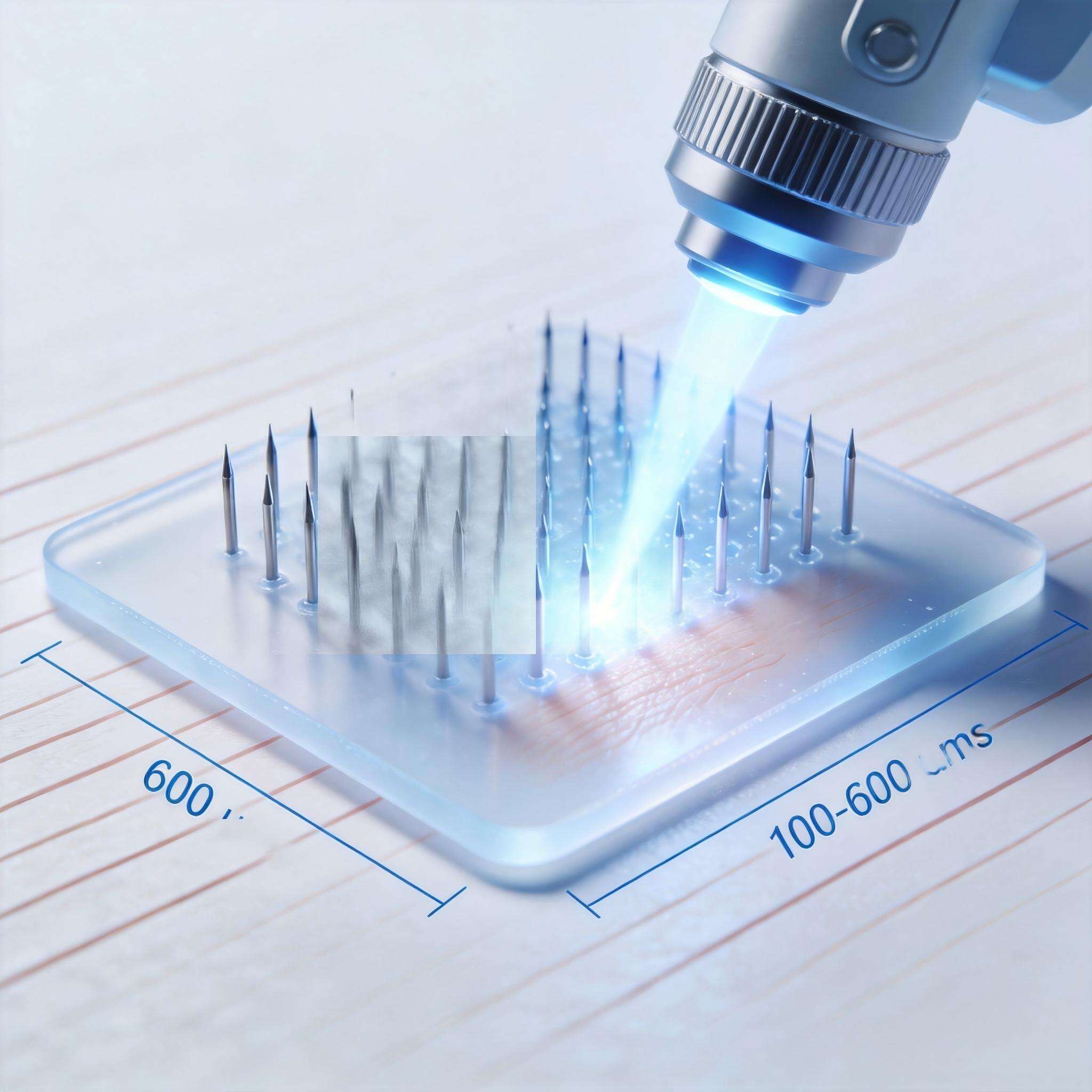
That's where laser etching steps in as a game-changer. At GuangYao Laser, systems like the PrecisionLase MediMark series and related microfabrication workstations adapt ultrafast laser technology to etch microneedle patterns directly onto substrates — from biocompatible polymers to thin metals — supporting the move from research to real-world therapeutics.
What Makes Microneedles Tick (and Deliver)
Microneedles come in flavors: solid ones for poking and coating drugs on the surface, hollow for liquid flow, coated for dry powders, or dissolving types that release payloads as they break down in tissue. Each demands exact control over height (often 100–800 µm), tip sharpness, and base spacing to ensure even skin penetration across an array of hundreds.
Clinically, this matters for everything from diabetes management to vaccine campaigns in remote areas. A 2024 trial in Southeast Asia, for example, used microneedle patches to deliver measles boosters with immune responses matching injections — but patient compliance jumped because of zero reported pain.
Laser etching shines here because it's material-agnostic. Whether you're working with PLGA (a biodegradable polymer), silicon wafers, or stainless steel sheets, the process adjusts on the fly via software-controlled pulses, avoiding the chemical etching baths or mold wear that plague other techniques.
Etching in Action: How Lasers Build the Array
Picture the laser as a digital scalpel. Ultrashort pulses — think femtoseconds or picoseconds — vaporize material layer by layer, sculpting each needle's taper and reservoir without melting surrounding areas. GuangYao Laser's medical workstations handle this with stable beam delivery and precise XY scanning stages, often under cleanroom-grade enclosures to keep particulates low.
The workflow typically unfolds like this:
- Load a substrate sheet (e.g., 100x100 mm polymer film).
- Align via fiducials or camera vision.
- Etch the array pattern — tips first, then shafts and bases.
- Inline check for uniformity, then release for drug loading.
Gas assist (nitrogen or clean dry air) sweeps away debris, ensuring edges stay sharp and free of residue. This contactless approach naturally leans sterile, cutting down on post-processing sterilization steps.
Laser vs. Legacy Methods: A Side-by-Side
To see why laser etching is pulling ahead, consider this comparison based on common medtech fabrication challenges:
|
Aspect |
Laser Etching (e.g., PrecisionLase setups) |
Photolithography/Electroforming |
Micro-Molding |
|
Resolution |
Down to 2–5 µm features |
5–10 µm, material-limited |
20+ µm, mold-dependent |
|
Materials |
Polymers, metals, silicon, hybrids |
Mostly photoresists/silicon |
Polymers only |
|
Prototype Speed |
Hours from CAD |
Days/weeks with masks |
Days for new molds |
|
Scalability |
Direct to high-volume sheets |
Low throughput |
Medium, mold lifespan |
|
Cleanliness |
Minimal residue, gas-swept |
Chemical cleanup needed |
Release agents common |
|
Cost per Array |
Drops with volume |
High setup |
Mold amortization |
Laser wins on flexibility, especially for custom arrays tailored to drug viscosity or skin type. GuangYao Laser's platforms support this transition, helping pharma partners iterate designs without retooling.
Drug Delivery Precision: Channels and Kinetics
The magic happens in the microstructures. Laser-etched channels — as narrow as 10 µm — control how fast a drug diffuses post-insertion. For insulin patches, shallow reservoirs might release over 4–6 hours; deeper ones for vaccines extend to days.
In one collaboration GuangYao Laser supported, a team etched dissolvable microneedles from hyaluronic acid film. The array penetrated porcine skin consistently at 400 µm depth, with ex vivo tests showing 85–95% drug release within two hours. Uniformity across the patch was key — no "dead zones" where needles failed to breach the stratum corneum.
This level of control opens doors to combo therapies: one needle type for immediate analgesic, another for sustained anti-inflammatory. It's not just about delivery; it's engineering the pharmacokinetics right into the device geometry.
Clinical Scenarios: From Diabetes to Vaccines
Let's ground this in practice. For type 1 diabetes patients, daily microneedle patches could automate insulin dosing via app-linked applicators — no more finger pricks or bulky pumps. Early adopters report adhesion issues with molded needles, but laser-etched surfaces (with tuned micro-roughness) grip skin better and shed less drug during wear.
In global health, vaccine microneedles address cold-chain fragility. Stable, dry-coated arrays survive room temperature for months, ideal for rural clinics. A European pharma trial last year hit seroconversion rates over 90% with laser-fabricated patches, rivaling syringes but slashing logistics costs.
GuangYao Laser's micro-etching capabilities fit seamlessly into these pipelines, providing the repeatable arrays that turn pilot data into scalable production.
Regulatory and Safety Realities
No medtech breakthrough skips scrutiny. Laser-etched microneedles must pass ISO 10993 biocompatibility, skin irritation tests (ISO 10993-23), and sharps injury assessments. The process helps here: no metal tools mean lower extractables, and precise ablation leaves clean profiles less prone to bacterial adhesion.
Manufacturers often pair this with validated cleaning (ultrasonic + IPA rinse) and packaging under nitrogen. GuangYao Laser supports these workflows with process data logs, aiding IQ/OQ/PQ for FDA 510(k) or EU MDR submissions. It's about building trust — one consistent array at a time.
Scaling Up: From Lab Bench to Factory Floor
Prototyping 10 arrays? Easy. Hitting 10,000 patches daily? That's where multi-beam heads and roll-to-roll handling come in. GuangYao Laser's workstations scale via modular add-ons: vision alignment for sheet registration, automated loading for 24/7 runs, and exhaust integration for clean production.
Cost-wise, laser etching amortizes quickly. After initial setup, per-array expense drops below $0.10 at volume, versus molding's upfront tooling hits. Plus, digital control means design tweaks — say, optimizing for thicker skin tones — happen in software, not hardware.
Real-World Example: Dermatology Patch Development
A skincare pharma approached GuangYao Laser needing arrays for transdermal retinoids. Early molds warped under heat, unevenly spacing needles. Switching to laser etching, they achieved 150 µm tall pyramids on PVA film, with 95% penetration uniformity on human cadaver skin.
The result? A patch that delivers actives steadily over 12 hours, minimizing irritation. Production ramped from 500 to 5,000 units weekly without quality dips — a testament to how laser precision bridges R&D and market.
Frequently Asked Questions
Q: Do laser-etched microneedles hurt more than molded ones?
No — often less. Sharper, more uniform tips penetrate cleaner, avoiding the drag that amplifies pain in rougher molds. Patients in trials consistently rate them as "painless."
Q: Which materials work best with GuangYao Laser etching?
Polymers like PLGA, PVA, and hyaluronic acid excel for dissolving types. Metals and silicon suit reusable or diagnostic arrays. We tune parameters per substrate for optimal results.
Q: How do you ensure sterility in production?
Contactless etching plus gas purging keeps it clean from the start. Add validated rinsing and packaging, and you're GMP-ready with minimal bioburden risk.
Q: Can this handle personalized or small-batch runs?
Absolutely. CAD-to-etch in minutes supports custom geometries — great for clinical trials or niche therapies before scaling.
The Road Ahead: Smarter, Smarter Delivery
Microneedles are evolving — think integrated sensors tracking drug uptake or pH-triggered release. Laser etching will underpin this, enabling sub-50 µm features and hybrid substrates.
For developers eyeing the $10B+ transdermal market, GuangYao Laser's PrecisionLase platforms offer a reliable path: precise, adaptable, and production-proven. It's precision light turning drug delivery from invasive routine to elegant innovation.
Table of Contents
- The Shift Toward Painless Drug Delivery
- What Makes Microneedles Tick (and Deliver)
- Etching in Action: How Lasers Build the Array
- Laser vs. Legacy Methods: A Side-by-Side
- Drug Delivery Precision: Channels and Kinetics
- Clinical Scenarios: From Diabetes to Vaccines
- Regulatory and Safety Realities
- Scaling Up: From Lab Bench to Factory Floor
- Real-World Example: Dermatology Patch Development
- Frequently Asked Questions
- The Road Ahead: Smarter, Smarter Delivery
