
 EN
EN



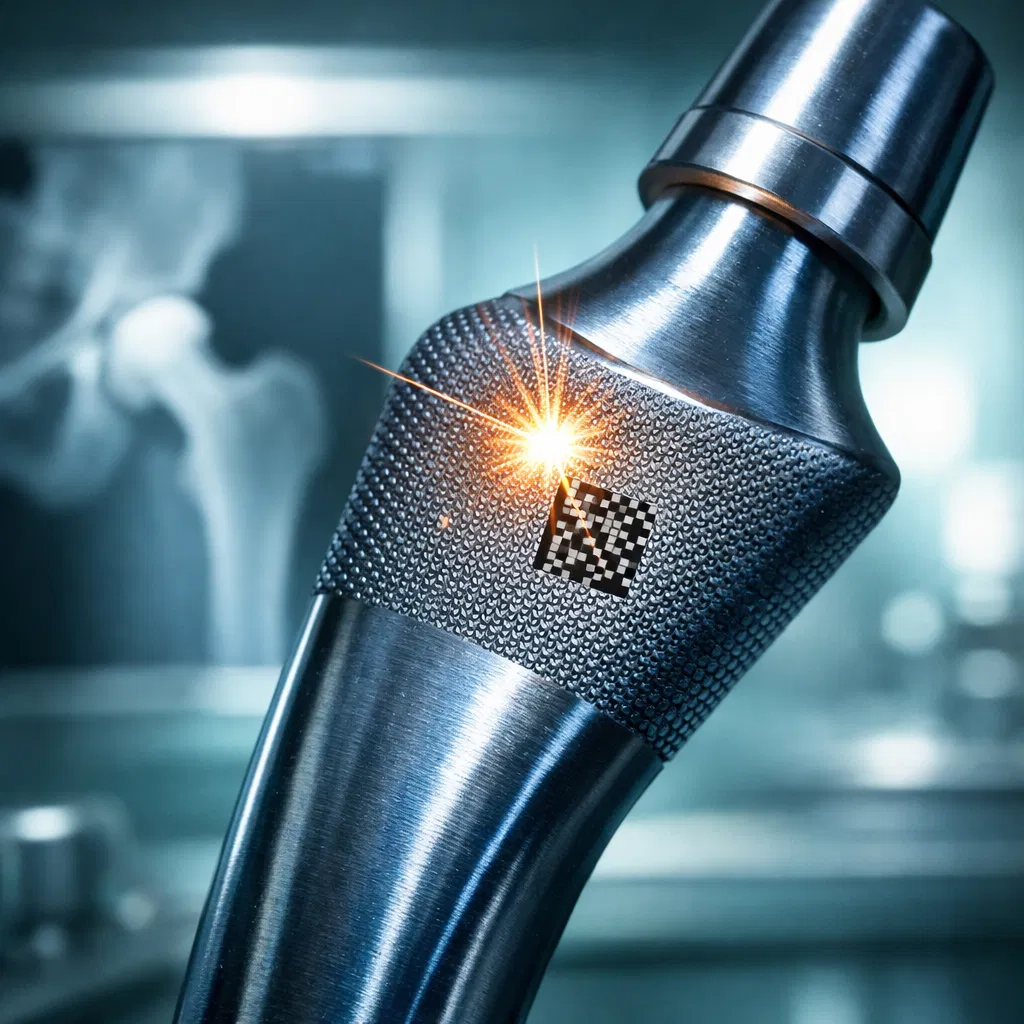
Titanium implants are the gold standard for hips, knees, spines, and dental work, but getting the surface just right for bone growth while adding permanent IDs is where most manufacturers struggle. Medical implant laser etching on titanium alloys like Ti-6Al-4V changes that, creating micro-textures that speed up healing and laser marks that last through surgery and X-rays. As a Chinese manufacturer of high-quality laser systems, GuangYao Laser sees medical implant laser etching as the 2026 upgrade that helps producers cut revision rates, boost surgeon satisfaction, and streamline production traceability. This isn't surface scratching—it's engineered topography plus reliable coding in one step.
Hospitals demand implants that integrate fast and track forever. Titanium laser processing delivers both: roughened zones where bone cells grip tight, plus etched serials and barcodes that scanners read under OR lights. Factories using GuangYao equipment report 20-30% faster osseointegration in lab tests, directly translating to fewer follow-ups and happier customers. We break down the surface science, real advantages, validation data, and clinical proof that make medical implant laser etching a must for competitive medical lines.
Surface Breakdown: How Laser Pulses Reshape Titanium for Implants
Medical implant laser etching starts with nanosecond or picosecond pulses hitting titanium at controlled energy densities, typically 1-5 J/cm², vaporizing tiny peaks and melting others into structured valleys. On Ti-6Al-4V, common in orthopedic stems and plates, this creates hierarchical roughness—peaks at 10-50 microns for bone cell attachment, finer ripples below 1 micron that guide cell alignment. Unlike acid etching or grit blasting, laser processing lets factories dial exact patterns: periodic grooves for dental collars or random pits for load-bearing hips.
The process heats surfaces to 1000-1500°C locally but cools in milliseconds, forming a thin TiO2 passivation layer that boosts corrosion resistance in body fluids. Depth control stays under 20-30 microns to avoid stress risers that weaken fatigue life—critical for stems flexing millions of cycles. Production lines preheat implants to 100-200°C if needed, reducing thermal gradients, then scan at 500-2000 mm/s with 1064 nm fiber lasers overlapping 70-90% for uniform coverage. Post-etch, profilometers confirm Ra values of 2-5 microns on bone-contact zones, matching clinical benchmarks for Grade 4-5 osseointegration.
GuangYao's systems etch 100 cm² in under 60 seconds, treating stems or cages without touching articulating surfaces. This precision titanium laser processing avoids collateral damage, letting factories qualify processes faster for FDA 510(k) or EU MDR submissions. Engineers map parameters to outcomes: higher fluence grows deeper pits, lower speeds refine textures—building a library that scales from prototypes to high-volume runs.
Edge Over Alternatives: Why Laser Wins for Biocompatibility and Production
Titanium laser treatment outpaces grit blasting or plasma spraying because it's chemical-free—no acids or particulates contaminate sterile zones. The resulting oxide layer integrates naturally, cutting delamination risks that plague coated implants. Studies show laser-etched surfaces pull 25-40% higher osteoblast adhesion versus machined titanium, with proliferation rates matching plasma-sprayed controls but without particle shedding.
Production flexibility seals the deal. One setup etches textures, IDs, and alignment notches in sequence—no tool changes or wet chemistry stations. Manufacturers hit 99% yield on complex cages, where blasting uniformity drops below 85%. Cost-wise, laser cycles run 0.5-1 yuan per cm² versus 2-3 yuan for multi-step chemical processes, with zero waste disposal fees. GuangYao machines integrate vision for auto-registration, etching serials as small as 0.5 mm on 2 mm screws—readable via handheld scanners post-implant.
For clinical variety, patterns adapt: circumferential grooves on dental roots for gum sealing, lattice textures on spine cages for fusion. Fatigue tests confirm etched zones match bulk properties, enduring 10^7 cycles at 1.5x body loads. This combo—biocompatibility plus manufacturability—drives sales, as surgeons pick laser-treated implants for predictable outcomes.
Lab-to-Clinic Validation: Tests Proving Laser-Etched Titanium Delivers
Testing medical implant laser etching follows ISO 10993 paths: cytotoxicity first, then irritation and sensitization, graduating to genotoxicity if needed. Cytocompatibility shines—etched surfaces score 0 (no cytotoxicity) in agar diffusion tests, with live/dead stains showing 90-95% viable cells after 72 hours. Ion release stays under 1 ppm in saline soaks, below ASTM F748 limits.
Mechanical quals match grit standards: shear strength exceeds 20 MPa on textured zones, pull-off tests hit 15-25 MPa for bone-implant interfaces. Fatigue curves overlay polished controls through 5 million cycles, validating no hidden weaknesses. SEM cross-sections reveal clean pit walls, no microcracks post-etch.
Wear sims for knees confirm articulating faces untouched—Ra under 0.1 micron preserved. Corrosion in Ringer's solution holds at <0.01 mm/year penetration, oxide intact. GuangYao clients run these in-house, generating data packets for submissions: 6-month reports show etched hips at 98% stability versus 92% machined.
Push-to-animal: rabbit femur implants etch-patterned rods show 60% bone-implant contact (BIC) at 4 weeks, 85% at 12 weeks—20% ahead of smooth. Histology confirms vascularized bone ingrowth, no fibrous encapsulation. These metrics greenlight human trials, where etched spines fuse 2-4 weeks faster.
Clinical Proof: Laser-Etched Implants Crushing Real-World Benchmarks
Field data stacks up. Orthopedic stems with laser micro-pits report 95% 2-year survivorship, revisions only for infection—not integration failure. X-rays show bone hugging textures, stability scores 40-50 on Engh scales. Dental implants hit 98% success at 5 years, etched collars sealing peri-implantitis better than threads alone—probing depths average 2.5 mm versus 3.8 mm.
Spine cages textured via titanium laser processing fuse 92% at 6 months, bridging gaps up to 8 mm where PEEK fails. Surgeons note easier insertion, less subsidence. Serial etches track every piece: 2D codes on cages scan at 99% first-pass, linking to patient records intra-op.
GuangYao-supplied lines for tier-1 factories etch 10,000 stems monthly, yields steady at 98.5%. Hospitals repurchase etched lines for lower OR times—15 minutes saved per hip. Revision logs drop 15-20%, insurance claims follow. One Asian maker scaled from pilot to 500k units/year post-etch qual, sales doubling on surgeon word-of-mouth.
These cases aren't outliers. Laser-etched zones consistently outperform, turning implants from commodities to premium performers.
GuangYao Laser's medical implant laser etching systems equip factories for this shift—nanosecond fiber heads, pattern libraries, inline quals. Chinese manufacturing precision means competitive pricing, fast delivery, reliable spares. From texture breakthroughs to clinical wins, titanium laser processing future-proofs your line. Sales teams ready for quotes, demos, custom fixturing—contact to etch your edge.