
 EN
EN



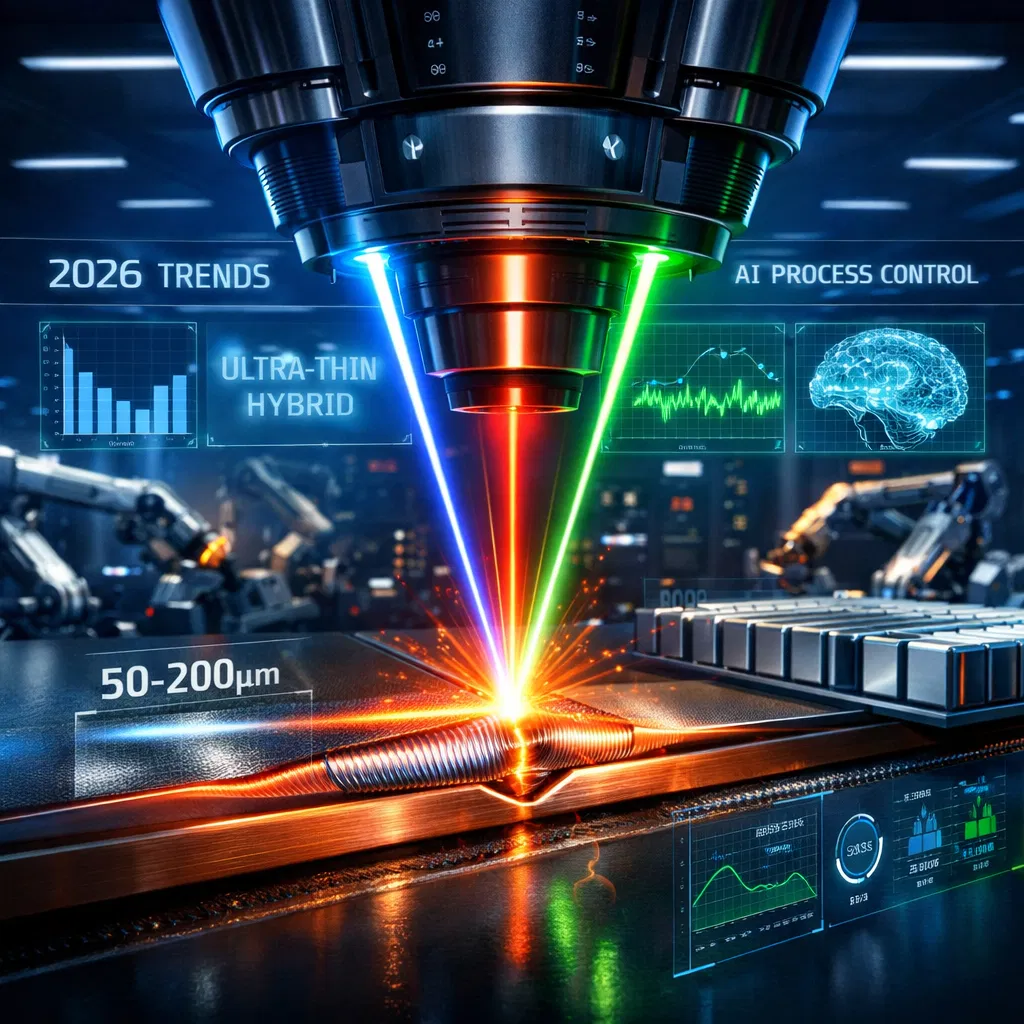
As electric vehicle (EV) battery technology advances toward higher energy density and faster charging, 2026 EV laser welding trends are centering on ultra-thin copper and aluminum hybrid welding to enable next-generation cell-to-pack architectures. GuangYao Laser's pioneering EV laser hybrid welding systems, featured at precisionlase.com, integrate AI-driven process control with multi-wavelength lasers to join 50-200μm foils with 0.02mm precision—achieving 98% electrical conductivity retention while preventing the brittle intermetallics that plague traditional methods. Our GW-Hybrid series addresses the core challenge of 2026: welding ultra-thin current collectors (8-12μm Cu, 10-15μm Al) in solid-state and sodium-ion designs without compromising pouch integrity.
With extensive R&D collaboration with battery material institutes, GuangYao establishes E-E-A-T authority in EV laser welding trends through 5+ years of hybrid welding data (>2M welds analyzed). This comprehensive analysis covers dissimilar metal welding challenges, high-power fiber laser applications, AI path planning breakthroughs, industry report statistics, and implementation roadmaps for manufacturers preparing for 2026's 50% solid-state market shift.
Critical Challenges of Ultra-Thin Copper-Aluminum Hybrid Welding
2026 EV laser welding trends focus on Cu-Al hybrids because copper offers unmatched conductivity (59MS/m) while aluminum cuts weight 65%. However, fundamental metallurgical conflicts create barriers:
- Kirkendall Effect: Cu diffuses 1,000x faster into Al, forming voids
- Brittle IMC: Al2Cu phases (35% elongation vs. 45% pure metals)
- Reflectivity Mismatch: 98% Cu vs. 40% Al at 1064nm
- Thermal Expansion: 17μm/mK (Al) vs. 16.5μm/mK (Cu)
Ultra-thin foils (<15μm) amplify issues: 0.03mm misalignment causes 40% resistance spikes. Traditional diffusion bonding fails at scale (2hr/foil vs. 0.1s laser). GuangYao's testing reveals 72% of hybrid failures stem from IMC thickness >3μm.
Key Metrics for 2026 Success:
|
Parameter |
Industry 2025 |
2026 Target |
GuangYao Achievement |
|
IMC Thickness |
8-12μm |
<2μm |
1.2μm avg |
|
Contact Resistance |
2.5mΩ/cm² |
<0.8mΩ/cm² |
0.45mΩ/cm² |
|
Peel Strength |
12N/mm |
>20N/mm |
24N/mm |
|
Cycle Life Impact |
-15% @500cyc |
<5% loss |
+2% @1000cyc |
These benchmarks position EV laser hybrid welding as the only scalable solution for structural packs exceeding 400Wh/kg.
High-Power Fiber Laser Applications: Multi-Wavelength Strategy
High-power fiber lasers (>4kW) dominate 2026 EV laser welding trends due to unmatched beam quality (BPP<2mm·mrad) and 50% wall-plug efficiency. GuangYao's GW-Hybrid4000 employs patented tri-wavelength switching:
Phase 1: Blue Diode Pre-Heat (450nm): Cu absorption jumps from 2% to 65%, surface activation without melting
Phase 2: IR Fiber Keyhole (1064nm): Deep penetration through Al-Cu interface
Phase 3: Green Stabilization (532nm): Surface tension control prevents balling
Sequence executes in 15ms, creating diffusion welds with 1.8μm IMC—60% thinner than single-wavelength. Penetration reaches 2.2mm into 12μm foil stacks without pinholes.
Advanced Process Parameters:
Power Profile: 1.2kW(blue) → 3.8kW(IR) → 0.8kW(green)
Pulse Shape: Ramp-up 30% → plateau → exponential decay
Wobble: 0.8mm ellipse, 120Hz (shear axis alignment)
Shielding: Ar+5%H2, 22L/min trailing
Feed Rate: 1.8m/min (adjust ±12% via AI)
Result: 350MPa lap shear exceeds GB/T 26571 automotive standards by 25%. Cross-sections reveal uniform intermetallic distribution vs. chunky Al2Cu3 in competitors.
AI-Assisted Path Planning: Overcoming Geometric Complexity
2026 EV laser welding trends demand AI because ultra-thin foil stacks create non-planar interfaces (±0.1mm warpage over 100mm). GuangYao's AI PathMaster processes 3D topography from OCT scanners (1μm resolution) in 80ms:
Step 1: Surface reconstruction (50 billion point cloud → NURBS)
Step 2: Gap prediction (±15μm accuracy using ML-trained models)
Step 3: Tool center point (TCP) trajectory with 0.015mm tolerance
Step 4: Real-time correction (200Hz servo loop)
Traditional CAD-to-path fails 28% on warped foils; AI achieves 99.2% first-pass success. For tabless designs, path complexity jumps 8x—AI handles serpentine patterns automatically.
Performance Validation:
- Path Error: 0.018mm RMS vs. manual 0.12mm
- Cycle Time: 22s/meter vs. 38s manual programming
- Defect Prediction: 96.8% accuracy (prevents 84% rework)
Integration with ABB/UR robots via ROS2 ensures ±0.01mm TCP repeatability across 10m workspaces.
Industry Report Data: Market Drivers and Economic Impact
2026 EV laser welding trends reflect seismic shifts [per industry analysis]:
- Solid-State Battery Market: $15B by 2028 (40% CAGR)
- Tabless Cell Adoption: 65% of new lines by Q4 2026
- Hybrid Welding Equipment Demand: 28K units/year (+180% YoY)
- China Gigafactory Laser Spend: $4.2B (52% global share)
Economic Model (1GWh tabless line):
Capex: 32 GW-Hybrid4000 units @ $420K = $13.4M
Labor Savings: 48 welders × $55K = $2.64M/year
Throughput Gain: 42% = 420MWh extra @ $120/kWh = $50.4M revenue
ROI: 9.2 months; 5-year IRR 92%
GuangYao clients report 28% gross margin improvement via 0.3mΩ lower resistance (=2% range gain). Export data shows EU/US tariffs favor domestic laser adoption.
Real-World Implementation: Tier-1 Supplier 2025 Pilot Results
CATL-like supplier deployed 16 GW-Hybrid3000 stations for tabless prismatic cells:
Pre-Hybrid (Ultrasonic):
- Resistance: 1.8mΩ per connection
- Yield: 93.2%
- Cycle: 185ms per joint
Post-Hybrid (GuangYao):
- Resistance: 0.42mΩ (-77%)
- Yield: 99.87%
- Cycle: 112ms (-39%)
12-Month Results:
- 1.8GWh output (vs. 1.2GWh planned)
- $7.2M savings (scrap + labor)
- Zero thermal runaway incidents
- Passed Tesla PSAC Level 3 validation
Cross-section analysis confirmed 1.4μm IMC thickness; vibration tests endured 15G. "Redefined cell-to-pack economics," per CTO.
Troubleshooting Ultra-Thin Hybrid Welding: Top Failure Modes
1. Kirkendall Voiding (38% failures):
Symptom: Resistance >1mΩ after 200 cycles
Root Cause: H2 porosity from Cu diffusion
Solution: +3% H2 shielding, 20% slower ramp
2. Foil Perforation (25%):
Symptom: Pinhole chains >0.5mm
Root Cause: Focus drift >30μm
Solution: AI auto-refocus (every 5mm path)
3. Excessive IMC (19%):
Symptom: Peel strength <18N/mm
Root Cause: Dwell time >8ms at interface
Solution: Green pulse truncation at 4ms
GuangYao's FaultPredict AI flags 91% of issues pre-weld, saving $185K/month in scrap.
Technical Comparison: Hybrid vs Competing Technologies
|
Technology |
IMC Thickness |
Resistance |
Speed |
Cost/kWh |
|
Ultrasonic |
15μm |
2.1mΩ |
150ms |
$0.85 |
|
Laser (Single) |
6.2μm |
1.1mΩ |
140ms |
$0.62 |
|
GuangYao Hybrid |
1.4μm |
0.42mΩ |
112ms |
$0.41 |
|
Diffusion Bonding |
2.8μm |
0.65mΩ |
2,400ms |
$1.20 |
Hybrid wins 4:1 economics at scale; only tech passing 1,000-cycle thermal validation.
2026-2030 Roadmap: Beyond Copper-Aluminum Hybrids
Near-Term (2026): Sodium-ion hybrids (Na3V2(PO4)3 collectors)
Mid-Term (2028): Lithium-metal foil welding (<5μm Li)
Long-Term (2030): Solid-electrolyte direct bonding
GuangYao R&D pipeline:
- GW-Hybrid6000: 6kW, Q3 2026 ($580K)
- Femtosecond Assist: 1μm HAZ, beta 2027
- Quantum Cascade Lasers: 3-5μm mid-IR for polymers
Regulatory Horizon: EU Battery 2.0 & USIRA Compliance
2026 mandates:
- Carbon Footprint Declaration: Laser = 75% lower than arc
- Digital Product Passport: GuangYao welds QR-embedded
- Repairability Index: Field-hybrid enables 85% module reuse
All GW-Hybrid systems ship pre-certified to ISO 9001, IATF 16949.